
Prescription Safety Glasses: Workplace Guide
Prescription safety glasses help employees maintain clear vision without giving up protection from workplace eye hazards. But ordinary prescription eyewear is not automatically safety eyewear. Safety managers must match the frame and lenses to the hazard, confirm the product markings and protection claims, and make sure the glasses fit securely with the rest of the employee's PPE.
Browse prescription safety glasses for workplace eye protection
What are prescription safety glasses?
Prescription safety glasses combine corrective vision with protective eyewear designed for workplace hazards. They may use prescription lenses in a safety-rated frame, prescription inserts behind a protective lens, or a design intended to fit over the wearer's regular glasses. The correct solution depends on the task, the hazard, the prescription, and the manufacturer's specifications.
That distinction is important for employers and employees. A standard pair of everyday eyeglasses may improve vision, but it should not be treated as impact protection unless it is specifically designed, marked, and supplied as protective eyewear. Prescription safety glasses are selected as part of the site's hazard assessment and PPE program, not simply as a convenient replacement for ordinary glasses.
- Prescription safety frames: A complete protective frame and lens system designed around the wearer's prescription.
- Prescription inserts: A corrective insert used with a compatible protective eyewear system.
- Over-the-glass protection: Protective eyewear that fits over prescription glasses without shifting either pair out of position.
- Reader safety glasses: Protective eyewear with a built-in magnification area for near-vision tasks, when that design meets the user's needs.
These options are not interchangeable. A worker who needs distance correction may require a prescription lens or insert, while a worker who only needs help with close print may prefer a reader design. Review the product details and consult an eye-care professional when the prescription or job demands are complex.
What does OSHA require for prescription eyewear?
OSHA requires employers to ensure that affected employees use appropriate eye or face protection when workplace hazards could cause injury. For employees who wear prescription lenses during eye-hazard work, OSHA says the protection must either incorporate the prescription or be worn over the prescription lenses without disturbing the proper position of the prescription or protective lenses.
Read the full OSHA eye and face protection standard, 29 CFR 1910.133, when building or reviewing a workplace program. The rule also addresses side protection for flying-object hazards, manufacturer identification markings, and filter lens shades for injurious light radiation.
In practice, OSHA compliance is not established by the phrase "prescription" alone. A safety manager should document the hazard assessment, identify the required protection, select equipment with appropriate markings and instructions, and verify that employees can wear it correctly. The product must be suitable for the actual exposure, including particles, splash, chemicals, radiation, or other hazards.
Can regular prescription glasses be used as safety glasses?
Regular prescription glasses should not be assumed to provide workplace eye protection. They can be used only when the protective eyewear solution is designed and selected for the hazard. This may mean a safety-rated prescription frame or protective eyewear that fits over the prescription lenses without pushing them out of position or creating gaps.
A face shield also does not automatically replace safety glasses. Depending on the hazard, it may be used with primary eye protection rather than instead of it. Follow the employer's hazard assessment and the eyewear manufacturer's instructions.
How should safety managers evaluate prescription safety glasses?
The best prescription safety glasses are the ones that address the specific exposure, maintain the needed vision correction, stay in the correct position, and work with the employee's other PPE. Evaluate impact protection, side coverage, lens material, coatings, fit, markings, and care requirements together instead of choosing based on appearance or magnification alone.
| Evaluation point | What to confirm | Why it matters |
|---|---|---|
| Hazard and coverage | Front impact, side impact, dust, splash, chemical, or light-radiation exposure | Coverage must match how the hazard can reach the eyes. |
| Protective markings | Manufacturer markings and applicable performance information | Markings help identify the equipment and support a documented selection. |
| Prescription method | Safety-rated prescription lens, insert, over-the-glass design, or reader | The corrective solution must preserve clear vision without shifting protection. |
| Fit and compatibility | Nose bridge, temples, side coverage, head movement, and other PPE | A secure, comfortable fit supports consistent use. |
| Maintenance | Cleaning, inspection, scratch control, fog control, and replacement process | Damaged or poorly maintained eyewear can reduce usable protection and visibility. |
Why do impact protection and side coverage matter?
Impact protection addresses the way particles or objects may approach the eye, while side coverage helps limit exposure from angles ordinary frames may leave open. A task with flying debris may call for protective eyewear with side protection. A splash or heavy dust hazard may require a more enclosed design, such as goggles, rather than standard safety glasses.
Do not use a product category name as the only selection test. Review the manufacturer's intended application and the hazard assessment. A clear lens can be appropriate for some conditions, but it does not address every chemical, optical radiation, or environmental exposure.
Which lens materials and coatings should employees consider?
Lens material affects weight, impact performance, optical clarity, and resistance to everyday wear. Polycarbonate is common in protective eyewear, but the material name alone does not prove that a finished product is suitable for a particular workplace hazard. Check the complete product specification and required performance marking.
Coatings can affect how well employees see and maintain the eyewear. Anti-fog features may help in temperature changes or humid work areas. Scratch-resistant coatings may help preserve clarity during normal use. UV protection can be useful for outdoor work when the product provides it. None of these features replaces task-specific hazard selection or proper inspection.
Compare safety eyewear for impact, splash, fog, and fit requirements
How do prescription needs affect fit and PPE compatibility?
Prescription eyewear must stay aligned with the wearer's eyes while the worker moves, bends, looks down, and uses other PPE. A poor fit can create pressure points, fogging, gaps, or a temptation to remove the protection. Fit should be checked with hard hats, hearing protection, respirators, face shields, and other equipment used during the task.
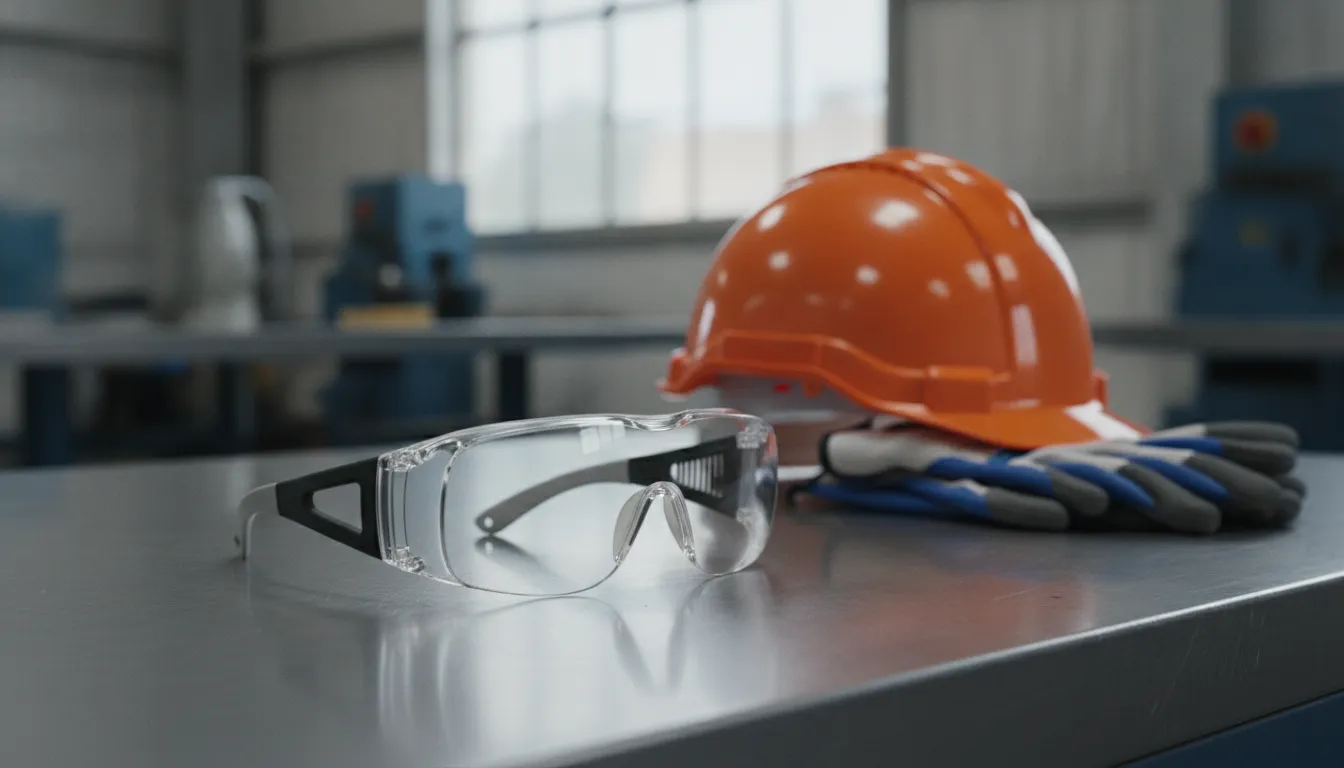
Ask employees to assess the following during a controlled fitting:
- The frame sits securely on the nose and behind the ears without painful pressure.
- The protective lens remains in the intended position during normal head movement.
- Side coverage does not leave an obvious gap for the identified exposure.
- The eyewear does not interfere with a respirator seal, hard-hat suspension, or face shield.
- The employee can see clearly through the full working field without distracting distortion.
- The chosen design can be cleaned, inspected, stored, and replaced under the site's PPE process.
Over-the-glass models may be practical for some employees, but they need enough interior space and a stable fit. Prescription inserts can reduce the need to stack eyewear, but the insert must be compatible with the protective frame. Reader designs may help with close tasks, but they are not a universal substitute for a full prescription assessment.
What should employees check before using prescription safety glasses?
Before each use, employees should confirm that the eyewear is clean, intact, and positioned correctly. Look for cracks, deep scratches, loose temples, damaged side protection, distorted vision, or other conditions that could affect protection or visibility. Follow the manufacturer's cleaning instructions and remove equipment from service when damage cannot be corrected.
Supervisors should also watch for changes in the work process. A new chemical, tool, lighting condition, production step, or respirator can change the required eye protection. Revisit the hazard assessment instead of assuming that the original prescription safety glasses remain appropriate for every task.
For additional context on selecting protective eyewear by exposure, see Safety Company's workplace guide to safety goggles. Goggles and safety glasses solve different coverage problems, so the choice should follow the hazard rather than a general preference.
Shop PPE and safety eyewear for your workplace hazard assessment
Frequently asked questions about prescription safety glasses
Is it possible to get prescription safety glasses?
Yes. Prescription safety glasses are available as complete prescription safety frames, compatible prescription inserts, over-the-glass protective eyewear, and some reader designs. Choose the option that matches the employee's prescription, workplace hazard, fit needs, and the manufacturer's stated protection.
What does OSHA say about prescription safety glasses?
OSHA 29 CFR 1910.133 requires eye protection appropriate to the hazard. For employees who wear prescription lenses during eye-hazard work, the protection must incorporate the prescription or fit over it without disturbing the proper position of either the prescription or protective lenses.
Do prescription safety glasses need side shields?
When flying objects create a hazard, OSHA requires eye protection that provides side protection. The exact design should match the hazard assessment and product specifications. Side shields may be integrated or detachable when they meet the applicable requirements.
Are prescription safety glasses different from regular glasses?
Yes. Regular prescription glasses correct vision, but they should not be treated as impact or hazard protection unless they are specifically designed and marked for that purpose. Prescription safety glasses combine correction with a protective design selected for workplace use.
How often should prescription safety glasses be replaced?
Replace them when lenses, frames, side protection, or other components are damaged, visibility is impaired, or the equipment no longer fits correctly. A fixed calendar interval is not a substitute for inspection. Follow the manufacturer's care guidance and the employer's PPE replacement procedure.
Contact Safety Company for help selecting workplace eye protection
Recent Posts
-
Cut Gloves: How to Choose the Right ANSI Level
A hand-protection program works best when it starts with the task, not a product label. A packaging …Oct 5th 2026 -
Kevlar Gloves. Cut, Heat, and Task-Specific Selection
Choosing hand protection by material name alone can leave a serious gap in your safety program. Star …Oct 2nd 2026 -
Face Shield for Grinding: Selection and Safety Guide
Grinding can send fragments, sparks, dust, and other debris toward a worker's face in an instant. Th …Sep 30th 2026