
Secondary Containment: Choosing Spill Control for Industrial Facilities
Secondary containment helps keep a leak or spill from spreading beyond a designated area while a team responds. For facility and environmental-health buyers, choosing secondary containment is not simply a matter of buying a berm or tray: the right approach depends on the substances present, the containers and transfer tasks, the consequences of a release, and the rules that apply at the site. Start with a documented hazard and volume assessment, then select compatible equipment and a workable inspection and response process.
Review a portable spill-containment option
What should secondary containment do at your facility?
Primary containment is the container, tank, pipe, or process vessel that holds a material during normal use. Secondary containment is a separate protective measure intended to catch or control a release if that primary barrier leaks, breaks, overflows, or is damaged. It can also help keep a spill from reaching a drain, soil, an adjacent work area, or other sensitive location. It does not prevent a release, make a damaged container safe, or replace a spill response plan.
Define the job before comparing products. Ask what is being contained, where a release could travel, and what needs protection. A storage area with several drums presents different conditions from a transfer point where hoses are connected and disconnected, a maintenance station with small containers, or a mobile operation that moves materials between work zones.
For each area, record the material types, container sizes and quantities, how the materials are used, and the people or pathways potentially affected by a release. Include nearby drains, doorways, floor openings, pedestrian routes, equipment, and outdoor areas. Consider both routine leaks and less frequent events such as a dropped container, failed connection, or damaged package. This assessment gives the buyer a basis for selecting containment geometry, capacity, material, access, and response supplies.
How should a team assess hazards and containment volume?
Begin with an inventory of the materials that could enter the containment area. Use current safety data sheets (SDSs), product labels, process documentation, and input from the people who handle the material. Note relevant hazards and handling conditions, including whether liquids are corrosive, combustible, water-reactive, or otherwise subject to special controls. Do not rely on a generic description such as “oil” or “cleaner” when the actual product and concentration matter.
Next, map the containers and release scenarios. A useful site worksheet can capture:
- Material name or identifier and the location where it is stored or used.
- Container type, capacity, number of containers, and whether containers are connected to equipment.
- Routine tasks, including dispensing, filling, sampling, cleaning, and container changes.
- Likely release points and the route a liquid could take across the floor.
- Exposure to rain, washdown, vehicle traffic, heat, sunlight, or other site conditions.
- Nearby drains, floor seams, doorways, traffic lanes, and sensitive equipment.
- Existing controls, spill-response supplies, and the person responsible for inspections.
Then establish the volume basis for the decision. Identify the largest container in the proposed area, the number of containers that could fail in a credible event, and any liquid that could enter from a connected process or transfer operation. Consider how a spill would actually behave: containers can be moved, tipped, or opened during work, and rain or wash water may take up available capacity in outdoor or wet areas. Make assumptions visible and have the responsible safety or environmental professional confirm them.
Do not treat a single capacity rule as universally applicable. Requirements depend on the material, the activity, the jurisdiction, and sometimes the type of facility or storage system. For example, Washington's administrative code includes a secondary-containment provision with a stated volume calculation for the scope it covers; that is not a general rule for every US facility or material. The Washington administrative code provision is one reason to check the controlling requirements for the specific site instead of copying a figure from a product description or another jurisdiction.
Write down the applicable design basis, the source of each assumption, and who approved it. When a process or inventory changes, review the calculation again. A tray that was sufficient for a small maintenance supply area may no longer fit after additional containers or a transfer line are introduced.
Which containment format fits the task?
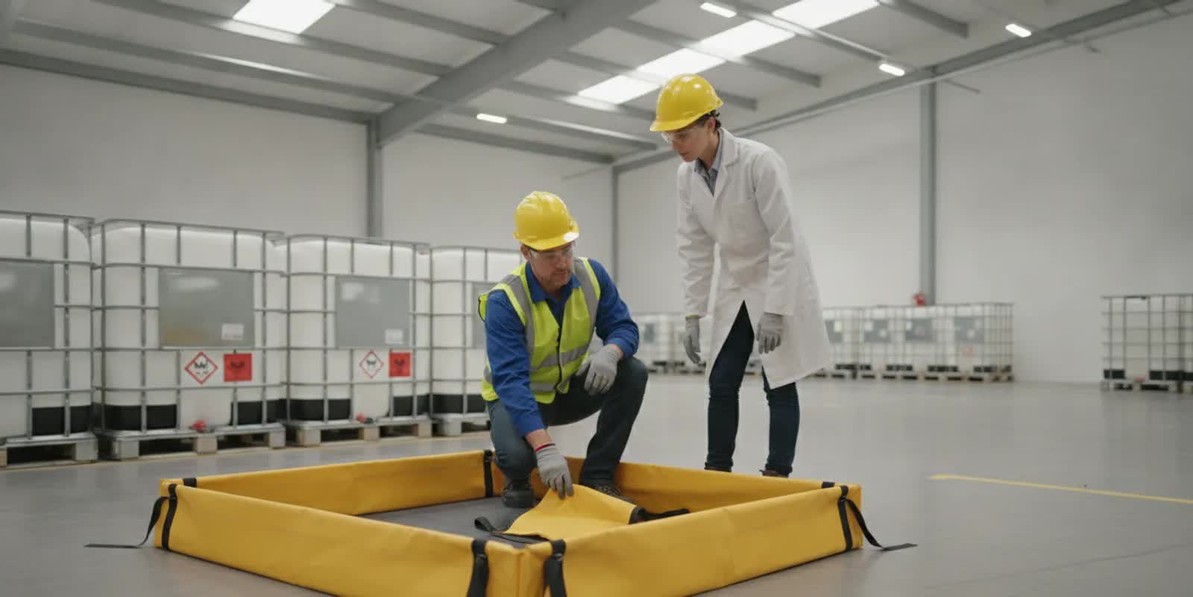
Containment equipment may be fixed in place or portable. A rigid tray or pallet can suit a stable storage location if the load, footprint, and access match the containers. A portable berm or pool may be useful when the work is temporary or the response area changes, but setup time, traffic, and the condition of the floor become important. A dedicated room or engineered collection area may require site-specific design review. No format is suitable just because its nominal volume looks adequate.
| Approach | May fit when | Planning checks | Potential limitation |
|---|---|---|---|
| Rigid tray or pallet | Containers remain in a defined storage position and staff need routine access. | Confirm capacity basis, container footprint, load support, chemical compatibility, and how accumulated liquid is detected and removed. | Fixed dimensions can limit container layouts; a damaged or incompatible tray may fail without obvious warning. |
| Portable berm or pool | A work or staging area changes, or a temporary boundary is needed. | Check setup and entry points, floor condition, traffic, material compatibility, and how staff will prevent trips or equipment damage. | It may require deployment before work begins and can be obstructed, punctured, or bypassed if poorly placed. |
| Fixed collection area | Ongoing operations and site layout call for a permanent, managed containment zone. | Have qualified personnel assess construction, drainage, access, capacity, maintenance, and applicable requirements. | Changes to processes or building conditions can alter the original design assumptions. |
| Task-specific spill barrier | A transfer or maintenance task creates a localized release pathway. | Identify the likely release point, nearby drains, task duration, and compatible response equipment. | It may address only a particular task and should not be mistaken for storage containment. |
Use a product's specifications as a starting point, not as a complete suitability decision. The drum containment listing and the portable containment pool listing illustrate different equipment formats. Review each manufacturer's details and confirm the specific model, intended use, capacity, construction, and restrictions before selecting it. These examples are not a recommendation for a particular chemical or regulatory application.
How should buyers check chemical compatibility?
Compatibility is specific to the chemical and the equipment materials. A product that performs well with one liquid may degrade, soften, swell, become brittle, or lose strength when exposed to another. Compatibility can also depend on concentration, temperature, duration of contact, repeated exposure, cleaning agents, ultraviolet exposure, and mechanical stress.
Do not infer universal chemical resistance from a material name or a broad product category. Start with the exact chemical identity and concentration, then ask the manufacturer or supplier for written compatibility information for the exact model and relevant use conditions. Compare that information with the SDS and the facility's exposure scenario. If the answer is unclear, pause the selection and involve the site's environmental, health, and safety (EHS) lead or a qualified technical resource.
Check more than the main basin or surface. Seams, drains, valves, liners, coatings, fasteners, supports, and repair materials can have different properties. If multiple substances may mix in the containment area, assess the combined scenario rather than checking each material only in isolation. Do not assume that mixing is safe; follow the site's chemical-management and emergency procedures.
Also check how equipment will be used. A compatible basin may still be unsuitable if a forklift can strike it, a sharp edge can puncture it, a door blocks access, or a hose repeatedly rubs across a seam. A simple compatibility record should identify the reviewed substance, concentration or range, equipment model and materials, the information source, any operating limits, and the reviewer.
Where do portability and site layout matter?
Portability affects more than how easily a product can be moved. Consider whether the containment device must be in place during every transfer, whether workers can deploy it without interrupting a critical operation, and whether it can be moved while contaminated. Identify who handles setup and where equipment is stored between uses. If a portable unit is brought out only after a leak, it cannot capture a release that happens before deployment.
Walk the route from storage to the work location. Look for ramps, thresholds, narrow turns, uneven floors, vehicle paths, and door swings. Consider whether a loaded device can be relocated safely, or whether it should be emptied and decontaminated first under the site's procedures. A portable containment unit should not create a new hazard by blocking an exit, obstructing an aisle, or causing a trip.
Review placement against the work, not just the floor plan. For a transfer activity, the protected area needs to account for the connection, the container opening, and the likely direction of a release. For storage, allow access for inspection and removal of containers without damaging the barrier. Keep response equipment accessible. A spill barrier near a drain, for example, is not effective if stored materials or a parked cart prevent workers from reaching it promptly.
Products such as a spill-control sock can be one part of a response setup for managing a spill pathway, subject to the product's intended use and the material involved. It should not be treated as a replacement for a properly selected storage containment system. Ensure the response plan explains how such supplies are used, where they are stored, and what workers should do when a product is not appropriate for the spill.
What inspection and housekeeping routine should be in place?
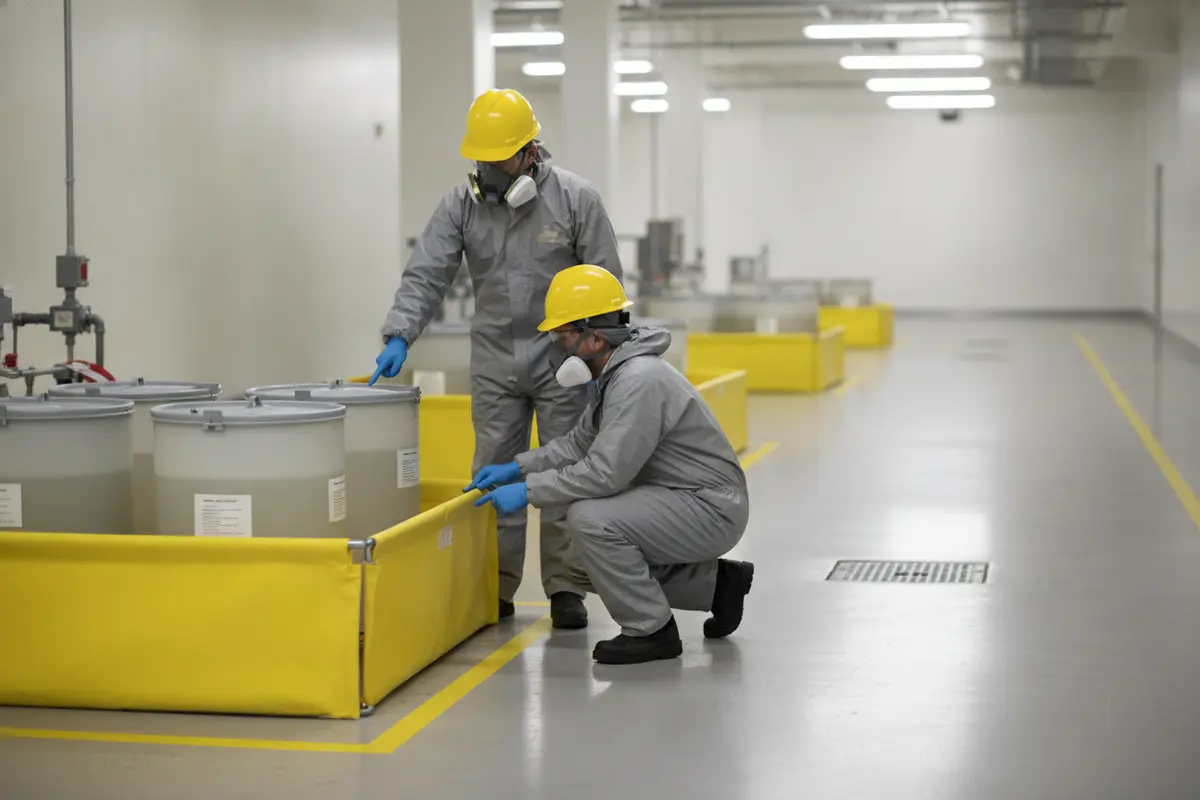
Containment is only useful when it is ready to perform its intended role. Create an inspection routine that matches the equipment, substances, environment, and frequency of use. Follow manufacturer instructions and applicable site requirements. Assign a named role or team to conduct the checks, and make clear who reports a concern and who can take equipment out of service.
Inspection points may include:
- Cracks, punctures, abrasions, corrosion, deformation, separated seams, or signs of chemical attack.
- Drain plugs, valves, covers, joints, and other fittings in their required condition.
- Liquid or debris already present, including rainwater where outdoor equipment is used.
- Containers positioned fully within the containment area and arranged as planned.
- Leaks, residue, staining, or odors that may indicate a loss of primary containment.
- Clear access to the area, response materials, and any designated inspection points.
- Changes to nearby operations, equipment, drains, or traffic that could affect performance.
Housekeeping helps preserve capacity and visibility. Do not allow packaging, tools, waste, or unrelated materials to accumulate in the containment zone. Manage any liquid found in the area according to site procedures; do not assume that it is harmless rainwater. Identify it, determine whether it may be contaminated, and use the site's approved handling and disposal process. Never drain or discharge collected material without confirming that the action is permitted and safe.
Inspection frequency should reflect actual risk and use rather than an arbitrary schedule copied from a different site. Areas with frequent transfers, outdoor exposure, or a history of damage may need closer attention. Define event-triggered inspections after a spill, impact, equipment relocation, maintenance, or a change in stored materials. Manufacturers' instructions and regulations may set specific requirements; the site's responsible personnel should verify those requirements.
A practical record can be brief but useful: date and area, inspector, condition observed, action taken, and follow-up owner. If a defect is found, isolate or stop use as appropriate under site procedures, arrange repair or replacement, and document the release-to-service decision. A checklist does not make damaged containment acceptable; it helps ensure a problem is noticed and acted on.
How should spill response connect to containment?
Secondary containment buys a boundary; it does not tell workers how to safely respond. The facility's spill procedures should explain how to recognize a release, alert others, protect people, restrict access, and contact the designated response lead. The plan must distinguish spills workers are trained and equipped to handle from situations that require evacuation or specialist assistance. Do not ask workers to enter an unsafe area or handle an unknown substance.
Train workers on the actions that apply to their roles. They should know how to find the relevant SDS and emergency instructions, whom to notify, where response supplies are kept, and how to avoid spreading contamination. Include spill scenarios relevant to actual tasks, such as a container leak during dispensing or a damaged package in a staging area. Make clear that the correct action depends on the substance, amount, location, and conditions; a generic cleanup sequence is not suitable for every release.
Plan the boundary and response supplies together. Check whether absorbents, barriers, containers, and personal protective equipment are appropriate for the chemicals and response tasks in the plan. Provide a safe means to access supplies without crossing the likely spill path. Identify how contaminated cleanup materials will be contained, labeled, moved, and managed under site procedures. Clarify who determines when the area can reopen and what inspection or decontamination must occur first.
For a significant, unknown, or uncontrolled release, workers should follow the facility's emergency plan and applicable reporting procedures. Do not rely on the presence of a containment berm to make an otherwise unsafe response manageable. Review response actions with qualified EHS personnel and coordinate them with the facility's emergency contacts.
Compare a spill berm with your site requirements
Which records help sustain the program?
Keep records that show why the chosen approach fits and how it is maintained. Useful documentation may include the chemical and container inventory, area map, volume assessment, design assumptions, compatibility information, manufacturer instructions, inspection logs, maintenance and repair history, spill reports, training records, and approvals. Keep the current version easy for authorized staff to find.
Link equipment records to a physical location or asset identifier. This makes it easier to connect a finding to the correct unit, retrieve its compatibility documentation, and determine whether it is still approved for the materials stored there. Where a site has multiple containment types, distinguish their uses so a task-specific barrier is not accidentally relied on for routine storage.
Set review triggers in addition to periodic review. Reassess when a material, concentration, container size, quantity, process, location, equipment model, drainage condition, or applicable requirement changes. Also review after a spill, equipment failure, near miss, or inspection finding that suggests the original assumptions were wrong. Assign an owner and a due date for corrective actions; unresolved issues should remain visible until closed.
Regulatory sources can help identify requirements, but their scope matters. The UNIDOCS uniform document describes containment construction considerations in its own context. Use it as a reference to investigate, not as a substitute for determining which rules govern your facility. Confirm requirements with the appropriate authorities and qualified professionals for the material and operation at hand.
How can a buyer put the decision into practice?
A staged review helps connect the hazard assessment to a purchase and a functioning site program:
- Define the location and task. Separate storage, transfer, dispensing, maintenance, and mobile work rather than treating an entire facility as one scenario.
- Collect material and container details. Confirm the chemical identity, relevant SDS information, container type and capacity, quantities, and process connections.
- Map release pathways. Walk the area and note drains, doors, traffic, sensitive equipment, outdoor exposure, and locations where a leak could escape.
- Establish the capacity basis. Document the credible release scenario and any applicable requirement. Have the appropriate EHS or environmental lead review the basis.
- Verify compatibility and physical fit. Check exact materials and product details, then evaluate access, load, setup, movement, maintenance, and use conditions.
- Plan inspection and response. Assign responsibilities, set checks based on risk and manufacturer instructions, stage suitable response supplies, and train affected workers.
- Document approval and revisit it. Keep the decision record and review it after relevant changes, findings, or incidents.
Before placing an order, give the reviewer the intended material, the location, operating conditions, container arrangement, and the documented capacity basis. Ask for model-specific product information, including chemical compatibility, construction, limitations, and maintenance instructions. If information needed to establish suitability is missing, do not fill the gap with an assumption.
Review a drum-containment option for your assessment
Frequently Asked Questions
Is secondary containment a substitute for safe primary containers?
No. Secondary containment is a backup measure for controlling a release. Containers, equipment, handling practices, and maintenance still need to be suitable for the material and task. Workers should report leaks and damage and follow site procedures rather than treating the secondary barrier as permission to continue using faulty equipment.
Can one containment product be used for every chemical?
No universal compatibility should be assumed. Confirm the exact chemical, concentration, equipment materials, exposure duration, and operating conditions with model-specific manufacturer information. When compatibility is unclear, ask a qualified technical or EHS resource before use.
How much volume must secondary containment hold?
There is no single volume figure that can be applied to every facility and substance. Applicable rules and design assumptions vary by jurisdiction, material, and activity. Document the site-specific basis and have the appropriate responsible professional confirm it against current requirements.
How often should containment be inspected?
Set a routine suited to the equipment, exposure, use, and applicable requirements, and follow manufacturer instructions. Also inspect after events such as a spill, impact, move, repair, or change in stored materials. Record findings and actions so that damage or loss of capacity is addressed.
Does a portable berm replace a permanent storage system?
Not automatically. A portable berm may suit a particular temporary task, but its setup, capacity, compatibility, condition, and intended use must match that task. Confirm that it meets the site's actual requirements before relying on it for any storage or process scenario.
A dependable secondary-containment program connects the right equipment to a site-specific assessment, compatible materials, clear inspections, trained response, and records that stay current as operations change.
Recent Posts
-

Secondary Containment: Choosing Spill Control for Industrial Facilities
Secondary containment helps keep a leak or spill from spreading beyond a designated area while a tea …Nov 2nd 2026 -

What buyers should know about Safety Data Sheet Training
Safety data sheet training should help employees do more than recognize a form. Workers need to find …Oct 30th 2026 -

What buyers should know about Construction Signs
Construction signs help communicate hazards and changing conditions, but a familiar sign is not auto …Oct 29th 2026