
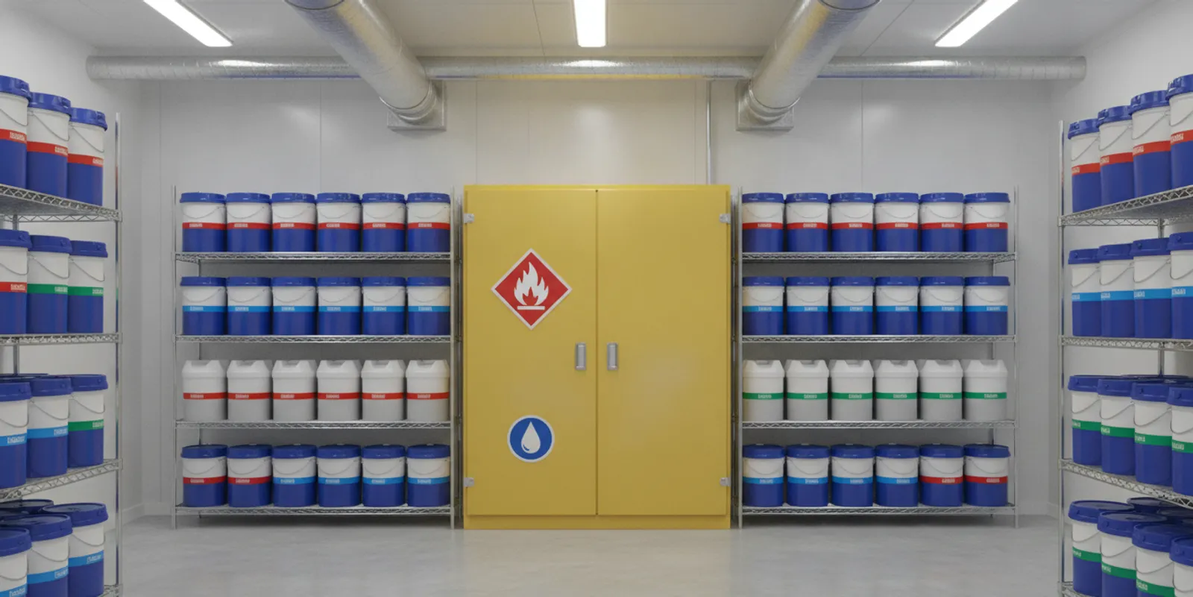
Chemical Storage Cabinets for industrial work: use and compliance
Chemical storage cabinets help workplaces control access to hazardous materials and keep storage conditions matched to the hazards present. Choosing chemical storage cabinets starts with the chemicals, their hazards, and the way employees use them—not simply the cabinet’s size or color. A safety manager should confirm the applicable OSHA, fire-code, and local requirements, then select equipment for the specific chemical group and work process.
Call to discuss workplace safety equipment
What role do chemical storage cabinets play?
A chemical storage cabinet is a purpose-built enclosure for storing particular types of hazardous materials. Depending on the cabinet design, its role may include restricting access, organizing containers, and providing a storage environment intended for a defined hazard class. The cabinet should be treated as one part of a chemical safety system, not as a substitute for hazard assessment, employee training, safe handling, or emergency planning.
Begin by identifying the chemicals on site, the quantities stored, and their intended uses. Consult each product’s Safety Data Sheet (SDS), container label, and supplier guidance. Then verify the cabinet’s intended use and technical documentation. Do not assume that one cabinet is suitable for every chemical just because the containers fit inside.
Storage decisions affect employees who receive, move, dispense, and use chemicals, as well as maintenance and emergency-response personnel. Keep the inventory current and make storage arrangements understandable to the people who work around them. If a chemical’s identity, concentration, or compatibility is uncertain, pause the storage decision and ask a qualified safety professional or the chemical supplier for guidance.
How should a buyer identify the hazards first?
Build a chemical inventory before comparing cabinets. Record product names, relevant hazard information, container sizes, the maximum amount that may be stored, and the work areas where each material is used. Include seasonal, maintenance, and emergency-use products; a partial list can lead to a cabinet that does not fit the real storage need.
- Read the SDS and label. Look for hazard information, storage recommendations, incompatibilities, and any special handling instructions. Do not rely on a familiar product name alone.
- Group by storage compatibility. Identify which chemicals can be stored together and which need separation. Compatibility is determined by the chemical properties and product guidance, not by convenience or shelf space.
- Note the quantities and containers. Record the largest container and total planned inventory. Include headroom for safe placement and retrieval, rather than calculating capacity from the cabinet’s outside dimensions.
- Consider how materials are handled. A cabinet used only for closed containers has a different work pattern from a location where employees routinely remove and return materials.
- Identify exposure routes and response needs. Consider possible splash, vapor, spill, fire, and contact hazards. The cabinet does not replace appropriate PPE, spill supplies, eyewash or emergency response provisions.
Use the inventory to make a compatibility map that staff can maintain. When several hazard groups are present, avoid solving the problem by putting all containers into one enclosure. A cabinet should be selected for its stated use; it is not automatically a universal chemical locker.
A practical inventory review can start with one work area rather than the entire facility. For each item, note its exact product identity, concentration when relevant, container type, and the place where employees use it. Then compare the SDS storage instructions with the cabinet plan. If a maintenance product appears only occasionally, include it if it will be stored on site; otherwise the cabinet may be sized or organized around an incomplete picture. Mark products whose instructions need clarification and resolve those questions before assigning shelf space.
For example, a facility may have a frequently used solvent, cleaning products, and a small container of a specialized process chemical. The fact that all three are liquids does not make them a compatible group. The buyer should review each SDS, identify any incompatibilities, and confirm the cabinet’s intended hazard class. The outcome may be separate storage arrangements, a revised inventory, or additional professional review. This is safer and more useful than selecting a cabinet based on a generic list of common products.
Which cabinet type fits the chemical hazard?
Cabinet selection should follow the hazard class and the cabinet manufacturer’s stated purpose. Common purchasing categories include flammable-liquid cabinets, corrosive-storage cabinets, and cabinets intended for other defined chemical hazards. Exact features and applicable requirements vary by product and jurisdiction, so compare the documentation for the specific model rather than relying on category names alone.
| Buyer consideration | What to verify | Common review question |
|---|---|---|
| Hazard class | Cabinet is designed and identified for the chemical group being stored | Does the cabinet documentation match the SDS and intended use? |
| Compatibility | Materials stored together are compatible; incompatible groups are separated as needed | Have we checked each product and its storage guidance? |
| Capacity | Interior dimensions, shelf capacity, and container arrangement support the planned inventory | Can containers be placed and removed without unsafe crowding? |
| Location | Placement, access, and nearby work activities suit the risk and local rules | Can employees reach it safely without blocking an exit or work route? |
| Controls and upkeep | Labels, access practices, housekeeping, and inspection responsibilities are defined | Who checks the cabinet and responds to damage or a spill? |
For flammable liquids, check that the cabinet is specifically designed for flammable-liquid storage and that the proposed use follows the cabinet instructions and applicable fire and workplace requirements. Do not use a cabinet designed for one hazard class as a general-purpose chemical cabinet. The NIH Office of Research Services explains that its chemical storage cabinets are designed for specific hazard classes and should not be used for multipurpose or general chemical storage (NIH chemical storage cabinet guidance).
Corrosive materials may require storage equipment selected for compatibility with the substances and containers. Verify the cabinet’s materials, shelves, and intended use in the product documentation. A label saying “corrosive” is not enough to establish that every acid or base can share a cabinet. Separate incompatible substances according to authoritative chemical guidance and your site’s hazard assessment.
Other chemical classes may call for different storage arrangements or controlled access. Do not infer that a cabinet is appropriate for a gas cylinder, reactive material, or any unusual process chemical unless its instructions expressly cover that use. If the inventory includes special hazards or conflicting recommendations, involve your EHS lead and the supplier before placing an order.
Compare the candidate cabinet’s written scope with the actual work, not with a simplified department label. A laboratory, maintenance shop, and production line may each use products described broadly as solvents, yet the product identities, quantities, and handling patterns can differ. Make sure the selected model and any proposed accessories are suited to that specific storage plan. If the vendor documentation leaves an important point unanswered, ask for clarification in writing and keep the response with the purchasing record.
How can you confirm the cabinet and chemicals are compatible?
Compatibility review is more than matching a cabinet category to a broad label. Review the SDS storage and incompatibility information for every chemical planned for the enclosure. Check whether containers could leak, react with neighboring products, or be damaged by the cabinet’s interior materials. Follow stricter instructions where a product label, SDS, manufacturer, or applicable rule sets a limit.
Keep incompatible chemicals in separate, clearly designated storage arrangements. Physical separation may mean different cabinets or other suitable separation as determined by the hazard assessment and relevant requirements. Avoid storing materials together just because they are used by the same department. A convenient shared location can create an unnecessary interaction risk if containers leak or are handled incorrectly.
Secondary containment may be appropriate for certain materials, but it also has to be chemically compatible and sized for the purpose. Do not add a tray, liner, absorbent, or other accessory without checking its compatibility and the cabinet’s instructions. Spill-control equipment supports response planning; it does not make incompatible storage safe. For related response planning, a facility may review suitable spill-control equipment and spill-control pillows alongside its written procedures.
Maintain an up-to-date list of what belongs in each cabinet. A simple cabinet map can identify permitted chemical groups, prohibited items, maximum working inventory, and the person responsible for review. Post or keep the information where employees can use it without obscuring the manufacturer’s labels or required safety information.
Make the compatibility map operational by assigning responsibility for updates. When a new product arrives, the receiving employee or supervisor should know who confirms its storage location before it is placed in a cabinet. When a process changes or a product is discontinued, update the list and remove obsolete entries. A map that no longer matches the contents can mislead workers just as easily as having no map at all.
It can help to organize the review as a simple decision record: identify the product, cite the applicable SDS storage information, note the compatible storage group, name the intended cabinet, and record any unresolved question. This does not replace professional hazard analysis, but it makes assumptions visible. It also gives a safety manager a clear trail to review when products, staff, or storage arrangements change.
What size and capacity should a buyer plan for?
Start with the maximum inventory that will actually be stored at one time. Measure the largest containers, including their closures and any secondary containment, and consider the space needed to place and remove each one without tipping or striking neighboring containers. Use the cabinet’s usable interior dimensions and rated shelf capacity—not just its external footprint.
Overfilling creates practical problems: containers become difficult to identify or retrieve, shelves may be overloaded, and employees may be tempted to set chemicals on top of or beside the cabinet. Do not exceed stated load limits or alter shelves unless the manufacturer permits it. Include room to read labels and inspect containers. A slightly larger appropriate cabinet may be preferable to a tightly packed enclosure, but size must not override hazard compatibility or location requirements.
Plan capacity for normal operations and likely inventory changes. Consider whether deliveries arrive in cases, whether containers are replenished before they are empty, and whether multiple shifts use the same materials. Purchasing more capacity than needed can encourage accumulation of unused stock. Establish an inventory limit and a process for removing expired, unwanted, or unidentified chemicals through the site’s approved waste process.
Use a shelf-by-shelf sketch before ordering. Draw the cabinet’s usable interior, then place rectangles representing the largest containers and any containment equipment. Check whether workers can see labels and lift containers without reaching around other products. If different chemical groups require separate cabinets, keep those groups separate in the sketch rather than combining them to make the layout look efficient. This simple exercise often reveals that a proposed cabinet is too narrow, that a frequently handled container needs a more accessible location, or that the planned inventory should be reduced.
Think about peak storage, not only an average day. A delivery may temporarily increase quantities, or a maintenance shutdown may bring products into one area that are normally stored elsewhere. Set a clear maximum inventory and decide what employees should do if a delivery would exceed it. Do not treat a crowded cabinet as a short-term exception that can continue indefinitely. A defined receiving and replenishment routine helps prevent unplanned overflow into work areas.
Get help planning your workplace safety equipment list
Where should the cabinet be placed?
Choose a location based on the hazard, the work process, and applicable requirements. The area should be accessible to authorized employees while avoiding unnecessary exposure to people who do not use the chemicals. Consider routes for moving containers, nearby heat or ignition sources where relevant, ventilation instructions, potential vehicle impact, and proximity to exits and emergency equipment.
Do not block an aisle, exit, electrical panel, or emergency equipment to make room for storage. Make sure employees can approach and operate the cabinet without stretching over other hazards or carrying containers through crowded work areas. If the cabinet is in a production area, assess whether routine traffic, vibration, water, or process conditions could damage containers or interfere with access.
Follow the cabinet maker’s placement and installation instructions. Do not make unapproved penetrations or modifications, and do not presume a cabinet can be vented, grounded, or connected to building systems in a particular way. Such decisions depend on the product, contents, facility design, and applicable rules. Ask a qualified professional when the instructions or local requirements are unclear.
Consider emergency access as part of the layout. Employees should know where the cabinet is, what it contains, and what to do if a leak or exposure occurs. Provide appropriate response resources based on the hazards and site plan. For example, confirm that required emergency washing provisions are accessible; an eyewash station option may be relevant to a facility’s broader assessment, but it does not substitute for determining the site’s actual requirements.
Walk the route from delivery or receiving to the proposed storage point. Check whether a worker can move the largest container without passing through an area where it could be struck, dropped, or exposed to incompatible operations. Then walk from the cabinet to the point of use and consider how often containers travel that path. The safest location is not always the one closest to the workbench; it must also fit access, hazard separation, emergency response, and applicable fire and workplace requirements.
Ask employees who use the area to review the proposed position before installation. They can identify practical obstacles such as a door that swings into the access path, a cart route that crowds the cabinet, or a location where labels are hard to see. Addressing those details early can prevent later workarounds, such as leaving containers beside the cabinet because returning them is inconvenient.
What should you check before ordering?
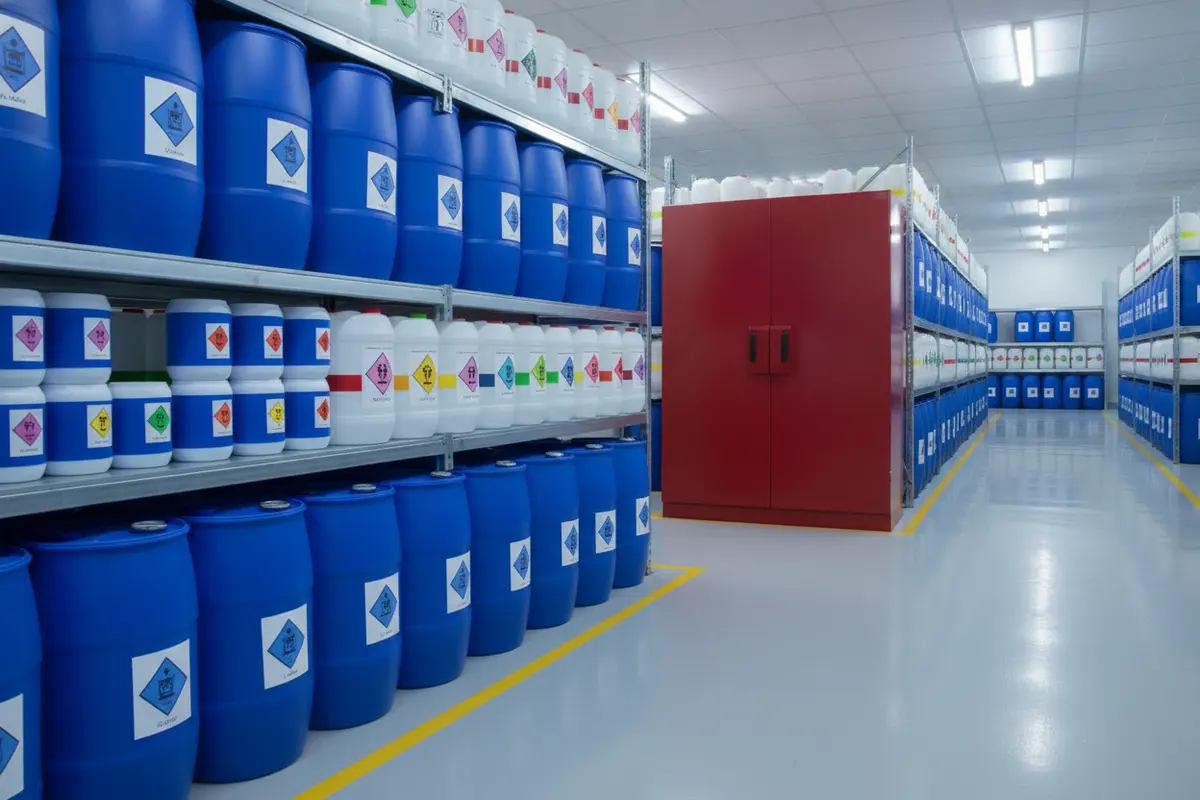
A disciplined pre-purchase review reduces the chance of selecting a cabinet that looks suitable but does not match the job. Ask the supplier for current product documentation and confirm that the model is intended for the specific application. Compare more than price: evaluate compatibility, usable capacity, construction, configuration, installation conditions, and maintenance instructions.
- Confirm the use case. State which chemical types will be stored, how many containers, and whether the cabinet is for closed storage or an active work area.
- Check the documentation. Review the manufacturer’s description, limitations, applicable certifications or listings if relevant, installation instructions, and care guidance. Do not treat a marketing phrase as proof of compliance.
- Verify dimensions and loading. Compare usable space and shelf capacity with the actual containers and expected inventory.
- Review accessories. Confirm that shelves, trays, locks, or other features are compatible with the cabinet and chemicals, and are allowed by the instructions.
- Assess the location. Confirm the proposed position, access, route, and nearby conditions against the site hazard review and local requirements.
- Set operating rules. Decide who may access the cabinet, how items are labeled and inventoried, and who will inspect it.
Where an OSHA standard, fire code, local regulation, or insurer requirement may apply, verify the current requirements for the specific facility and use. Requirements may depend on the chemical, quantity, occupancy, building, and jurisdiction. This guide is general purchasing information, not a determination that a particular installation complies with every applicable rule. Have your EHS professional or fire-protection authority review questions that affect compliance.
For a broad safety procurement review, compare the cabinet decision with related PPE and response needs. Employees handling chemicals may need task-specific gloves; for example, buyers can review chemical-resistant glove options only after checking their material compatibility and the chemical supplier’s guidance. Gloves are not interchangeable across substances, and a product link is not a substitute for a hazard assessment.
Before submitting an order, make a short record of the selection rationale. Include the products and quantities considered, the cabinet model and intended use, the dimensions and loading review, the installation location, and any open compliance questions. Attach or retain current manufacturer instructions and the SDS documents used for the compatibility review. If more than one buyer or department is involved, identify who approves the final arrangement and who will receive the cabinet after delivery.
When the cabinet arrives, compare the delivered model with the order and documentation before putting chemicals inside. Check for shipping damage, confirm the configuration and accessories, and follow the manufacturer’s installation directions. If the delivered equipment differs from the reviewed specification or has visible damage, stop and resolve the discrepancy rather than adapting the plan on the spot.
How should employees use and maintain a chemical cabinet?
Write simple storage procedures that reflect the actual products and cabinet. Train employees to read labels, return containers to their assigned locations, close containers as instructed, and report damaged or leaking packages. Keep the cabinet orderly and avoid storing food, personal items, or unrelated supplies there. Restrict access when the hazard or site rules call for it.
Use an inspection routine suited to the materials and workplace. The University of Texas at Austin Environmental Health & Safety guidance says chemicals should be kept in secure containers, preferably within enclosed cabinets, and advises periodic checks of shelves and supports (UT Austin chemical storage cabinet guidance). Incorporate the cabinet maker’s instructions and site procedures into the inspection plan.
- Check that the cabinet is stable, accessible, and not visibly damaged.
- Look for leaks, corrosion, residue, swelling, or damaged containers, following site procedures for any suspected release.
- Confirm that containers remain closed, legible, and assigned to the correct storage group.
- Check shelves, supports, and any secondary containment for damage or accumulated material.
- Remove unrelated items and address any blocked access or unsafe crowding.
- Document findings, corrective actions, and follow-up responsibility.
Inspection frequency should be set by the workplace’s hazard assessment, product instructions, and applicable rules; there is no one interval suitable for every inventory. If an inspection identifies a leak, unknown substance, or damaged cabinet, keep people away as appropriate and follow the facility’s emergency procedures. Do not improvise cleanup or move a hazardous container without the required training and equipment.
Make the routine part of everyday work rather than relying only on a calendar reminder. At the end of a task, employees can return each container to its assigned position, check that its closure and label are intact, and report any issue. A designated person can then conduct the more complete condition review and record follow-up. The division of responsibility should be clear: all users report problems, while the responsible supervisor or safety lead tracks corrective actions to completion.
Use a change in inventory as a trigger for review. Before adding a newly purchased chemical, check whether the cabinet map and compatible storage group still apply. When a product is removed from service, follow the site’s approved disposal process and update the inventory. If a cabinet is moved, modified, or damaged, revisit the location and installation review rather than assuming the former approval still applies.
What are the limits of a chemical storage cabinet?
A cabinet does not make an incompatible chemical safe, neutralize a spill, or eliminate the need to control access and train employees. It does not guarantee that the contents are protected under every fire or exposure scenario. The cabinet must be appropriate for the materials, correctly used, maintained, and installed according to its instructions and applicable requirements.
It also does not replace the site’s chemical hygiene or hazard communication practices. Employees still need access to hazard information, safe handling instructions, appropriate PPE, and emergency procedures. A cabinet is only one control among several. Choose additional controls based on the task and exposure assessment rather than assuming cabinet purchase resolves the underlying risk.
Do not use a cabinet beyond its stated purpose, combine hazard groups without compatibility review, or store unidentified chemicals. If the inventory changes, reassess the arrangement before adding products. Review the cabinet decision after process changes, incidents, inspection findings, or updates to relevant requirements.
It is also not a substitute for deciding whether the quantity stored is appropriate for the task. Keeping excess material on hand can increase the burden of inventory control and the consequences of a storage failure. Work with the responsible safety personnel to set reasonable stock levels, remove unneeded products through approved channels, and confirm that day-to-day handling has suitable safeguards beyond the cabinet itself.
Call for help reviewing safety equipment needs
Frequently asked questions about chemical storage cabinets
Can one cabinet be used for all workplace chemicals?
No. Select a cabinet for its stated hazard class and intended use. Review the SDS and manufacturer instructions, and separate incompatible chemicals as required by the hazard assessment and applicable rules. A general-purpose cabinet should not be assumed suitable for every chemical.
Does a chemical storage cabinet by itself establish compliance?
No. Compliance depends on the chemical, amount, process, cabinet, installation, facility, and applicable requirements. Confirm current federal, state, local, and fire-code obligations with the responsible safety professional or authority. This guide cannot determine whether a particular setup complies.
How do I decide how much cabinet capacity I need?
List the maximum inventory, measure the largest containers and any compatible containment, and compare those needs with usable interior dimensions and shelf load limits. Leave enough room for safe placement, removal, label reading, and inspection. Avoid using excess capacity as a reason to accumulate unnecessary stock.
How often should a cabinet be inspected?
Set an inspection schedule based on the stored hazards, manufacturer instructions, site procedures, and applicable rules. Inspect after a spill, damage, or significant inventory change as appropriate. Checks should include the cabinet condition, shelves and supports, containers, labeling, housekeeping, and access.
What should I do if a chemical does not clearly fit the cabinet plan?
Do not place it in a cabinet based on guesswork. Review the product label and SDS, contact the manufacturer or supplier, and ask your EHS professional to resolve compatibility and regulatory questions before storage.
Speak with a safety equipment representative
A careful cabinet decision starts with an accurate inventory and a clear understanding of the hazards employees face. Match the cabinet to its intended chemical group, verify the documentation and local requirements, and maintain a routine for safe use and inspection.
Recent Posts
-

Chemical Storage Cabinets for industrial work: use and compliance
Chemical storage cabinets help workplaces control access to hazardous materials and keep storage con …Oct 23rd 2026 -

How to Properly Wear a Safety Harness
Knowing how to properly wear a safety harness is only one part of protecting workers at height. The …Oct 23rd 2026 -

Safety Harness for facility and field teams
A safety harness is one part of a fall-protection decision, not a stand-alone answer to every work-a …Oct 22nd 2026