
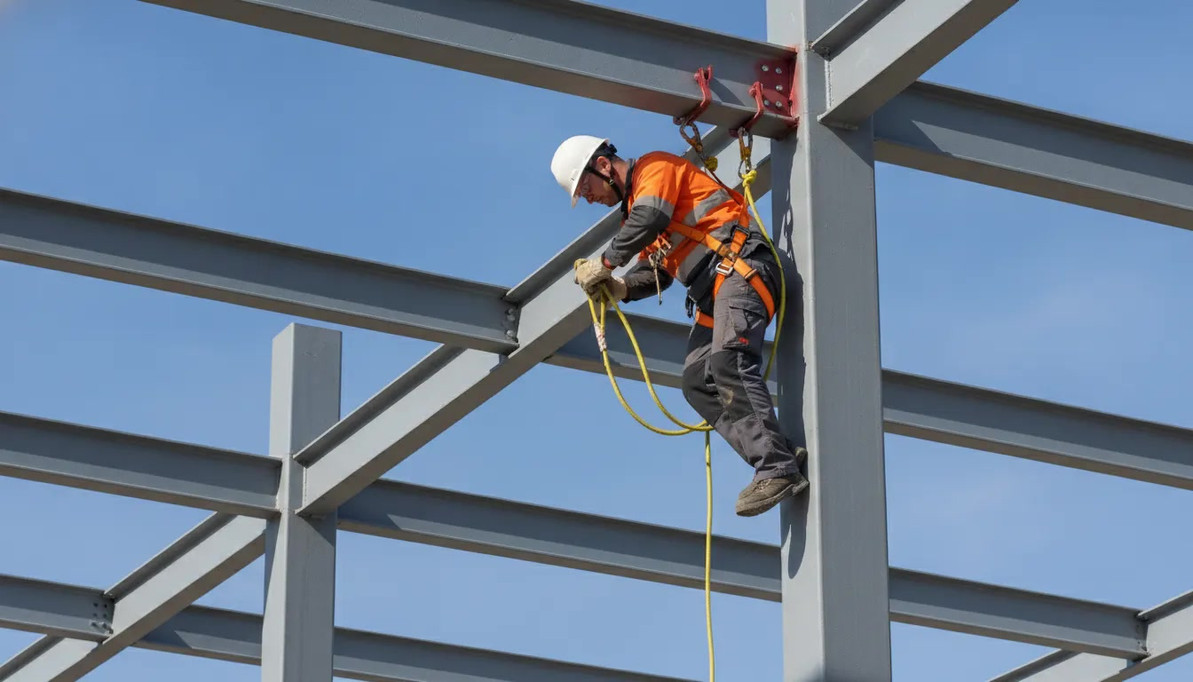
Fall Protection Requirements OSHA 1926: A Compliance Guide
Fall protection is not a single piece of equipment or a policy kept in a binder. For construction teams, it is a site-specific system of hazard recognition, compliant equipment, worker training, inspection, and rescue planning. Falls to lower levels remain a critical construction hazard. The Bureau of Labor Statistics reported 389 fatal falls to a lower level among 1,034 construction fatalities in 2024. Every safety manager, EHS officer, and site supervisor needs a practical way to apply the fall protection requirements OSHA 1926 establishes.
Shop OSHA-compliant fall protection equipment for your crew.
Quick answer: OSHA 1926 Subpart M generally requires protection when a construction employee works on a walking-working surface with an unprotected side or edge 6 feet or more above a lower level. The employer must provide a permitted system, such as a guardrail, safety net, or personal fall arrest system, and must train exposed employees.
Effective compliance starts by separating three questions. When is protection required? What performance criteria must the selected system meet? What training, inspection, and rescue practices keep the system effective? This guide answers each question and connects the regulation to equipment-selection decisions for US construction and industrial safety teams.
What Are the Fall Protection Requirements OSHA 1926 Sets Out?
Answer: The fall protection requirements OSHA 1926 sets out in Subpart M are organized around three core provisions. Section 1926.501 explains when employers must provide protection, 1926.502 establishes criteria for protective systems, and 1926.503 requires training for employees who may be exposed to fall hazards.
For construction employers, Subpart M is a working standard, not simply a purchasing reference. OSHA 1926.501 establishes the employer's duty to protect employees from falls. It addresses unprotected sides and edges, leading edges, hoist areas, holes, formwork, ramps, runways, excavations, and other construction exposures.
OSHA 1926.502 then sets the criteria and practices for guardrail systems, safety nets, personal fall arrest systems, positioning-device systems, warning lines, safety monitoring systems, and related controls. OSHA 1926.503 covers training, retraining, and certification records.
The distinction matters when a team is selecting equipment. A harness may be suitable for a personal fall arrest system, but the harness alone does not create a compliant system. The employer must consider the anchorage, connector, clearance, swing-fall exposure, inspection process, worker training, and prompt rescue. Likewise, a guardrail may be a strong choice for a permanent edge, but it cannot be treated as a universal answer for every task or work surface.
Use 1926.501 to identify the exposure, 1926.502 to verify system performance, and 1926.503 to confirm that workers understand the hazard and the controls. This sequence gives safety managers a defensible process for evaluating changing work areas and documenting their decisions.
Who Must Comply Under OSHA 1926.501?
Answer: Construction employers must protect employees exposed to covered fall hazards, including unprotected sides and edges, leading edges, hoist areas, holes, low-slope roofs, overhand bricklaying, and other listed conditions. The 6-foot threshold is central, but the exact subsection and work activity determine the permitted control.
Section 1926.501(b)(1) addresses unprotected sides and edges. When an employee is on a walking or working surface with an unprotected side or edge 6 feet or more above a lower level. The employer must provide a guardrail system, safety net system, or personal fall arrest system. A hazard assessment should identify these surfaces before a crew begins work and again when the work area changes.
Leading edges and hoist areas
Leading-edge work creates a changing exposure because the edge moves as construction progresses. Employees constructing a leading edge at or above the applicable height must be protected with a permitted system. Workers performing other work near the edge also need protection. A fall protection plan is not a convenient replacement for conventional protection. It is a limited alternative that requires the employer to demonstrate that conventional systems are infeasible or create a greater hazard.
Hoist areas create a separate risk because a guardrail may be opened temporarily to land materials. Employees exposed to a fall of 6 feet or more must be protected by guardrails or personal fall arrest systems. When the opening is not actively being used for hoisting, a chain, gate, or removable guardrail section must protect the access point.
Roofing, bricklaying, and floor openings
Low-slope roofing work may use a guardrail, safety net, personal fall arrest system, or a permitted combination involving a warning line, depending on the task and conditions. A warning line controls access. It does not make every activity safe by itself, and it does not remove the need to follow the specific requirements for roof work.
Overhand bricklaying has its own controlled-access provisions. Only trained employees involved in the work may enter the controlled access zone, and the employer must use the protection method allowed for that activity. The same principle applies to holes and openings. A cover must support at least twice the maximum intended load of employees, equipment, and materials. It must also be secured against displacement and marked or color coded to warn workers.
Document each exposure by location, task, height, lower-level condition, selected control, and responsible supervisor. This record makes it easier to update protection when a floor opening moves, a roof perimeter changes, or a hoist area is reconfigured.
Read our fall protection guide for a practical hazard-planning overview
How Does the Six-Foot Rule Work in Practice?
Answer: The six-foot rule generally requires fall protection at 6 feet or more above a lower level when a construction employee is exposed to an unprotected side or edge. It is a trigger for protective planning, not a complete hazard assessment. The task, surface, opening, edge, and permitted system still must be evaluated.
The phrase 6-foot rule is useful shorthand, but safety managers should avoid applying it mechanically. A lower-level exposure can involve a floor, roof, platform, scaffold, excavation, or another surface. The supervisor must identify how a fall could occur, where the worker could land, and whether the selected system will prevent or arrest the fall as intended.
For example, a worker on a roof perimeter may need a guardrail or personal fall arrest system. A crew moving across a large structural opening may need a safety net or another system appropriate to the work. A maintenance employee who changes position frequently may need a properly selected harness, connector, anchorage, and rescue plan. The correct choice depends on the work geometry and the control hierarchy, not only on the product name.
According to the Bureau of Labor Statistics Census of Fatal Occupational Injuries, 389 workers died in falls to a lower level in construction in 2024. That figure supports a disciplined pre-task review. Before work starts, ask whether the employee can reach an edge, step through an opening, fall through a fragile surface, or be exposed while a guardrail is removed. Then confirm the control is installed, accessible, and understood.
- Identify the exposure: Mark edges, holes, hoist openings, leading edges, and changes in elevation.
- Measure the working condition: Confirm the height above the lower level and the available clearance.
- Select the control: Use a guardrail, safety net, personal fall arrest system, or another method specifically permitted for the activity.
- Check the system: Verify installation, compatibility, inspection status, and worker access.
- Plan the response: Establish prompt rescue procedures before anyone relies on a personal fall arrest system.
Which Fall Protection System Fits the Work?
Answer: Guardrails, safety nets, and personal fall arrest systems are the three primary system types addressed by OSHA 1926.501. Choose among them based on the hazard, mobility required, installation conditions, clearance, maintenance needs, and whether the system protects workers without relying on individual action.
Passive systems can reduce dependence on worker behavior. Guardrails protect an edge continuously when properly installed. Safety nets provide a catch area below certain work surfaces. Personal fall arrest systems provide mobility, but workers must wear, connect, inspect, and use them correctly. Many jobsites combine controls because different phases of work create different exposures.
| System. | Strengths. | Planning considerations. | Common applications. |
|---|---|---|---|
| Guardrail. | Passive protection along an exposed edge. | Must be installed to required dimensions and loads; account for material movement and access points. | Roof perimeters, platforms, walkways, and recurring edge exposures. |
| Safety net. | Broad catch coverage beneath a work area. | Must be placed as close as practicable, checked for clearance, and maintained after installation or relocation. | Structural work, large decks, and locations where other systems are infeasible. |
| Personal fall arrest. | Mobile protection for workers who must move through an exposure. | Requires compatible harnesses, connectors, anchorages, clearance, inspection, and prompt rescue. | Leading edges, maintenance, installation, and changing work positions. |
A system comparison is only the beginning. A guardrail can be compromised by an unprotected opening or an unauthorized removal. A safety net can be ineffective if it is too far below the work, damaged, or obstructed. A personal fall arrest system can expose a worker to a swing fall or a lower-level impact if the anchorage and clearance are not evaluated.
Ask the competent person to document why the selected system fits the work and what conditions would require a change. Include the answer in the job hazard analysis and the daily pre-task discussion.
What Must Each System Meet Under OSHA 1926.502?
Answer: OSHA 1926.502 establishes measurable criteria for fall protection systems. Examples include guardrail height and strength, safety-net placement and testing, and personal fall arrest limits on free fall, anchorage capacity, inspections, and rescue. Always verify the current regulatory text for the exact application.
Guardrail system criteria
A guardrail top edge is generally 42 inches plus or minus 3 inches above the working level. The system must withstand the loads specified in 1926.502(b), including a 200-pound force applied within 2 inches of the top edge in an outward or downward direction. Midrails, screens, mesh, intermediate vertical members, and other components must also meet the applicable criteria.
Guardrails should be designed for the actual work environment. Consider whether materials will be stacked near the edge, whether workers will pass through an access point, and whether a temporary component can be removed without authorization. A damaged or altered guardrail should be taken out of service or repaired before the exposure continues.
Safety net system criteria
Safety nets must be installed as close as practicable beneath the work surface and never more than 30 feet below it. The net must extend far enough beyond the outermost projection of the work surface to catch a falling employee. Employers must inspect the net after installation, relocation, major repair, or another event that could affect its integrity. The rule also addresses drop testing and removal of materials that fall into the net.
Personal fall arrest system criteria
A personal fall arrest system must be rigged so an employee cannot free fall more than 6 feet or contact a lower level. Anchorages must be independent of anchorages used to support or suspend platforms and must support at least 5,000 pounds per attached employee. Or be designed as part of a complete system under the supervision of a qualified person. The system must be inspected before each use, and defective components must be removed from service.
Do not stop at the harness. Check the connector, anchor, leading-edge rating where relevant, fall clearance, swing-fall exposure, rescue method, and compatibility between components. A product that is individually strong may still be unsuitable when paired with the wrong connector or anchorage.
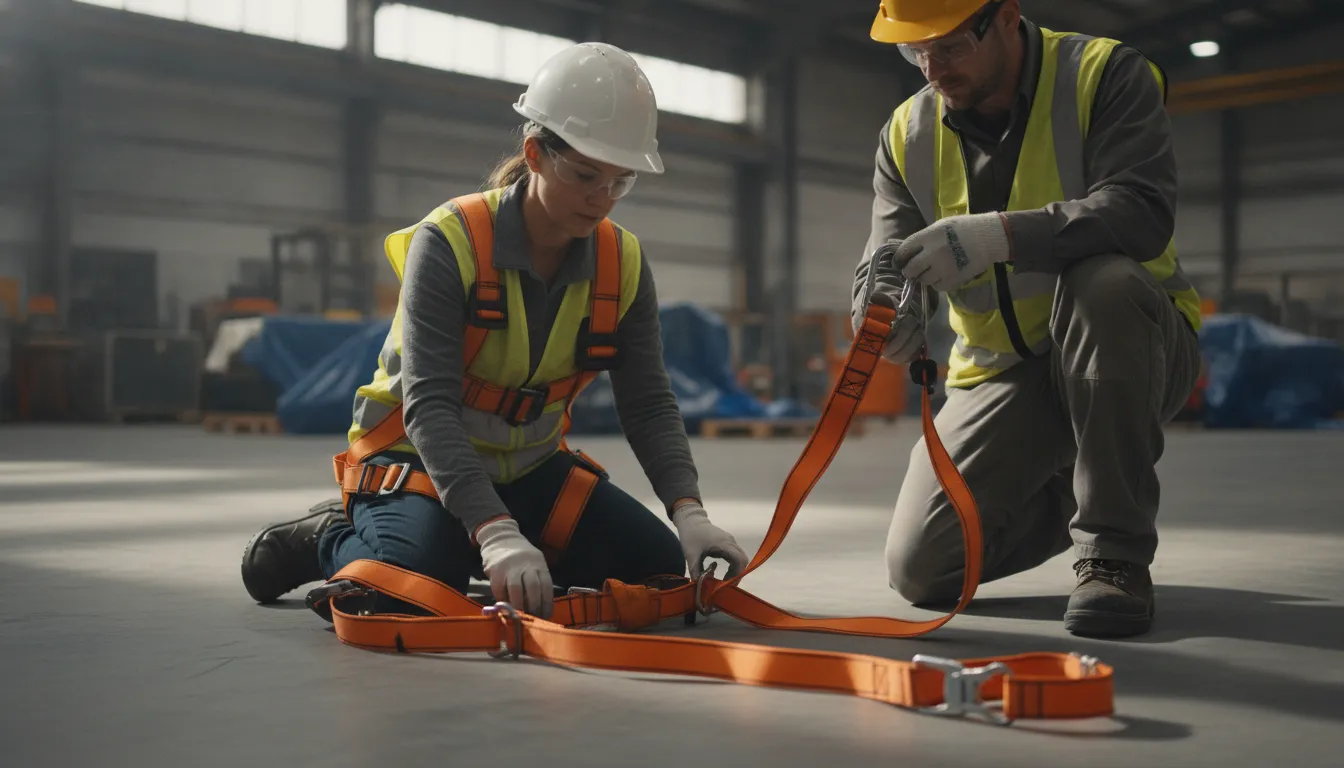
Compare fall protection lanyards for your arrest system
What Training Does OSHA 1926.503 Require?
Answer: Employers must train every employee who may be exposed to fall hazards so the employee can recognize the hazards and follow the procedures used to minimize them. Training must address the relevant systems and procedures, and employees must be retrained when workplace changes or other evidence makes previous training inadequate.
Training should connect the written program to the work employees actually perform. Workers need to understand the location of the hazard, the limits of the selected control. How to inspect and use their equipment, what actions are prohibited, and how to report damaged or incompatible components.
What the training program should cover
- Hazard recognition: Explain edges, holes, leading edges, fragile surfaces, swing-fall zones, and lower-level hazards.
- System use: Demonstrate how to select, don, adjust, connect, and inspect the equipment used on the job.
- System limits: Cover free-fall limits, clearance, anchorage requirements, authorized access, and conditions that require a stop-work decision.
- Care and removal: Explain how to protect equipment from damage and when defective equipment must be removed from service.
- Response: Practice reporting, communication, and rescue steps appropriate to the site.
Retraining is required when changes in the workplace or in the types of fall protection used make prior training obsolete. It is also needed when an employer has reason to believe an employee no longer has the required understanding or skill. Keep the training certification record required by 1926.503(b), including the employee name or identifier, training date, and trainer or employer signature.
What is a competent person?
Under OSHA's construction definitions. A competent person can identify existing and predictable hazards in the surroundings that are unsafe or hazardous to employees and has authorization to take prompt corrective measures. The designation is not merely a title. The person must have job-specific knowledge and real authority to stop work or correct a hazard.
Document who serves as the competent person for each project or activity, what authority the person has, and how workers contact that person. Supervisors should also record inspections, corrections, and changes to the fall protection plan.
Browse full-body harnesses for your fall protection program
How Do ANSI Z359 Standards Support Equipment Selection?
Answer: OSHA 1926 defines regulatory performance requirements, while the ANSI Z359 family provides consensus standards that help buyers specify and evaluate fall protection equipment. ANSI standards do not replace OSHA obligations, so the selected equipment and complete system must still satisfy the applicable OSHA requirements.
Safety managers should avoid treating ANSI language as a substitute for a hazard assessment. Instead, use the relevant standard as part of a written equipment specification. Confirm the product type, intended use, compatibility, capacity, clearance, inspection requirements, and any leading-edge or rescue considerations.
The Z359 family includes standards addressing full-body harnesses, connecting components, shock-absorbing lanyards, self-retracting devices, and broader personal fall protection systems. A buyer may encounter references such as ANSI Z359.11 for full-body harnesses, Z359.12 for connecting components, Z359.13 for energy-absorbing lanyards and lifelines, and Z359.14 for self-retracting devices. Confirm the edition and product marking with the manufacturer or a qualified safety professional before relying on a specific designation.
Equipment selection should follow the job rather than the catalog category. A worker near a leading edge may need a connector specifically rated for that exposure. A worker who must move vertically may need a different lifeline than a worker who moves horizontally. A harness must fit the wearer, and the total system must keep the worker from striking a lower level after deployment.
Safety Company distributes fall protection equipment from vetted brands, including FallTech, Guardian Fall Protection, 3M, and MSA. As a distributor, Safety Company does not manufacture the equipment. Buyers should review each manufacturer's instructions and confirm the complete system is appropriate for the site.
Compare self-retracting lifelines for changing work positions
How Should a Team Inspect and Maintain Fall Protection Equipment?
Answer: Inspect personal fall arrest components before each use and after events that could affect their integrity. Look for cuts, fraying, burns, chemical damage, deformation, corrosion, broken stitching, damaged hardware, illegible labels, and evidence of impact loading. Remove defective or impact-loaded equipment from service until a qualified determination is made.
Inspection must be specific to the component. On a harness, examine webbing, stitching, D-rings, buckles, grommets, labels, and adjustment points. On a lanyard, inspect the energy absorber, connectors, snap hooks, locking mechanisms, webbing, and labels. On a self-retracting lifeline, inspect the housing, lifeline, connector, brake function, labels, and attachment point according to the manufacturer's instructions.
Do not rely on a quick visual glance when the equipment has been exposed to a fall, heat, chemicals, sharp edges, welding spatter, or another damaging condition. Quarantine suspect equipment so it cannot return to service by mistake. Record the inspection result, the inspector, the date, the equipment identifier, and any corrective action required by the program.
Storage also affects service life. Keep equipment away from direct sunlight, moisture, extreme temperatures, chemicals, and sharp objects. Follow the manufacturer's cleaning and storage instructions. OSHA does not set one universal expiration date for every harness or lanyard. Retirement decisions should follow the manufacturer's instructions, the equipment condition, impact history, inspection findings, and the direction of a qualified person.
When Is a Written Fall Protection Plan Required?
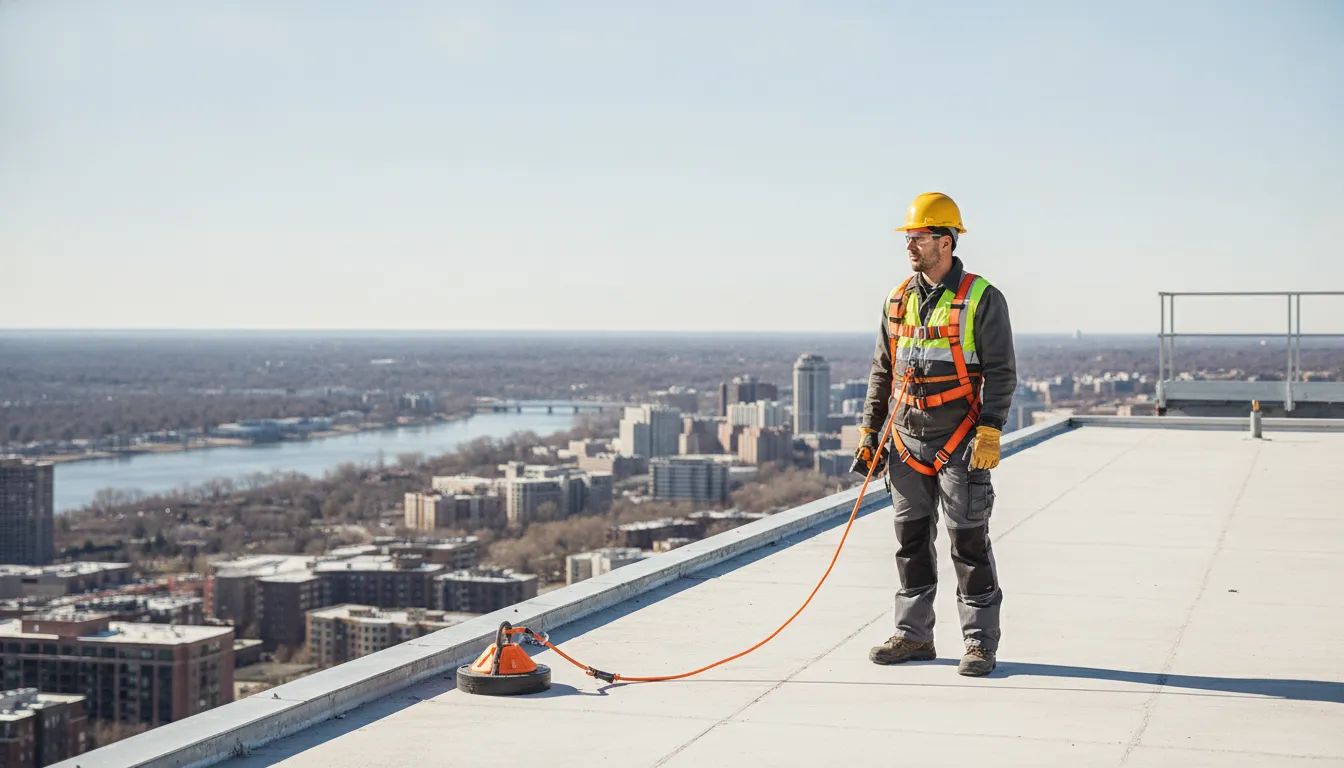
Answer: A written fall protection plan under 1926.502(k) is a limited alternative for certain leading-edge and residential construction situations when conventional systems are infeasible or create a greater hazard. The employer must prepare the plan under the direction of a qualified person and keep it available at the jobsite.
Conventional fall protection remains the normal path. A written plan cannot be used simply because a guardrail, net, or personal fall arrest system is less convenient. The employer must explain why conventional systems are infeasible or would create a greater hazard, identify the alternative measures used, and ensure the plan is implemented and supervised.
The plan should identify the work area, fall hazards, tasks, alternative controls, safety-monitoring responsibilities, training, enforcement, and the qualified person directing the plan. Review it when the work sequence, crew, weather, structure, or equipment changes. If conventional protection becomes feasible, use it.
Keep the plan practical. Workers should be able to identify the controlled area, know who can enter, understand what they may and may not do, and know how to report a change. A plan that cannot be understood in the field is not an effective control.
How Can Safety Managers Build a Fall Protection Compliance Program?
Answer: Build the program around a repeating cycle of hazard assessment, system selection, installation, training, inspection, rescue readiness, and documentation. Recheck the cycle whenever the work area, crew, equipment, or construction phase changes.
- Survey the work: Map edges, openings, leading edges, hoist areas, roofs, scaffolds, ladders, and lower levels before assigning the task.
- Apply the regulation: Match each exposure to the applicable 1926.501 provision and confirm whether a specific activity has additional requirements.
- Use the strongest practical control: Prefer a properly installed passive system when it fits the hazard, then select a complete personal system when mobility or site conditions require it.
- Verify installation: Check dimensions, loads, anchor locations, clearances, access points, and compatibility before releasing the area for work.
- Train and brief the crew: Explain the hazard, the equipment, the boundaries, the inspection steps, and the response plan in language workers understand.
- Inspect and correct: Require pre-use inspections and competent-person reviews. Correct hazards promptly and record the action.
- Plan for rescue: Identify how a fallen worker will be reached, lowered, or otherwise recovered. Assign communication and equipment responsibilities.
- Audit the records: Keep the hazard assessment, training records, inspection reports, equipment information, written plan when applicable, and corrective actions together.
Use a daily start-of-shift review for changing work areas and a more formal review at each construction phase. Include procurement personnel in the review so replacement equipment does not introduce incompatible connectors, incorrect sizes, or unapproved substitutions.
What Common Fall Protection Mistakes Should Employers Avoid?
Answer: The most preventable failures involve treating a product as a complete system, overlooking changing exposures. Skipping pre-use inspections, using an unsuitable anchorage, failing to train workers, and having no prompt rescue method. A strong program checks these risks before work begins.
- Buying a harness without the system: A harness does not provide arrest protection without a compatible connector, suitable anchorage, adequate clearance, and a rescue plan.
- Using the wrong connector: A lanyard or self-retracting device must match the task, fall direction, clearance, anchorage, and leading-edge conditions.
- Assuming one measurement solves the hazard: The 6-foot threshold does not replace an assessment of openings, fragile surfaces, swing falls, lower-level obstructions, or changing work.
- Ignoring fit and adjustment: A poorly fitted harness can affect comfort, movement, attachment position, and performance during a fall.
- Leaving damaged equipment in circulation: Quarantine equipment after a fall or when inspection identifies damage. Do not let a suspect component return to a communal equipment area.
- Relying on a warning line alone: Use the control only where the regulation permits it and combine it with the required measures for the activity.
- Training once and never revisiting the topic: Retrain when the workplace, equipment, procedures, or worker performance indicates that previous training is no longer adequate.
- Planning rescue after the fall: A personal fall arrest system can stop a fall, but the program must also address prompt rescue or self-rescue where appropriate.
Use these mistakes as audit prompts. Ask the competent person to select one work area each week, trace the system from hazard to rescue, and record any corrective action. This turns compliance from a paperwork exercise into a visible operating practice.
Review fall protection equipment options for your next job hazard assessment
Frequently Asked Questions
Answer: OSHA 1926 fall protection decisions depend on the work activity, exposure, height, selected system, training, inspection, and rescue plan. The questions below summarize common starting points, but employers should review the full regulatory text and applicable manufacturer instructions for each job.
What is the OSHA 1926 fall protection height requirement?
For many construction exposures, OSHA requires protection at 6 feet or more above a lower level when an employee is exposed to an unprotected side or edge. Other provisions address specific activities and hazards. Apply the rule to the actual work surface and consult the applicable 1926.501 subsection.
What does OSHA 1926 Subpart M cover?
Subpart M covers fall protection requirements and criteria for construction work. It includes duties to provide protection, guardrails, safety nets, personal fall arrest systems, training, fall protection plans, and related work-area controls.
What is the difference between OSHA 1910 and 1926 fall protection?
OSHA 1926 generally applies to construction work, while OSHA 1910 generally applies to general industry. The applicable standard depends on the work and workplace. Do not apply a construction provision to a general-industry task, or vice versa, without confirming the governing standard.
Are guardrail systems required under OSHA 1926?
Guardrails are one permitted fall protection option, but they are not required for every exposure when another system allowed by the applicable provision is suitable. Guardrails must meet the performance and construction criteria in 1926.502 and must be maintained while the exposure exists.
When is fall protection training required under 1926.503?
Employers must train each employee who may be exposed to fall hazards. Training must help workers recognize hazards and follow procedures that minimize them. Retraining is required when changes or worker performance make previous training inadequate.
What should employers do after a fall arrest event?
Provide or activate the planned rescue response, obtain medical evaluation as appropriate, secure the area, and remove involved fall arrest components from service. A competent or qualified person should evaluate the equipment and determine whether it may be returned to service. Follow the manufacturer's instructions and the employer's incident procedure.
Review how a personal fall arrest system works before selecting components.
Get Started With Compliant Fall Protection Equipment
Choosing equipment that aligns with OSHA requirements and applicable ANSI standards can support a more consistent fall protection program. Safety Company supplies harnesses, lanyards, self-retracting lifelines, anchorage equipment, and related safety products from vetted brands for US workplace buyers. Product selection should always be matched to the job hazard assessment, the complete system, worker fit, manufacturer instructions, and the site's rescue plan.
Call 1-800-310-7233 to discuss fall protection equipment for your work environment
Recent Posts
-
Cut Gloves: How to Choose the Right ANSI Level
A hand-protection program works best when it starts with the task, not a product label. A packaging …Oct 5th 2026 -
Kevlar Gloves. Cut, Heat, and Task-Specific Selection
Choosing hand protection by material name alone can leave a serious gap in your safety program. Star …Oct 2nd 2026 -
Face Shield for Grinding: Selection and Safety Guide
Grinding can send fragments, sparks, dust, and other debris toward a worker's face in an instant. Th …Sep 30th 2026