
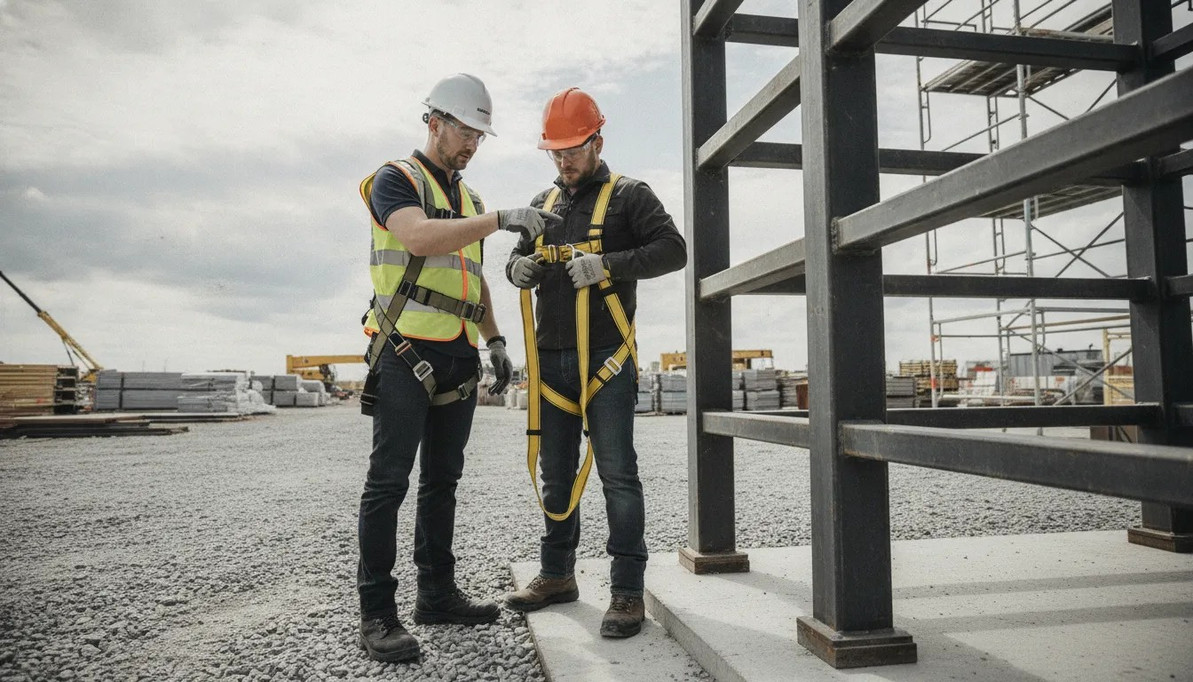
Safety Harness Guide: Fit, Inspection, and Fall Protection
A fall-protection harness is not a standalone solution. Its effectiveness depends on how well it works with the anchorage, connector, lanyard or lifeline, and the employer's rescue plan. Choosing equipment by appearance or comfort alone can leave critical compatibility and inspection questions unanswered.
A safety harness is a wearable component of a personal fall-protection system that helps distribute fall-arrest forces across the body while allowing the worker to move. OSHA identifies the body harness, anchorage, lifeline or lanyard, and connectors as system components. The exact combination must match the task, applicable requirements, and current manufacturer instructions.
For employers and workers, the safest starting point is to understand what the harness does during a fall. It is also important to understand how its attachment points connect to the rest of the system. That foundation makes later decisions about compliance, fit, inspection, care, and replacement more practical.
Review fall protection equipment for your workplace
What Does a Safety Harness Do in a Fall-Protection System?
A safety harness is the body-worn part of a personal fall-protection system. Its job is to help minimize stress forces on the worker during a fall while allowing enough freedom of movement to perform the task. It is not designed to stop a fall by itself, and wearing one does not make an otherwise incomplete setup safe.
A complete system typically brings together several coordinated components:
- Harness: The worker wears the harness, which distributes arrest forces through the body rather than concentrating them at a single belt or strap. OSHA distinguishes a body harness from a body belt because body belts are not acceptable as part of a personal fall arrest system.
- Anchorage: This is the secure attachment point for a lanyard, lifeline, or deceleration device. The anchorage must be appropriate for the work and compatible with the rest of the system.
- Connector: Connectors couple system components. Depending on the design, this may include snap hooks, carabiners, or other approved connection hardware.
- Lanyard or lifeline: This connects the harness to the anchorage and may incorporate energy absorption or automatic fall-arrest functions. The selected device must match the task and the harness attachment point.
- Rescue planning: The employer needs a practical response for a worker who falls and remains suspended. A harness is not a rescue plan, and the plan should be established before work begins.
Attachment location also matters. OSHA guidance states that a body-harness attachment should be centered on the wearer's back near shoulder level or above the head. That guidance does not mean every D-ring has the same purpose. A harness may have attachment elements intended for different applications, so workers should use each point only as described in the product instructions.
For a closer explanation of how these parts work together, review the fall arrest system components. Before selecting equipment, the employer should evaluate the work area, fall hazards, anchorage, connection method, clearance, and rescue procedure. Confirm compatibility with the exact manufacturer's instructions and the employer's fall-protection program. A harness is an important part of protection, but its performance depends on the entire system around it.
How Do OSHA Requirements Apply to Safety Harness Use?
OSHA requirements for a safety harness depend on the work setting, the exposure, and the complete fall-protection system. Employers should begin with the current federal regulation that applies to the job, then account for any state-plan requirements, the employer's written program, and the exact manufacturer's instructions. A harness is not automatically compliant simply because it is labeled for fall protection.
How does general industry differ from construction?
In general industry, personal fall-protection systems must meet the applicable performance, care, and use criteria in OSHA 1910.140. The employer is responsible for ensuring that each system used by employees meets the applicable requirements and is appropriate for the work. That responsibility includes planning the system before work begins, identifying suitable anchorages, and selecting equipment for the employee's specific work situation.
Construction work is governed by the applicable requirements in 29 CFR Part 1926, including OSHA 1926 requirements for fall-protection systems. OSHA explains that personal fall arrest is one protection option for construction workers exposed to vertical drops of 6 feet or more. NIOSH also uses 6 feet or more as a general construction reference. That figure should not be treated as a universal rule for every task, industry, or jurisdiction. The specific regulation, exception, work activity, and site conditions control.
What does the employer need to verify?
Before issuing a safety harness, the employer should evaluate the full system, including the harness, lanyard or lifeline, connectors, anchorage, and rescue arrangements. OSHA identifies these as components of a personal fall arrest system. The selected system should fit the work and keep free-fall distance to a minimum. Compatibility cannot be determined from the harness alone or from a generic equipment chart.
Employers should also provide training, establish procedures for inspection and use, and ensure that required systems are available and installed before applicable construction work begins. A competent or qualified person may need to evaluate hazards, system design, and installation. Do not use a body harness to hoist materials. And do not substitute a body belt for a personal fall arrest harness where the applicable standard does not permit it.
For practical reference, review the OSHA fall protection standard, then confirm the current regulation, state plan, employer program, and manufacturer instructions before work starts. Those sources, applied to the actual task, determine how the equipment must be selected and used.
How Should Employers Choose the Right Safety Harness and Connectors?
Start with the work, not the product name. A harness selected for routine fall arrest may not provide the attachment points or configuration needed for ladder climbing, work positioning, confined-space retrieval, descent, or suspension. Manufacturers list these as distinct application types. So the employer should match the equipment to the task and then verify the complete system with current instructions and a qualified person.
| Work need | Attachment or connector consideration | What to verify before use |
|---|---|---|
| General fall arrest | A back D-ring is commonly used for fall arrest. | Confirm the lanyard or lifeline, anchorage, and attachment point are approved for the exact harness model. |
| Ladder climbing | A front attachment may be designed for a ladder-climbing system. | Follow the harness and climbing-system instructions; do not substitute a different D-ring because it is convenient. |
| Work positioning | Hip D-rings may support a positioning device and hands-free work. | Confirm that positioning is not being used as fall arrest and that the system has the required backup protection. |
| Confined-space rescue | Shoulder D-rings may facilitate upright retrieval on a compatible rescue system. | Coordinate the harness, retrieval equipment, entrant profile, and documented rescue plan. |
The connector must also suit the anchorage and the movement pattern. Review whether the system uses a shock-absorbing lanyard, self-retracting lifeline, or another connector, and check the manufacturer's compatibility instructions. Never connect a snap hook directly to webbing, rope, wire rope, another snap hook. Or a D-ring that already carries another connector unless the equipment is specifically designed for that connection. The NIOSH checklist also emphasizes reviewing the system's documented tensile-load performance rather than assuming that one strength figure applies to every configuration.
What should an employer confirm before issuing the equipment?
- Identify the task, fall exposure, work position, movement, environment, and likely rescue method.
- Select a harness with attachment points intended for that application, then match the connector and anchorage to the same system instructions.
- Check for hazards such as sharp edges, welding, chemicals, heat, oil, or abrasion that could damage webbing or connectors.
- Calculate required clearance for the exact setup, including anchorage location, connector length, deceleration, harness movement, and worker height. Do not rely on a generic distance.
- Confirm labels, model information, training, inspection procedures, and a prompt rescue plan are in place before work begins.
Review fall protection equipment for harnesses, connectors, anchorages, lifelines, and rescue equipment that can be evaluated as a complete system.
SafetyCompany.com distributes equipment from multiple established brands, but the distributor does not replace the employer's hazard assessment or the manufacturer's instructions. Compare the documentation for each candidate, and choose full-body safety harnesses only after confirming the attachment point, connector, anchorage, clearance, and rescue requirements for the specific job.
How Should a Worker Fit and Adjust a Full-Body Safety Harness?
A full-body harness should fit snugly, keep each strap routed correctly, and leave the designated attachment point in the position specified by the manufacturer. Fit is not a matter of tightening every strap as much as possible. The harness must support the body as designed while allowing the worker to perform the task without loose, twisted, or misplaced webbing.
Use the exact product manual and employer procedure, and have fitting performed or supervised by a trained person. Check the harness over the clothing the worker will actually wear on the job. A fit that works over a light shirt may change when layers, seasonal workwear, or other required PPE are added.
- Inspect before donning. Confirm that the harness is the correct model for the task and that its webbing, stitching, buckles, adjusters, D-rings, labels, and energy-absorbing components are present and serviceable. Do not use equipment with damage, missing identification, or signs of a previous fall. Set the harness aside and follow the employer's removal-from-service process if anything is questionable.
- Orient the harness. Hold it by the designated dorsal attachment point and separate the shoulder, torso, and leg straps. Identify the front and back before putting it on. Untangle every strap and route it according to the manual. Twists can change how the harness bears force and can interfere with adjustment.
- Put on the shoulder and torso straps. Place the shoulder straps over the shoulders, then connect and adjust the torso or chest components as the design requires. Route loose webbing through the keeper or retainer provided. Adjust both sides evenly so the harness sits centered rather than pulling to one side.
- Adjust the leg straps. Bring each leg strap into its correct position, connect the buckle, and adjust it until the strap is secure without restricting normal movement. Check that the straps are not crossed or caught under other components. Use the manual's buckle instructions because tongue, pass-through, and quick-connect hardware do not all secure the same way.
- Confirm the attachment point. For fall-arrest use, verify that the designated attachment point is centered on the back near shoulder level or above the head, as OSHA's guidance describes. Other D-rings may be intended for positioning, ladder climbing, retrieval, or descent. Never choose an attachment point based on convenience or a generic illustration. Confirm the intended use in the exact manual.
- Secure and complete a partner check. Verify every buckle is fully engaged, each adjuster is locked as designed, and excess webbing is controlled. Have a trained partner check strap routing, snugness, attachment-point location, and visible hardware. Comfort can support consistent use, but it does not prove compatibility or compliance.
- Perform a movement check. Walk, bend, reach, climb, and assume the work position while remaining in a controlled area. Confirm that straps stay routed, buckles remain secure, and the harness does not shift into a position that conflicts with the task or connector. Correct the fit before connecting to the rest of the fall-protection system.
OSHA describes body harnesses as equipment intended to minimize stress forces while providing sufficient freedom of movement for work. That result depends on proper fitting, compatible equipment, training, and following the current manufacturer instructions, not on a universal size rule. Source: OSHA fall-arrest guidance.
What Should a Safety Harness Inspection Checklist Include?
A safety harness inspection should be a deliberate check of every load-bearing and identification component, not a quick glance before climbing. The user should follow the current manufacturer instructions and the employer's fall-protection program. A competent person must be able to recognize existing and predictable hazards and take prompt corrective action. If the condition or history of the equipment is uncertain, remove it from service until a qualified evaluator determines whether it can be returned.
Webbing and stitching
Run the webbing through your hands while inspecting it in good light. Look and feel for cuts, nicks, tears, broken fibers, fraying, abrasion, discoloration, hard or shiny spots, and uneven thickness. Hard, shiny, burnt, charred, or melted fibers can indicate heat damage. Uneven webbing thickness may indicate that the harness experienced a fall. Inspect every stitched area for pulled, missing, cut, hard, or shiny stitches. Because some damage may not be visible, a touch inspection matters as much as a visual inspection. The OSHA harness inspection guide identifies these conditions as reasons for careful evaluation and removal when appropriate: review the inspection indicators.
Hardware and connectors
Examine D-rings, buckles, adjusters, keepers, snap hooks, and other connectors for distortion, twists, bends, sharp edges, cracks, breaks, rust, and corrosion. Operate buckles and adjusters as directed by the product manual. A tongue buckle should overlap its frame and move freely in its socket. Check that connectors close and lock correctly, without forcing a mechanism or attempting an improvised repair. Inspect the entire connected system as well, since a sound harness does not make a damaged lanyard, lifeline, or anchorage acceptable.
Labels and energy absorbers
Confirm that every required label or tag is present and legible. It should identify the harness, model, manufacturer, manufacture date, limitations, and warnings. If the tagging system is missing or unreadable, remove the harness from service rather than guessing its identity or instructions. Inspect any energy-absorbing lanyard, integrated absorber, or fall indicator according to the manufacturer. Do not open, reset, alter, or conceal an energy absorber. A deployed indicator or suspected impact requires evaluation of the harness and the affected components before any possible reuse.
Contamination and alterations
Look for oil, grease, paint, chemicals, dirt, moisture damage, mildew, heat exposure, or other contamination that could affect the materials. Do not assume that washing removes chemical damage. Follow the manufacturer's approved cleaning method, detergent, drying process, and storage conditions. Reject unauthorized stitching, holes, knots, added hardware, cut straps, or other alterations. OSHA specifically cautions that body harnesses are not material-hoisting equipment, so do not repurpose one for lifting loads: review OSHA fall-arrest equipment guidance.
Documentation and tag-out
Record the inspection according to the employer's procedure, including the equipment identifier, inspection date, inspector, findings, and action taken. Do not invent a universal inspection interval; the competent person, employer program, applicable requirements, and manufacturer instructions control. Tag the equipment out immediately when you find damage, missing identification, failed hardware, contamination that cannot be evaluated, an unauthorized alteration, or any suspected fall arrest. Separate it from service equipment and clearly mark it so no one can accidentally use it. Keep it out of service pending the manufacturer's required evaluation or replacement decision. A checklist supports the process, but it does not replace a site-specific assessment or the judgment of a competent person.
How Do You Plan for Fall Clearance, Suspension, Rescue, and Care?
Fall clearance is a system calculation, not a standard number copied from a product page. Before work begins, the employer should evaluate the exact equipment and work area, including lanyard or lifeline length. Deceleration distance, harness stretch, worker height, anchorage position, connector configuration, and the distance to the next lower level. The selected system should fit the work situation and keep free-fall distance to a minimum. OSHA emphasizes planning before personal fall-protection systems are used, including locating suitable anchorage points. See the current OSHA planning guidance and follow the manufacturer's clearance calculation for the specific system.
Account for swing-fall exposure and obstructions as well as vertical clearance. A harness, lanyard, or self-retracting lifeline can be correctly labeled and still be unsuitable for an anchorage location or task. A competent or qualified person should review the complete arrangement, confirm compatibility, and document the assumptions used in the calculation. Do not replace that review with a generic clearance distance.
How should a suspension rescue plan be prepared?
Rescue should be planned before anyone connects to the system. OSHA requires an employer to provide a means for promptly rescuing an employee after a fall. The plan should identify who calls for help, who is trained and authorized to perform the rescue. What rescue equipment is available, how rescuers will reach the worker, and how the area will be controlled during the response. It should also address a worker who cannot self-rescue, restricted access, medical response, and communication failures.
Do not assume that a standard safety harness by itself provides rescue capability. Some harnesses and attachment points are designed for particular retrieval, descent, or positioning applications, while others are not. Verify the intended use in the exact manufacturer's instructions. Coordinate the harness, connectors, anchorage, rescue equipment, and task as one fall-protection system. Practice the procedure under the employer's program so a real response does not depend on improvised connections.
What happens after a fall or suspected impact?
Remove a harness and any affected lanyards, lifelines, connectors, or energy-absorbing components from service after a fall arrest or suspected impact. Identify and isolate the equipment so it cannot be issued accidentally. Follow the manufacturer's inspection, replacement, and return-to-service process. Equipment should not be returned to work based only on its appearance. And a worker should not make a final disposition without the required competent or qualified person and manufacturer guidance.
How should a safety harness be cleaned and stored?
Use the product instructions first, especially when the harness has contacted chemicals, paint, oil, grease, welding sparks, or other contaminants. For surface dirt, OSHA inspection guidance describes using a water-dampened sponge and a mild detergent solution. Hang the harness freely to dry away from excessive heat, steam, and long periods of sunlight. Do not apply unapproved solvents, bleach, heat, or aggressive scrubbing that could damage webbing, stitching, labels, or hardware.
Store clean, dry equipment where it is protected from fumes, heat, ultraviolet light, direct sunlight, and corrosive elements. Keep harnesses away from batteries because leaking chemicals can attack the material. Maintain an equipment record with the assigned user or location, inspection findings, cleaning or contamination notes, impact status, and disposition. Use the manufacturer's required records and inspection schedule rather than inventing a universal interval.
Review full-body safety harnesses for your fall-protection system
Frequently Asked Questions
What is a safety harness?
A safety harness is wearable fall-protection equipment designed to distribute fall-arrest forces across the body while allowing the worker to move. It is one component of a complete system that also requires compatible connectors, an anchorage, and a task-specific plan. OSHA identifies the body harness, lifeline or lanyard, anchorage, and connectors as parts of a personal fall arrest system. OSHA explains these system components.
What is the OSHA safety harness rule?
There is not one universal rule that makes every harness suitable for every job. Employers must select and use a personal fall-protection system that meets the applicable OSHA requirements, fits the work, and follows current manufacturer instructions. For construction, OSHA generally requires personal fall arrest protection when workers face vertical drops of 6 feet or more. State, employer, site, and activity-specific requirements may also apply. Review OSHA's construction fall-arrest guidance.
Which safety harnesses are OSHA approved?
OSHA does not provide a blanket approval list that makes a harness appropriate for every application. Confirm the exact model's labels, instructions, intended use, and applicable performance requirements. Then verify compatibility with the lanyard or lifeline, anchorage, and rescue plan. A competent or qualified person should evaluate the complete system for the specific task.
What is the most comfortable safety harness?
The best fit depends on the worker's body, clothing, movement, work position, and required attachment points. Choose a properly sized model, adjust every strap according to its instructions, and check that the webbing is snug, correctly routed, and free of twists. Comfort can support consistent wear, but it does not prove compatibility, compliance, or adequate protection.
When should a safety harness be removed from service?
Remove a harness from service when it has cuts, burns, abrasion, chemical damage, damaged stitching or hardware, missing or illegible labels, unauthorized alterations, or suspected fall impact. OSHA inspection guidance says a missing or illegible tagging system is a reason to remove the harness from service. Identify the equipment and follow the manufacturer's inspection, replacement, and post-fall procedures before considering a return to service. See OSHA's harness inspection guide.
Ready to Review Your Fall-Protection Equipment?
Choosing a full-body safety harness is only one part of building a compatible fall-protection system. Reviewing harness features alongside the task, connectors, anchorage, and employer procedures can help your team ask better product-compatibility questions before work begins.
Review full-body safety harnesses and fall-protection equipment
Contact the Safety Company safety equipment team if you need help comparing options for your workplace.
Recent Posts
-

Safety Harness for facility and field teams
A safety harness is one part of a fall-protection decision, not a stand-alone answer to every work-a …Oct 22nd 2026 -
Ear Protection: Plugs, Muffs, and Communication
Choosing ear protection for a workplace is not just a matter of picking the product with the highest …Oct 21st 2026 -

Workplace Planning with Bump Cap vs Hard Hat
When weighing bump cap vs hard hat, start with the hazard, not the appearance, comfort, or price of …Oct 21st 2026