
How to Choose a Respirator Mask for Workplace Safety
The right respirator mask is the NIOSH Approved model and configuration selected for the specific contaminant, concentration, oxygen level, task, and worker. Start with a documented hazard assessment, then confirm the filter or cartridge, facepiece fit, fit-testing requirement, and OSHA respiratory protection program before use.
Explore respirators for workplace protection
Choosing respiratory protection is not simply a matter of picking the mask that feels most comfortable or has the highest filter rating. A disposable filtering facepiece can be appropriate for some particulate hazards, while a reusable half-mask respirator, full-face respirator, powered air-purifying respirator, or atmosphere-supplying respirator may be needed for a different hazard. This guide gives US workplace buyers a practical framework for selecting and managing respiratory protection. It does not replace a qualified program administrator, medical evaluation, fit test, safety data sheet, or site-specific hazard assessment.
What does a respirator mask protect against?
A respirator mask protects the wearer only when its facepiece, air-purifying element, and approval are matched to the hazard. Particulate respirators address particles such as dust, mist, smoke, and some fumes. Gas and vapor cartridges use sorbent materials designed for specific contaminants. No single respirator protects against every airborne hazard.
Before selecting equipment, identify the contaminant and how it is generated. Review the safety data sheet, process information, exposure monitoring, and applicable OSHA substance-specific requirements. Record the expected concentration, duration of exposure, task conditions, temperature, humidity, visibility needs, communication needs, and other PPE that could interfere with the seal or field of vision.
- Dusts and mists: Consider an approved particulate filter selected for the hazard and exposure level.
- Metal fumes and other fumes: Confirm that the particulate filter is approved for the specific application and process.
- Gases and vapors: Use a cartridge or canister approved for the named contaminant. An N95 alone is not a gas or vapor solution.
- Combined hazards: Select an approved combination assembly when both particulate and gas or vapor protection are required.
- Unknown, oxygen-deficient, or IDLH atmospheres: Do not use an air-purifying respirator as a shortcut. The respiratory protection program must specify an appropriate atmosphere-supplying option.
OSHA's 29 CFR 1910.134 respiratory protection standard requires employers to evaluate workplace hazards, consider workplace and user factors, and select respirators that are appropriate for the intended purpose. Engineering and work-practice controls remain the preferred way to reduce atmospheric contamination when feasible.
Which type of respirator mask fits the job?
The facepiece determines how the respirator fits, what it can cover, and how it interacts with other PPE. The filter or cartridge determines which contaminants it is approved to address. Treat these as two separate selection decisions, then confirm that the complete assembly is approved for the intended use.
| Respirator type | Typical workplace role | Key selection checks |
|---|---|---|
| Filtering facepiece respirator | Shorter-duration particulate work, when the approved model matches the hazard | Particle class, approval number, seal, fit test, and replacement instructions |
| Elastomeric half-mask | Reusable protection for particles, gases, vapors, or combinations when equipped correctly | Approved facepiece and compatible filters or cartridges, fit, cleaning, and storage |
| Full-face respirator | Respiratory protection with eye coverage for compatible hazards | Contaminant, cartridge or filter, lens visibility, seal, fit test, and other eye protection needs |
| Powered air-purifying respirator | Filtered airflow for selected hazards and users who need a different fit or comfort approach | Configuration approval, battery and airflow checks, hood or facepiece type, and program requirements |
| Atmosphere-supplying respirator | Hazards where ambient air cannot be adequately purified, including specified emergency conditions | Breathing-air source, emergency procedures, training, and the written respiratory protection program |
A loose-fitting face covering is not equivalent to a tight-fitting respirator. The CDC and NIOSH comparison of respirator and mask types explains that NIOSH Approved filtering facepiece respirators such as N95 models protect against particles, not gases or vapors. Elastomeric respirators can address particles, gases, and vapors only when fitted with the appropriate approved element.
When is an N95 respirator mask appropriate?
An N95 is a NIOSH filter classification for a particulate filtering facepiece respirator. The N means it is not resistant to oil, and 95 refers to the minimum filtration efficiency for the test particles under the NIOSH approval standard. It does not mean the respirator removes every contaminant, protects against chemical vapor, or fits every worker.
Use the exact NIOSH approval information and the manufacturer's user instructions to confirm the intended application. A higher-looking number is not a substitute for selecting the correct contaminant control. For oil-containing aerosols, the program administrator must determine whether an R or P class filter, or another approved configuration, is required. Never substitute a consumer face mask or an unverified product for required workplace respiratory protection.
Compare disposable and reusable respirator options
How do OSHA and NIOSH requirements affect selection?
OSHA sets the employer's respiratory protection duties, while NIOSH approval identifies respirators that meet the applicable performance and quality requirements for a configuration. When respirator use is required, the employer needs a written, worksite-specific respiratory protection program administered by a suitably trained program administrator.
At a minimum, selection should be coordinated with the program's requirements for:
- Workplace hazard evaluation and exposure assessment.
- Engineering and work-practice controls before relying on respirators.
- Medical evaluation before an employee is fit tested or required to use a respirator.
- Fit testing for tight-fitting facepieces, using the same make, model, style, and size the employee will wear.
- Training on use, limitations, donning, doffing, seal checks, maintenance, and emergency procedures.
- Inspection, cleaning, storage, and replacement according to the program and manufacturer instructions.
- A review whenever the process, contaminant, exposure, respirator, or worker condition changes.
OSHA's assigned protection factor table is one part of the selection decision. It should not be used to choose a respirator without first identifying the contaminant, measured or estimated concentration, and whether the atmosphere is safe for an air-purifying device. If the hazard is unknown or the atmosphere is immediately dangerous to life or health, use the emergency and IDLH procedures in the written program rather than making an informal product substitution.
The NIOSH respirator selection guidance reinforces that employers are responsible for selecting an appropriate NIOSH Approved respirator and using it within a complete respiratory protection program.
What does a proper respirator fit process include?
Fit is a performance requirement, not a preference. A tight-fitting respirator cannot provide its expected protection when air leaks around the face seal. OSHA requires an appropriate qualitative or quantitative fit test before an employee uses a tight-fitting facepiece in the required program and at least annually thereafter. A new fit test is also needed when the employee changes to a different make, model, style, or size, or when a physical change could affect the seal.
Fit-testing checklist for employers
- Complete the required medical evaluation before fit testing or required use.
- Use the same respirator make, model, style, and size intended for the job.
- Offer a sufficient number of models and sizes so the worker can obtain an acceptable fit.
- Use an OSHA-accepted qualitative or quantitative test appropriate to the respirator.
- Keep facial hair, stubble, eyewear, headgear, and other items from interfering with the seal.
- Teach the worker to don the respirator exactly as instructed by the manufacturer.
- Require a user seal check every time a tight-fitting respirator is donned.
- Retest after a facial or dental change, significant weight change, or other condition that could change fit.
A successful fit test belongs to the tested facepiece configuration. It does not automatically transfer to another model, size, or style. Fit testing also does not prove that a cartridge protects against a particular chemical. The facepiece and air-purifying element must both be correct.
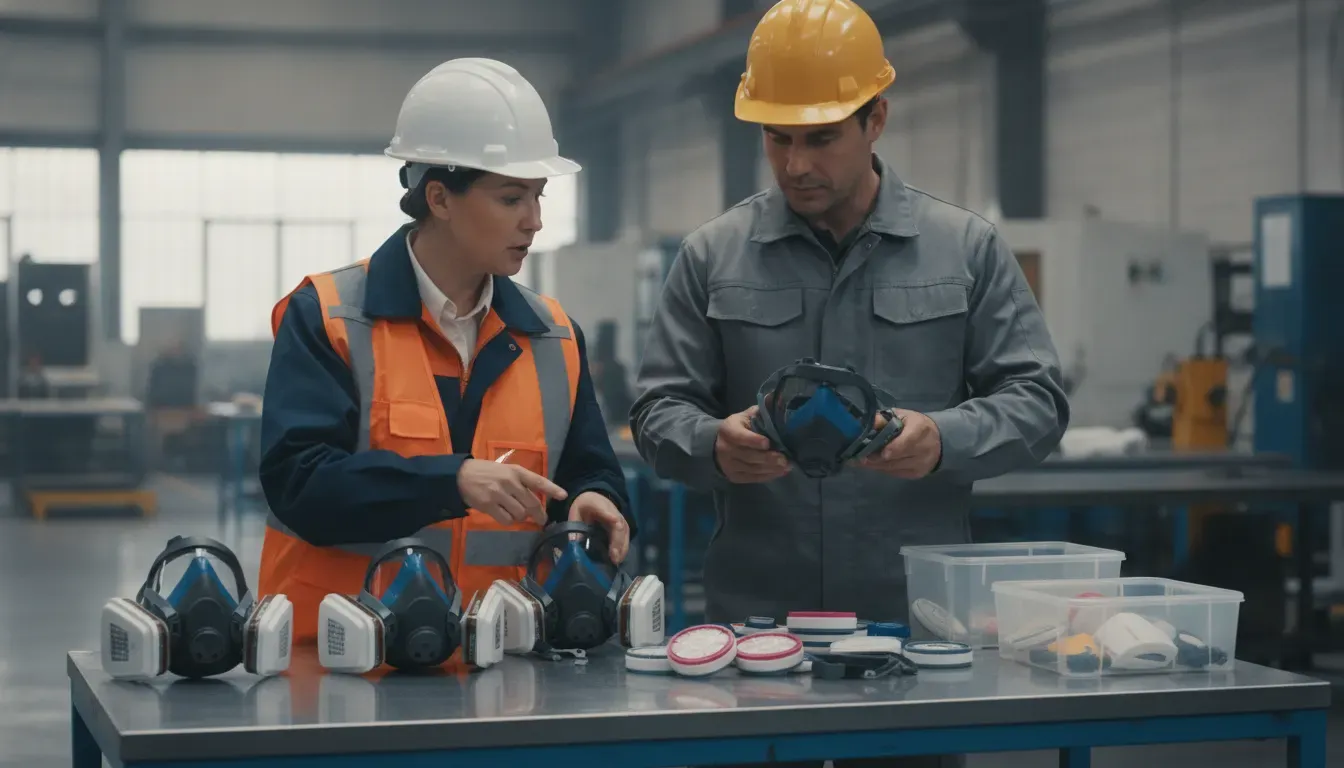
How should workplaces choose filters and cartridges?
Particulate filters and gas or vapor cartridges solve different problems. Read the complete approval information and manufacturer instructions for the specific respirator assembly. Do not assume that a cartridge from one product family fits another facepiece, or that a filter with a familiar label protects against a solvent, pesticide, disinfectant, or other vapor.
- Particulate filters: Match the N, R, or P class and efficiency level to the oil conditions and particulate hazard identified by the program.
- Gas and vapor cartridges: Select for the named contaminant and approved concentration limits. A cartridge for one vapor is not a universal chemical cartridge.
- Combination elements: Use when the complete approved configuration addresses both particulate and gas or vapor hazards.
- Change schedules: Establish a written schedule using reliable service-life information, workplace conditions, and a conservative safety factor.
- Storage and condition: Keep cartridges sealed and stored as directed. Moisture, temperature, contaminant concentration, breathing rate, and intermittent use can affect service life.
Employers should not rely on odor or irritation as the primary signal that a gas or vapor cartridge needs replacement. OSHA's respirator change-schedule eTool describes experimental testing, manufacturer recommendations, and mathematical modeling as ways to estimate service life. The resulting schedule belongs in the written program and should be reviewed when conditions change.
How does the workplace change the selection?
The same word, respirator mask, can describe different protection needs in different operations. Use the process and contaminant, not the industry label alone, to make the selection.
Industrial facilities
Manufacturing and maintenance tasks may create dust, metal fumes, mists, or solvent vapors. Match the element to the process and exposure assessment. Confirm compatibility with welding, grinding, coatings, confined-space work, eye protection, hearing protection, and communication requirements. A reusable facepiece may be practical for repeated work, but only when its filters and cartridges are approved for the hazards.
Construction sites
Construction respiratory hazards can include silica-containing dust, wood dust, coatings, welding fumes, and demolition contaminants. Conditions can change rapidly, so the employer should reassess tasks, ventilation, exposure controls, and the required respirator as work progresses. A disposable particulate respirator is not a universal construction respirator and does not address chemical vapors.
Laboratories
Laboratory buyers should begin with the chemical inventory, safety data sheets, process controls, and the institution's respiratory protection program. Chemical vapor, particulate, biological, and oxygen-related hazards require different decisions. A full-face respirator may help with eye exposure for a compatible hazard, but it is not automatically suitable for every laboratory release or emergency.
Food-processing plants
Food-processing operations may involve flour or spice dust, cleaning chemicals, sanitation vapors, and confined or wet environments. Select respiratory protection around the actual task and chemical, while coordinating it with hygiene procedures, face-seal requirements, eye protection, and the site's food-safety program. Do not describe a respirator as food-safe or FDA-approved unless the exact product documentation supports that statement.
How should respirators be maintained and replaced?
Maintenance keeps a selected respirator ready for use. Follow the manufacturer's instructions and the employer's written program for inspection, cleaning, disinfection, storage, and replacement. A respirator that is cracked, torn, distorted, heavily soiled, difficult to breathe through, or missing a required component should be removed from service until the program administrator determines the appropriate action.
- Inspect the facepiece, valves, straps, gaskets, filters, cartridges, and connections before use.
- Clean and disinfect reusable components on the schedule required by the program and whenever contamination or shared use makes it necessary.
- Store the respirator so the facepiece and seal are protected from damage, dust, sunlight, extreme temperatures, and contamination.
- Replace disposable filtering facepieces according to the manufacturer's instructions and the program's condition-based rules. Do not improvise a reuse period.
- Replace particulate filters when damaged, visibly dirty, or causing increased breathing resistance, subject to the program and manufacturer instructions.
- Replace gas and vapor cartridges on the written change schedule, not only when the wearer notices an odor.
- Document inspections, fit tests, training, medical evaluations, and program reviews as required by OSHA.
For reusable systems, use only the parts and accessories specified for the respirator. Mixing facepieces, filters, cartridges, or valves from unrelated systems can invalidate the approval and create a protection gap.
Build a workplace PPE selection around your respiratory hazard assessment
What common respirator mask selection errors should buyers avoid?
Most respiratory protection failures begin before the worker puts on the mask. The following mistakes are preventable with a documented selection and program review.
- Choosing by comfort or price alone: Comfort matters for consistent use, but it cannot replace hazard-specific approval and fit.
- Using an N95 for vapor: N95 filtering facepieces protect against particles, not gases or vapors.
- Assuming a higher number solves the hazard: Filter efficiency does not identify the chemical a cartridge can remove.
- Skipping fit testing: A tight-fitting respirator requires the appropriate fit process and an ongoing program.
- Allowing facial hair in the sealing area: Hair or stubble can prevent the seal required for a tight-fitting facepiece.
- Using the wrong cartridge: Familiar brand names and similar shapes do not prove compatibility or contaminant approval.
- Relying on odor breakthrough: Odor is not a reliable change-schedule control for gas and vapor cartridges.
- Ignoring other PPE: Eyewear, faceshields, hoods, hard hats, and hearing protection can affect fit and visibility.
- Using an air-purifying respirator in an unknown atmosphere: Unknown concentration, oxygen deficiency, and IDLH conditions require the emergency selection defined by the respiratory protection program.
Respirator mask selection FAQ
What is a respirator mask used for?
A respirator mask is used to reduce a worker's inhalation exposure to a specific airborne hazard when the complete respirator configuration, fit, and workplace respiratory protection program are appropriate. The filter or cartridge must match the contaminant, and the facepiece must fit the wearer.
Are respirator masks and N95 respirators the same?
No. N95 is one particulate filter classification used by some NIOSH Approved filtering facepiece respirators. Respirators also include elastomeric, full-face, powered air-purifying, and atmosphere-supplying types. An N95 does not protect against gases or vapors.
Does every respirator mask require a fit test?
OSHA fit testing applies to employees using tight-fitting facepiece respirators in a required respiratory protection program. Loose-fitting respirators follow their applicable program and manufacturer requirements. The employer's program administrator determines the appropriate process.
How often should a respirator cartridge be replaced?
Use the written change schedule established by the employer's respiratory protection program, based on reliable service-life information and workplace conditions. Do not set a universal number of days or wait for odor. Manufacturer instructions, exposure conditions, and changes in the process can affect the schedule.
Can one respirator mask work for dust and chemical fumes?
Only if the complete approved configuration is designed for both hazards. A particulate filter such as an N95 does not remove chemical vapors. A combination filter and cartridge may be appropriate for a documented combination hazard, but the program administrator must confirm the contaminant, concentration, approval, and fit.
Contact Safety Company about workplace respiratory protection options
Sources and standards
- OSHA 29 CFR 1910.134, Respiratory Protection
- CDC and NIOSH, Respirator Selection and Use
- CDC and NIOSH, Respirators and Mask Types and Performance
- OSHA Respiratory Protection eTool, Respirator Change Schedules
- NIOSH particulate filtering facepiece respirator information
Educational information only. Employers should use a qualified respiratory protection program administrator and follow current OSHA requirements, NIOSH approval information, exposure assessments, and manufacturer instructions for the specific workplace and product.
Recent Posts
-

LOTO Explained: Lockout/Tagout Steps for Safer Maintenance
LOTO, short for lockout/tagout, is an energy-control process that prevents a machine from starting o …Oct 12th 2026 -

N95 Respirator Guide for Workplace Safety
Dust, mist, fumes, and other airborne particles can create serious exposure risks before a worker no …Oct 12th 2026 -
Cut Gloves: How to Choose the Right ANSI Level
A hand-protection program works best when it starts with the task, not a product label. A packaging …Oct 5th 2026