
Drinking Fountains for Workplaces: ADA and Buying Guide
Drinking Fountains for Workplaces: ADA and Buying Guide
Choosing a workplace drinking-water fixture is a facilities decision, not just a matter of adding a convenient tap. The unit must fit the users, floor plan, water and waste connections, cleaning program, accessibility plan, and expected traffic. A fixture that looks suitable in a catalog may be difficult to service or obstruct circulation. It may also fail to meet the needs of people with different abilities when placed poorly.
Review commercial drinking fountains and bottle-filling stations
Drinking fountains are fixed fixtures that provide potable water through a basin and upward-directed stream. Commercial options include wall-mounted, bi-level, barrier-free, outdoor, filtered, refrigerated, and bottle-filler combinations. The best choice depends on accessibility, facility conditions, expected use, sanitation resources, installation requirements, and long-term service needs. Review the complete fixture plan before ordering.
This guide helps EHS managers, facility operators, construction teams, and procurement staff compare common configurations without relying on unsupported model-specific claims. Start with the use case and compliance requirements, then confirm dimensions, connections, certifications, replacement parts, and installation details in the selected product documentation.
What types of drinking fountains fit workplace and facility settings?
Commercial drinking fountains are available in several configurations. Each solves a different facilities problem, so the right comparison starts with location, users, and service conditions rather than finish or convenience features.
Wall-mounted units
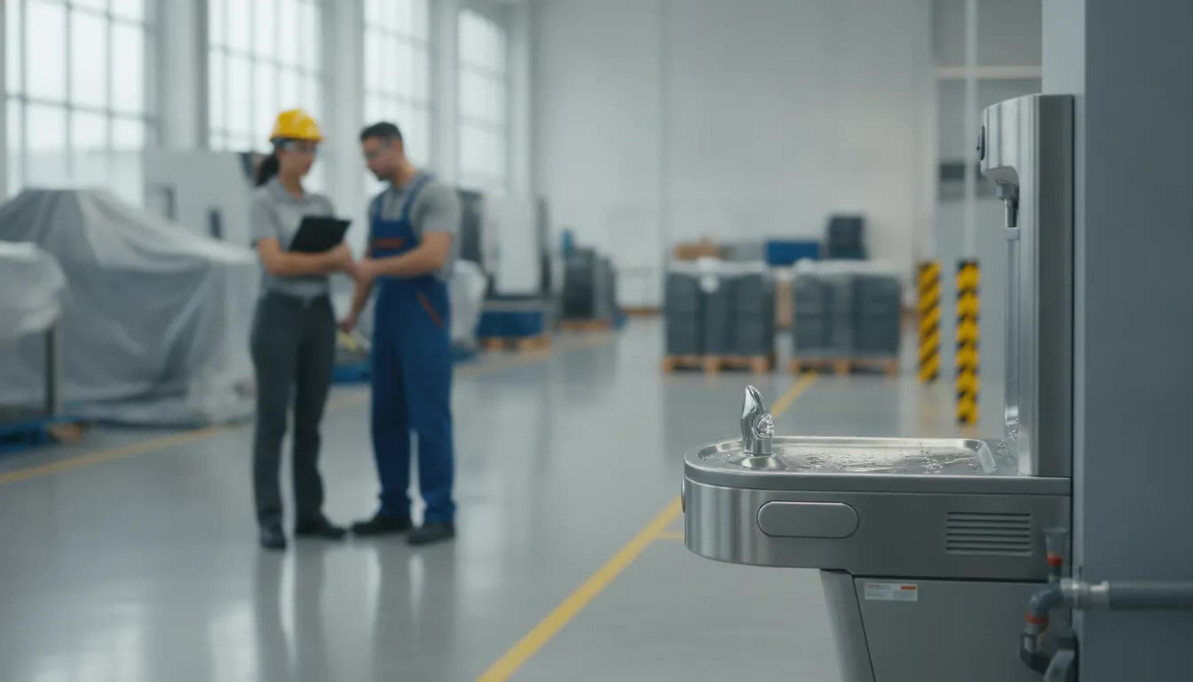
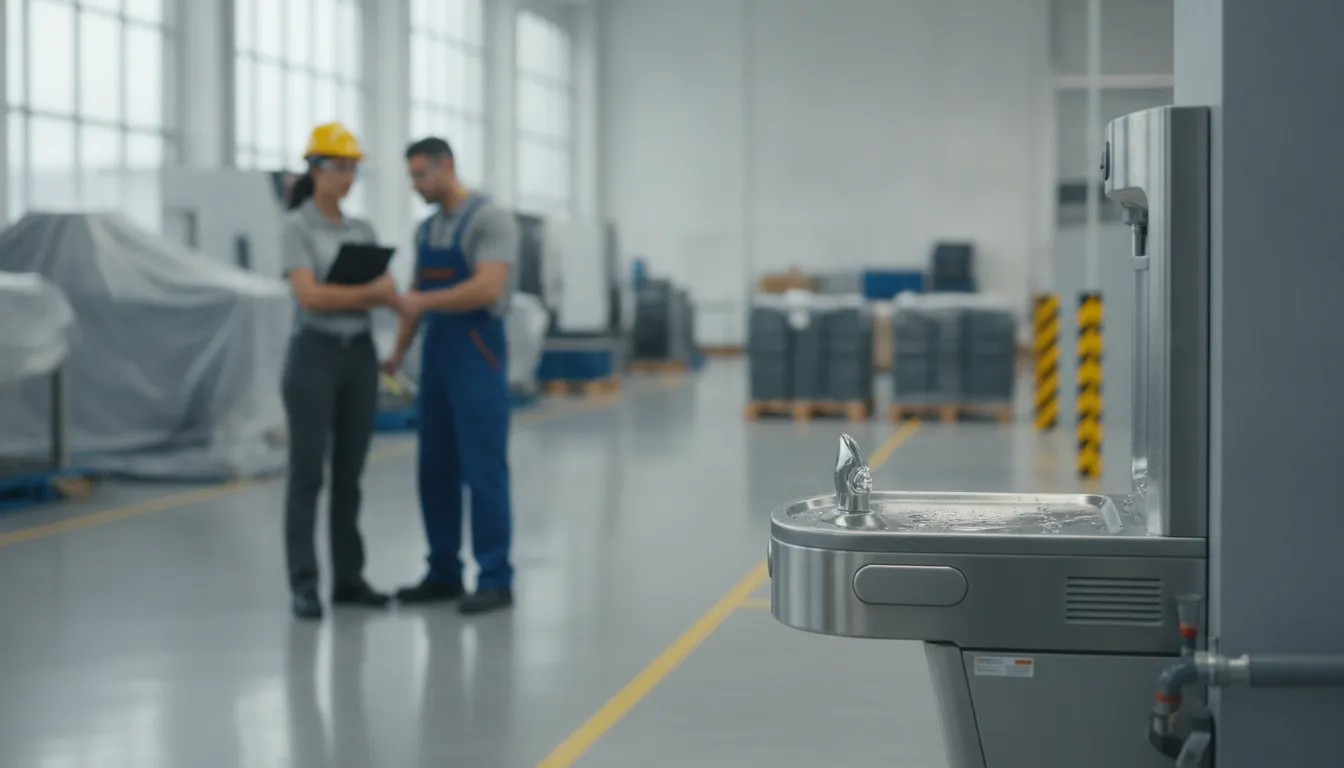
Wall-mounted drinking fountains are common in offices, industrial buildings, warehouses, schools, and other indoor settings with suitable water and waste connections. They can preserve floor space and create a defined, cleanable station. Before ordering, confirm wall construction, rough-in requirements, drain routing, access for service, and the finished clearance around the fixture.
For a focused product comparison, review the wall-mounted drinking fountain category. Use the product page and manufacturer documentation to confirm dimensions, mounting hardware, temperature options, filter requirements, and other model-specific details.
Bi-level and barrier-free designs
Bi-level or barrier-free configurations place outlets at different user heights. This can make a station more practical for people who use wheelchairs and people who drink while standing. The unit still needs an adequate approach, clear floor space, and controls that can be operated without excessive reach. The surrounding route must also remain clear of carts, storage, and equipment.
Bottle-filler combinations
A bottle-filler combination pairs a traditional basin with a separate filling outlet. It can support reusable-bottle use while retaining a conventional drinking option. Evaluate the station against traffic patterns, bottle-filling demand, cleaning procedures, electrical needs if applicable, and the accessibility plan. A bottle filler does not automatically replace the need for an appropriate drinking-fountain arrangement.
Outdoor, freestanding, filtered, and refrigerated options
Freestanding or pedestal fixtures may suit campuses, parks, loading areas, outdoor work zones, and sites where a wall is unavailable. Outdoor exposure adds decisions about drainage, weather, vandal resistance, winter conditions, and service access. Filtered or refrigerated units may be useful when water taste, temperature, or treatment is part of the facility plan, but filters and cooling systems add maintenance tasks. Compare the environment, users, cleaning access, replacement-part support, and installation requirements before selecting features.
How do ADA requirements shape drinking fountain placement?
Accessibility affects the complete station, including the fixture, approach route, clear floor space, controls, spout location, and nearby circulation. The U.S. Access Board explains the technical requirements for drinking fountains in its drinking fountain guidance. Facility teams should review the applicable requirements with the design professional or building official responsible for the project.
Plan for both seated and standing access
Where drinking fountains are provided, the Access Board guidance addresses access for people who use wheelchairs and for standing persons. A bi-level station may support both user groups in one location, while separate fixtures may be more appropriate when the room layout, traffic, or service conditions require them.
Do not treat accessibility as a last-minute product feature. A compliant-looking fixture can still create a problem when stored materials crowd it. The same is true inside a corridor pinch point or where a person cannot approach and leave without an obstruction.
Confirm quantities and locations
When multiple fountains are planned, review the applicable ratio and rounding rules with the project team. The Access Board guide describes how wheelchair-accessible and standing-accessible fountains are counted. Count fixtures within the relevant floor or area, document the intended access type for each one, and check that users can reach the station from the routes they actually use.
Review the surrounding route
Measure the approach and turning area shown in the design, not only the width of the fixture. Check door swings, columns, carts, lockers, shelving, waste bins, and other objects that may reduce clear space after the building is occupied. A commissioning walk-through should confirm the installed station against the approved plan. For broader workplace planning, review the construction safety guidance and adapt the same route-clearance discipline to the facility project.
How should a facility keep drinking fountains sanitary?
Sanitation depends on the fixture design, water source, user behavior, cleaning method, and consistency of the maintenance program. A polished finish does not replace routine cleaning. Assign ownership before the fountain is installed, and make the task easy to repeat across shifts and buildings.
Use a written cleaning routine
The routine should identify the basin, bubbler or outlet area, push buttons or sensors, bottle-filler surface, drain, splash zones, and nearby high-touch surfaces. Follow the selected product's cleaning instructions and the facility's approved chemical list. Do not mix chemicals or assume that a general-purpose cleaner is suitable for every finish or component.
For drinking-water fixtures used in regulated environments, review applicable sanitation requirements and site rules with the responsible facility or public-health professional. The federal text at 21 CFR 1250.85 is one authoritative reference for drinking-water facilities on vessels and should not be treated as a substitute for the requirements governing a particular workplace.
Inspect more than the visible surface
- Look for leaks, damaged guards, loose hardware, unusual flow, and drainage problems.
- Check that buttons, sensors, bottle-filler outlets, and protective components work as intended.
- Remove objects or storage that reduce approach space or create a trip and contamination risk.
- Confirm that filters, cartridges, and other service parts are changed according to the product instructions and facility schedule.
- Record issues that require a qualified plumber, electrician, manufacturer, or other specialist.
What should teams confirm before installing drinking fountains?
Installation planning prevents many of the problems that appear after delivery. Procurement should involve facilities, maintenance, accessibility, safety, and the installer early enough to resolve conflicts before the unit arrives.
Check the site conditions
- Identify the potable-water supply, shutoff access, drainage route, and any required waste connection.
- Confirm wall structure, mounting location, finished-floor conditions, and service clearances.
- Review electrical requirements for refrigerated, filtered, sensor, or bottle-filler models when applicable.
- Plan protection from weather, impact, freezing, or contamination for outdoor installations.
- Coordinate the fixture with the accessibility route, doors, equipment, storage, and emergency egress.
Use a documented installation sequence
- Verify the approved model, product documentation, rough-in information, and site measurements.
- Mark the fixture location and confirm approach, clear floor space, and service access before cutting or mounting.
- Install water, drain, electrical, and mounting components according to the manufacturer's instructions and applicable code.
- Test flow, drainage, controls, temperature features, leak points, and bottle-filler operation where present.
- Clean the station, remove installation debris, and complete an accessibility and circulation walk-through.
- Record the model, serial information, filters or cartridges, installer, warranty materials, and maintenance owner.
Model-specific specifications belong in the manufacturer's installation documentation. If the site conditions do not match the documentation, pause the installation and resolve the discrepancy rather than improvising a connection or clearance.
How can you compare drinking fountains for workplace use?
A useful comparison weighs compliance, total ownership effort, and user experience together. The least expensive fixture may not be the least costly choice if it is difficult to clean, lacks replacement parts, or requires disruptive service.
| Configuration | Often suits | Questions to ask |
|---|---|---|
| Wall-mounted | Indoor facilities with suitable wall and plumbing conditions | Are the wall, rough-in, drain, and service clearances confirmed? |
| Bi-level or barrier-free | Facilities planning access for different user heights | Does the full station support approach, operation, exit, and circulation? |
| Bottle-filler combination | Workplaces with reusable-bottle demand | Will traffic, cleaning, power, and accessibility needs be supported? |
| Outdoor or freestanding | Campuses, parks, yards, and wall-free locations | How will weather, drainage, impact, freezing, and service be handled? |
| Filtered or refrigerated | Sites with a defined treatment or temperature requirement | Who will replace filters, track service, and manage additional components? |
Build a short requirements sheet before comparing products. Include the intended location, user groups, expected traffic, indoor or outdoor exposure, plumbing and electrical conditions, accessibility objectives, cleaning resources, replacement-part plan, and acceptable downtime. Then ask suppliers for the documentation needed to verify each requirement.
Compare drinking-fountain options for your facility requirements
How do facilities build a practical maintenance and replacement plan?
Maintenance works best when it is assigned to a person or team, tied to a schedule, and supported by records. A facility does not need a complicated system. It needs a repeatable way to know what was cleaned, what was inspected, what parts were changed, and what remains unresolved.
Assign ownership and frequency
Define who performs routine cleaning, who completes functional inspections, who orders filters or parts, and who approves repairs. Set frequencies based on traffic, environment, manufacturer instructions, and the facility's sanitation program. High-use stations may need more frequent attention than a low-traffic office fixture.
Keep service records tied to the fixture
Record the location, model, serial information, installation date, service events, filter changes, leaks, repairs, and open issues. These records help a new maintenance worker understand the fixture and help procurement avoid ordering incompatible parts.
Know when service or replacement is warranted
Repeated leaks, unreliable controls, unavailable parts, damaged surfaces, poor drainage, or recurring sanitation problems may justify a repair review or replacement assessment. Before replacing the fixture, identify whether the underlying issue is plumbing, placement, cleaning, user behavior, or an incorrect product choice. Facility teams can apply the same preventive approach used in a workplace safety equipment checklist: assign ownership, document inspections, and close unresolved hazards. Replacing the unit without correcting the cause can repeat the same problem.
For product selection, use the relevant facility maintenance category alongside the drinking-fountain listings. Keep the final decision grounded in verified product documentation and the requirements of the installation site.
Review wall-mounted drinking fountains for indoor installations
Explore Safety Company's commercial drinking-fountain category
Frequently Asked Questions About Drinking Fountains
Are drinking fountains hygienic?
They can be, when the fixture is installed correctly and supported by a consistent cleaning and inspection program. Sanitation depends on the water source, outlet and basin design, user traffic, cleaning products, filter service when applicable, and prompt repair of leaks or damaged components. A written routine is more reliable than cleaning only when a surface looks dirty.
What are the different types of commercial drinking fountains?
Common types include wall-mounted, bi-level, barrier-free, outdoor, freestanding, filtered, refrigerated, and bottle-filler combinations. Some fixtures combine several functions. Compare each configuration against the location, users, plumbing, accessibility plan, weather exposure, service access, and maintenance resources instead of selecting by feature name alone.
Are bottle fillers better than traditional drinking fountains?
Not in every setting. Bottle fillers can support reusable bottles and may be useful in busy workplaces. But a facility still needs to evaluate accessibility, cleaning, traffic, electrical requirements if applicable, and whether users need a conventional drinking option. A combination unit may meet both needs, subject to the project plan and product documentation.
What are the ADA requirements for drinking fountains?
ADA planning addresses access to the fixture, including approach, clear floor space, operating features, spout and basin conditions, and access for different users. The U.S. Access Board drinking fountain guide is a useful starting point. Apply the requirements to the complete installed arrangement and confirm the final design with the project professional or responsible building official.
Should a facility choose indoor or outdoor drinking fountains?
Choose based on the installation environment and service plan. Indoor units usually offer more protection from weather, while outdoor units require additional planning for drainage, freezing, impact, exposure, and maintenance access. Confirm that the selected product is intended for the environment and that the site can support its installation and upkeep.
Recent Posts
-
Cut Gloves: How to Choose the Right ANSI Level
A hand-protection program works best when it starts with the task, not a product label. A packaging …Oct 5th 2026 -

Kevlar Gloves. Cut, Heat, and Task-Specific Selection
Choosing hand protection by material name alone can leave a serious gap in your safety program. Star …Oct 2nd 2026 -
Face Shield for Grinding: Selection and Safety Guide
Grinding can send fragments, sparks, dust, and other debris toward a worker's face in an instant. Th …Sep 30th 2026