
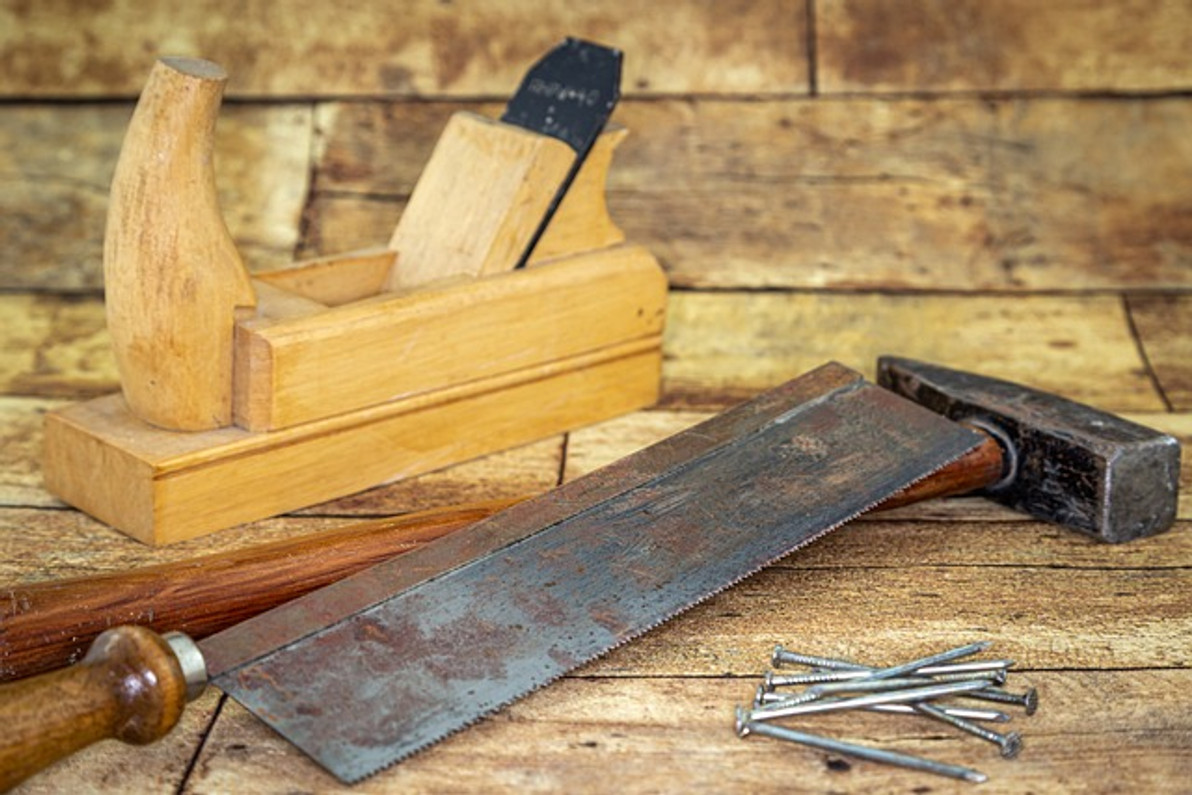
Understanding the Parts of a Hand Planer
Hand planers are used in a variety of woodworking applications. Also known as a surfacer, it features a blade attached to the bottom of a block. You can run a hand planer over the surface of a workpiece to shave wood off the workpiece. While they are simple and easy to use, however, hand planers feature several different parts.
Blade
All hand planers have a blade. The cutting blade is found underneath the hand planer. It runs perpendicular to the body of the hand planer, with the sharp end of the blade pointing towards the front of the hand planer. Pressing a hand planer against a workpiece and pushing it forward will allow the blade to shave off wood.
Blade Retainer
The blade is typically attached to a retainer. The retainer, as the name suggests, contains or "retains" the blade. It consists of a metal frame that's mounted to the hand planer via a set of screws. Over time, the blade will become dull. You can remove dull blades from the retainer, followed by replacing them with new and sharp blades.
Rear Handle
The rear handle consists of a lever-like handle on the back of a hand planer. Hand planers require pushing. After positioning the hand planer on the workpiece, you can grab the rear handle and front handle (see below) to push it.
Front Handle
In addition to a rear handle, most hand planers have a front handle. The rear handle is found on the back of a hand planer, whereas the front handle is found on the front. With two handles, you can use both hands to push the hand planer, resulting in greater leverage.
Manually Operated vs Powered Hand Planers
There are different types of hand planers. While they are all used to plane workpiece surfaces, some of them are manually operated, whereas others are powered.
Powered hand planers are typically powered by electricity. They may require a corded connection to a wall outlet, or they may use a rechargeable battery. Regardless, they run on electricity. Manually operated hand planers, conversely, are operated entirely by hand. You don't need to plug them into a wall outlet, nor do you need to recharge any batteries.
In Conclusion
Whether manually operated or powered, most hand planers feature a few basic parts. Some of these parts include a blade, blade retainer, rear handle and front handle. With that said, hand planers may feature other parts as well, such as a depth gauge and rollers.
Recent Posts
-

LOTO Explained: Lockout/Tagout Steps for Safer Maintenance
LOTO, short for lockout/tagout, is an energy-control process that prevents a machine from starting o …Oct 12th 2026 -

N95 Respirator Guide for Workplace Safety
Dust, mist, fumes, and other airborne particles can create serious exposure risks before a worker no …Oct 12th 2026 -
Cut Gloves: How to Choose the Right ANSI Level
A hand-protection program works best when it starts with the task, not a product label. A packaging …Oct 5th 2026