
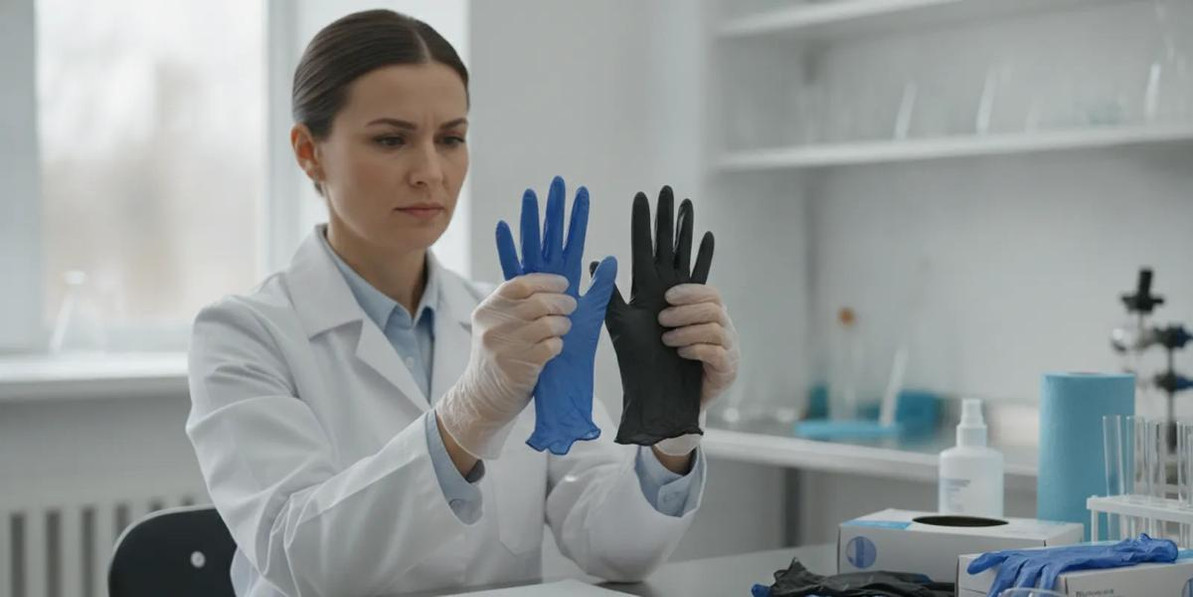
Nitrile Exam Gloves: Choosing Barrier Protection for Workplace Tasks
Nitrile exam gloves are often selected for tasks that need a disposable hand barrier, but the right choice depends on the exposure, the work, and the product documentation. For laboratory, food-processing, healthcare-adjacent, and industrial teams, a good selection process starts with the hazard assessment—not color, price, or a familiar box label. Treat nitrile exam gloves as one part of a control plan, and confirm that the chosen glove is suitable for the specific task.
Call to discuss workplace glove options
What decision should glove selection answer?
Before comparing products, define the decision the glove must support. An exam glove may be appropriate for brief contact and routine barrier tasks, but it is not automatically a chemical-protection glove, a cut-resistant glove, or a substitute for engineering controls. The word “nitrile” describes the material family; it does not by itself establish suitability for every chemical, duration, or mechanical hazard.
Write down the task, the substances or materials handled, contact duration, expected movement and dexterity, and what happens if the glove tears or becomes contaminated. Include who performs the work and whether the glove is changed between steps. A suitable selection is one supported by the hazard assessment and product information for actual conditions.
- Identify the exposure and how contact could occur.
- Decide whether the glove is a disposable barrier or whether a different protective glove is needed.
- Check applicable workplace requirements and product documentation before issue.
- Set clear limits for use, removal, and replacement.
How should buyers identify the task and exposure?
Different work areas may use a similar-looking glove for very different reasons. A laboratory worker may need a glove for handling a particular reagent during a short procedure. A food-processing worker may need a disposable barrier suitable for the operation and food-contact requirements. An industrial operator may need protection from incidental contamination while handling parts. These scenarios should not be treated as interchangeable.
Map tasks at a practical level. Note the product or material handled, concentration where known, temperature, contact time, whether contact is repeated or prolonged, and whether the worker may touch tools or equipment that could compromise the glove. Consider whether the task also involves abrasion, puncture, sharp edges, heat, or splash. A disposable exam glove is not designed to resolve all of those hazards.
Use the workplace hazard assessment and the product's instructions to confirm suitability. For regulated settings, check applicable rules and internal procedures rather than assuming that a generic description proves compliance. If compatibility information is incomplete or ambiguous, seek guidance from the manufacturer or a qualified safety professional before approving the product.
Translate the assessment into a task description
A useful assessment describes work as a sequence rather than a job title. “Lab work” is too broad: weighing a dry sample, cleaning a bench, and transferring a liquid can involve different contact patterns. “Food production” is also too broad: handling packaged goods is different from direct contact with ingredients. Describe the actual operation, including what touches the glove and what the worker touches next.
For each step, note whether contact is intentional or incidental, whether it is a splash or sustained contact, and whether the glove could be immersed or trapped against the skin. Record foreseeable deviations, such as a spill or a container break, but do not assume a disposable glove is an emergency response control. If a task's exposure changes, reassess rather than carrying over the old selection by habit.
What does thickness tell you—and what does it not?
Thickness can be one useful comparison point, but it is not a complete measure of protection. A thicker glove may feel more substantial, while a thinner glove may offer easier tactile control for a particular task. Neither conclusion alone establishes chemical resistance, puncture performance, or safe wear time. Formulation, manufacturing, fit, exposure conditions, and the product's tested claims also matter.
Compare thickness only when product documentation makes the measurement basis clear. Do not assume two gloves with similar stated thickness will perform identically. Consider whether the worker can complete the task without excessive strain and whether the glove remains intact during expected movements. Validate the choice in a controlled workplace trial, without exposing workers to avoidable risk.
| Selection factor | What to compare | What it cannot prove alone |
|---|---|---|
| Thickness | Documented measurement and intended task | Compatibility with a chemical or safe duration of use |
| Fit and size | Secure fit, reach, grip, and dexterity | Protection against an unassessed hazard |
| Powder status | Product labeling and workplace policy | Absence of all allergens or contaminants |
| Material and claims | Manufacturer instructions and relevant standards or requirements | Suitability outside stated use conditions |
| Task exposure | Substance, contact time, temperature, and failure consequence | Protection from unrelated mechanical hazards |
How can buyers compare two candidate gloves?
First remove any candidate that lacks documentation for a required use or cannot be evaluated for the task. Then compare the remaining products in the same order: use claims and restrictions, fit and dexterity, thickness measurement, powder status, package labeling, sizes available, and the clarity of manufacturer information. This avoids giving a convenient feature more weight than an essential safety requirement.
For example, if workers need fine control when handling small containers, a thicker option that impairs manipulation may create a usability issue. That observation does not mean the thinner option is protective enough; compatibility and barrier suitability still come first. Conversely, if the glove is frequently damaged during ordinary movements, investigate fit, task demands, and whether a different glove type is needed instead of simply choosing a thicker disposable glove.
How can teams check fit and sizing?
A glove that is too tight can restrict movement and may be more likely to tear during donning or work. A glove that is too loose can reduce control and make fine handling harder. A sizing chart is a starting point, not a substitute for checking the glove on the worker performing the task.
Ask workers to try the intended size and complete representative, low-risk motions. Check that fingertips do not bunch excessively, the cuff covers the intended area, and workers can grip tools or containers without losing control. Evaluate the glove with any other required PPE, since interfaces at the wrist can affect coverage. Do not trim or modify gloves to make them fit.

Record approved sizes and make them available where work occurs. If a team includes a wide range of hand sizes, stocking only one size can encourage workers to use a poor fit. In a fit check, observe the worker putting the glove on, closing and opening the hand, picking up representative objects, and removing the glove. Ask whether the glove slips, pinches, or makes the task harder. A worker's feedback is useful evidence about usability, though it does not prove chemical suitability.
For general disposable glove options, buyers can compare Ansell MICROFLEX N89 gloves and other product documentation against task requirements. Treat listing details as a prompt to review the manufacturer's current instructions for the exact model, rather than as a replacement for that review.
What should teams consider about allergies and powder?
Nitrile is commonly chosen as an alternative to natural rubber latex, but a material choice should not be treated as a guarantee that no worker can have a reaction. Workers may be sensitive to glove ingredients, additives, or residues. Follow workplace procedures for reporting skin symptoms, and consult occupational health or a qualified medical professional when a worker reports a possible reaction.
Powder status is another selection and handling consideration. Powder-free products can help avoid powder-related contamination in work areas, but the label does not establish that a glove is free of every substance that could concern a particular worker or process. Verify the product label and manufacturer information, and consider whether powder could interfere with samples, surfaces, product quality, or downstream procedures.
Make the approved product and its powder status clear in purchasing specifications. Avoid mixing visually similar gloves with different properties at one station. Train workers to stop and report a suspected reaction or unexpected residue rather than simply switching products without notifying the person responsible for the program.
How should a buyer respond to a reported reaction?
Have a defined path for a worker to report symptoms and pause work safely. The supervisor or designated safety contact should document the glove model, lot or package information if available, task, exposure, and timing, then follow the workplace's occupational-health process. Do not diagnose the cause from appearance alone; symptoms can have multiple explanations and require appropriate professional evaluation.
Keep an alternative product under review only if its documentation is suitable for the task. A fast substitution based solely on a different color or material label can create a new exposure risk. The replacement should be assessed using the same hazard and task criteria as the original glove.
How should chemical compatibility be verified?
Do not infer chemical resistance from the material name alone. Compatibility depends on the specific chemical and formulation, concentration, temperature, exposure method, and duration. A glove may resist brief contact yet be unsuitable for prolonged immersion or repeated exposure. Permeation and degradation can occur even when a glove appears intact.
Use the manufacturer's compatibility data and instructions for the exact glove model and the substance involved. Confirm that test conditions and contact scenario are relevant to the task. If the product data does not address the chemical or conditions, do not fill the gap with a guess based on another nitrile glove. Escalate the question to the manufacturer or a qualified safety professional and choose an alternative control while suitability is unresolved.
Where chemicals are involved, use the workplace's chemical hazard information and protective-equipment procedures. OSHA's laboratory safety resources are a starting point for employers reviewing laboratory hazards and protective measures: OSHA Laboratory Safety. This resource does not replace product-specific compatibility review.
What should the compatibility check record?
Capture the precise product model and chemical identity, including mixture or concentration information supplied by the process. Record relevant conditions such as temperature, contact type, and expected duration. Identify the data source, its test conditions, and any limitations stated by the manufacturer. A bare note such as “nitrile approved” is not sufficiently specific for someone else to repeat or review the decision.
When mixtures are involved, do not presume that data for an individual ingredient establishes performance for the mixture. Ask the manufacturer or safety professional what information is appropriate. If different steps involve different substances, document the approved glove for each step and how workers transition between them. The point is not to create paperwork for its own sake; it is to make the basis and limits of the selection visible.
What are the limits for punctures, tears, and sharp objects?
Disposable exam gloves can tear or puncture. Their presence does not make a sharp-edge task safe. If work includes needles, blades, metal edges, rough components, or cutting motions, assess that mechanical hazard separately and select controls designed for it. A disposable glove should not be represented as cut-resistant unless the specific product has that documented rating and is appropriate for the task.
Inspect gloves before use and during work when the task or procedure calls for it. Replace a glove if it is torn, punctured, visibly contaminated, or otherwise compromised. A worker should remove it safely, wash or otherwise clean hands according to the site's procedure, and put on a fresh glove when needed. Never wash and reuse a disposable glove unless the manufacturer explicitly permits the intended practice.
For tasks where cut resistance is required, compare purpose-designed options separately, such as Whizard cut-resistant hand protection. This is not a substitute for assessing whether that specific product matches the hazard and required protection level.
How can a team learn from glove failures?
When a glove fails, record what happened before restarting the task. Note the operation, hand motions, contact or snag point, glove model and size, how long it had been in use, and whether the failure was visible before exposure. Look for patterns across shifts or workstations: repeated tears at fingertips may point to sizing or task demands, while damage at the cuff may relate to donning or interaction with other PPE.
Do not respond to every failure by issuing a more substantial disposable glove. A recurring puncture near a sharp edge may require a different control, a redesigned handling method, or a purpose-built protective glove. Review the hazard assessment and manufacturer information with the responsible safety professional, then communicate any change to workers before it becomes routine.
How should teams set glove-change practices?
Changing gloves at the right point is part of the control, not an afterthought. Establish task-specific rules for when a glove is put on, removed, and replaced. Common triggers include visible damage, contamination, a change in task or substance, leaving a controlled work area, and the end of a defined procedure. Exact practices depend on the process and applicable workplace requirements.
- Train workers to put gloves on with clean hands and check for obvious defects.
- Define when gloves must be changed between tasks, people, materials, or work zones.
- Teach removal that limits contact between contaminated glove surfaces and skin.
- Provide appropriate hand-cleaning supplies and disposal containers near the work area.
- Review actual work practices to identify shortcuts, supply gaps, or cross-contamination risks.
Gloves do not replace hand hygiene or other controls. They can also transfer contamination if workers touch shared controls, handles, or clean supplies with contaminated gloves. Explain which items are considered clean and how workers should transition between work steps.
How can change rules work in a real process?
Consider a worker who handles an incoming sample, records information on a shared terminal, then prepares the sample. A single glove-change rule may not capture each transition. The procedure should identify which activity is considered clean, when gloves are removed, and whether hand cleaning is required before the next step. A food-processing line may use different zone boundaries and change triggers. The details must come from the site's process and applicable requirements, not from a generic glove label.
Make replacement supplies easy to reach without encouraging workers to keep a damaged glove in service. Place disposal containers where removal occurs, and explain what to do if the glove tears during a task. Supervisors should observe the actual workflow and ask where the written procedure is difficult to follow. If required supplies are far from the point of use, a well-written policy alone will not fix the practical obstacle.
Review nitrile exam glove details
What product documentation should buyers retain?
Procurement should create a traceable record of why the selected glove is appropriate. Keep the product name and model, manufacturer instructions, relevant compatibility information, any stated standards or claims, approved sizes, and the tasks for which the product is authorized. Record limits of use, change triggers, and who approved the selection.
Check that product information applies to the exact model being purchased. Similar names or colors do not guarantee the same construction or performance. Revisit documentation when a supplier changes a model, the task changes, a new substance is introduced, or workers report fit or durability problems.
SafetyCompany.com distributes safety products from multiple manufacturers. Buyers should verify product-specific instructions and claims before use, and should align purchasing decisions with their own hazard assessment and applicable requirements. A listing or general material description is not a substitute for that review.
What belongs in a usable glove specification?
- Task or operation covered, including any exclusions.
- Exposure and barrier needs established by the hazard assessment.
- Exact product name and model, plus manufacturer documentation reviewed.
- Approved sizes and how workers can obtain the right fit.
- Conditions that require a glove change, removal, or reassessment.
- Person or role responsible for approval and review.
Keep the specification accessible to purchasing and frontline supervisors. If procurement needs a substitute because the approved model is unavailable, the substitute should go through review before use; a similar description is not proof of equivalent performance. Update the record when the product model or process changes, and communicate the change at the station where the glove is issued.
How can buyers compare options without letting price lead?
Start by eliminating products that do not meet documented task requirements. Then compare fit, dexterity, thickness, powder status, package format, and availability of product information among viable options. A trial can help identify usability issues, but should be designed so it does not expose workers to an unverified hazard.
Use a written comparison rather than relying on color or a single specification. For each product, note which requirements it meets, what documentation supports the decision, and any limits. If more than one glove is approved, make the different use cases easy to identify at the point of issue. This reduces the chance that a glove intended for one operation is used for another.
Buyers comparing disposable options can review powder-free nitrile examination gloves and Ansell MICROFLEX N89 gloves. Confirm current product details and manufacturer documentation for the precise model and intended use.
How should a trial be structured?
Limit a trial to tasks for which the candidate has already passed the necessary documentation review. Provide workers with the correct size range and a clear way to report grip, dexterity, comfort, and durability observations. Observe representative movements, such as opening a container, manipulating a tool, or handling packaging, without introducing a hazardous exposure simply to test the glove.
Collect observations from different users and work steps rather than relying on one person's impression. Separate comfort feedback from evidence about protection: “easier to manipulate” is a usability observation, not proof of compatibility. The reviewer should compare trial notes with the written criteria, document the decision, and set conditions that would trigger another review.
What should the rollout and review process include?
Once a product is approved, make its use understandable at the point of work. Label storage locations with the approved model and sizes, distinguish products assigned to different tasks, and keep the relevant instructions available to supervisors. Include the selection limits in training: workers should know what the glove is intended to do, what it is not intended to do, and who to ask when the task changes.
Review the program after a process change, a new chemical or material, a recurring failure, a reported sensitivity, or a change in product model. A routine review can also check that the approved sizes remain stocked and that workers follow removal and replacement practices. Ask workers where the instructions are unclear and observe whether the real workflow matches the written procedure.
A practical review record can be concise: date, task reviewed, documentation checked, worker feedback, observed problems, decision, and responsible reviewer. This helps the next supervisor understand why the product was approved and which conditions would make the approval no longer applicable.
Frequently Asked Questions
Are nitrile exam gloves suitable for every chemical?
No. Suitability depends on the specific glove model, chemical, concentration, temperature, contact method, and duration. Use manufacturer compatibility information and do not assume that all nitrile products perform the same.
Does a thicker glove always provide better protection?
No. Thickness alone does not establish chemical compatibility, puncture resistance, or safe wear time. Compare product documentation and actual task conditions.
Can disposable exam gloves be reused?
Do not reuse a disposable glove unless its manufacturer explicitly permits the intended practice. Set replacement rules for damage, contamination, task changes, and the end of the relevant procedure.
Do powder-free gloves eliminate allergy concerns?
No. Powder status addresses one product characteristic, not every potential sensitivity. Check product information and follow workplace procedures when a worker reports symptoms.
What should a buyer do if a glove model changes?
Check whether the replacement has the same model identity and documentation before treating it as equivalent. Reassess suitability for the task, update purchasing records, and communicate any changed limits or sizes to users.
How can a team make the selection practical?
Turn the hazard assessment into a short, usable glove specification: identify the task, required barrier, approved model and sizes, relevant documentation, and clear change and disposal rules. Train workers, keep the approved product available, and review the choice when work or materials change. This process helps ensure nitrile exam gloves are used only where their documented characteristics fit the task.
Recent Posts
-

Nitrile Exam Gloves: Choosing Barrier Protection for Workplace Tasks
Nitrile exam gloves are often selected for tasks that need a disposable hand barrier, but the right …Nov 9th 2026 -

Fall Restraint Systems: How Employers Choose Work-at-Height Protection
A fall restraint system is intended to keep a worker from reaching a fall hazard, not to catch a wor …Nov 9th 2026 -

Impact Resistant Gloves: How to Choose
Impact resistant gloves protect the knuckles, fingers, and back of the hand when a tool, pipe, or pa …Nov 9th 2026