

Impact Resistant Gloves: How to Choose
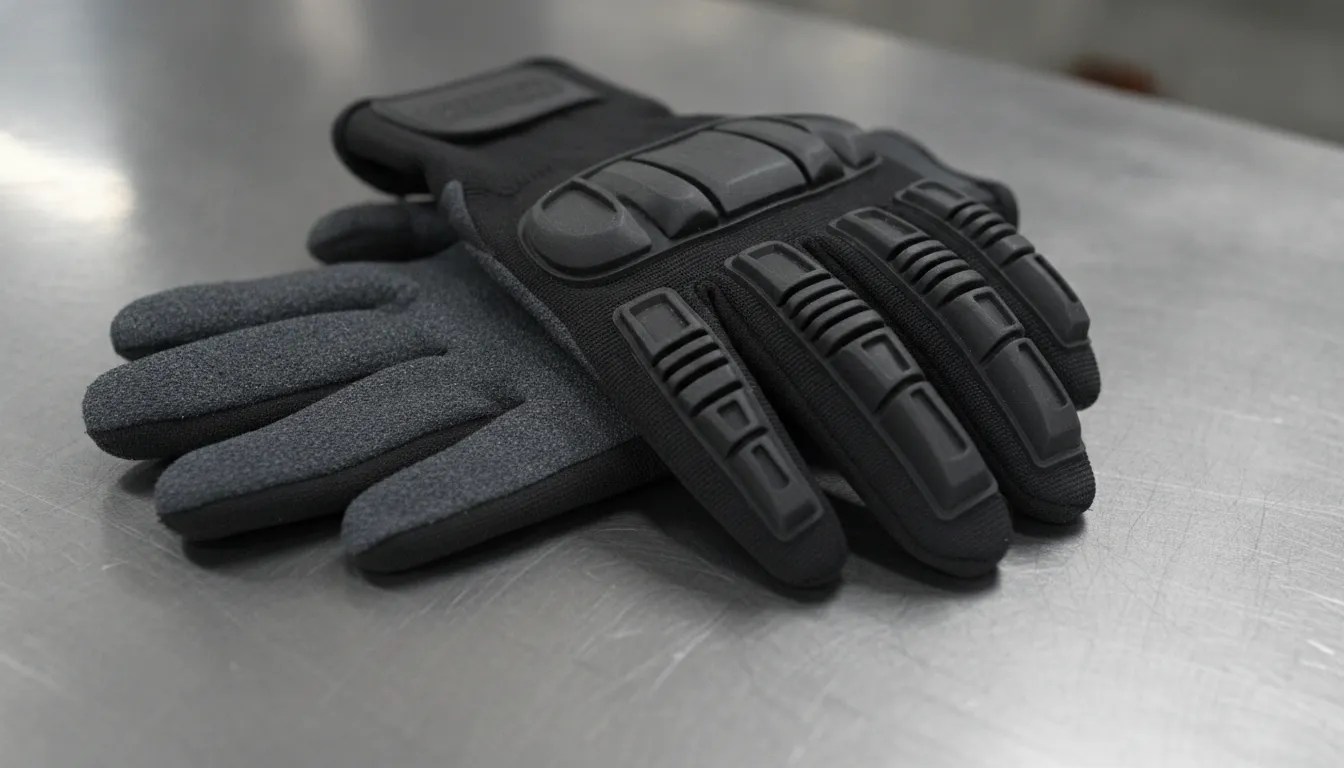
Impact resistant gloves protect the knuckles, fingers, and back of the hand when a tool, pipe, or part strikes those areas. A cut-rated shell or a plain leather palm does not do that job. Buyers who treat rubber pads as proof of protection often stock the wrong glove.
Call (800) 310-7233 to match an impact glove to the task
You can also start with the impact and anti-vibration glove category. Or send the task notes if you want help matching a level before you order.
This guide is for EHS managers and facility buyers who need a repeatable way to pick impact resistant gloves. It covers the ANSI/ISEA 138 scale, how that rating differs from cut and vibration protection, and what to check before you issue a pair.
What Do Impact Resistant Gloves Protect Against?
Impact resistant gloves are built for blunt force on the back of the hand. Typical events include a dropped wrench, a pipe that shifts in a rack, a pinch at a machine guard, or a part that slips during a lift. The padding spreads that blow so less force reaches bone and soft tissue.
The International Safety Equipment Association notes that the hand is the second most commonly injured body part at work. In 2017, the Bureau of Labor Statistics counted 121,860 hand cases among 286,150 nonfatal upper-extremity injuries with days away from work in private industry. ISEA flags offshore oil and gas, construction, mining, manufacturing, warehousing, and transport as higher-risk settings. The National Safety Council has put hand-injury costs in a range from about $540 to $26,000, and crushed bone is harder to treat than a clean break.
OSHA's hand-protection rule, 29 CFR 1910.138, requires employers to select hand protection based on the task, the conditions, how long the glove is worn, and the hazards found. 29 CFR 1910.132 adds a written hazard assessment, a fit requirement, and a ban on damaged PPE. Impact is not named as its own line in 1910.138, so the assessment is what puts back-of-hand strikes on the list.
A rubber strip on the knuckles is not a rating. Before ANSI/ISEA 138-2019, suppliers could call almost any padded glove impact resistant. The standard gives buyers a shared scale and a mark they can check on the glove.
How Does ANSI/ISEA 138 Rate Impact Resistant Gloves?
ANSI/ISEA 138-2019 is the American National Standard for impact-resistant gloves. ISEA convened the standard, which was released in February 2019. It rates how well the back of the glove reduces force at the knuckles and fingers. It does not rate the palm, and it does not rate cuts.
The scale runs from 1 to 3. A lower transmitted-force number means the padding absorbed more of the blow, so level 3 is the strongest class, not the weakest. Compliant gloves carry a pictogram for that level. Ask the supplier which zone set the overall score before you treat the label as final.
| ANSI/ISEA 138 level. | Mean transmitted force. | Every recorded impact. | Typical buyer use. |
|---|---|---|---|
| Level 1. | Under 9 kN. | Under 11.3 kN. | Occasional bumps in warehousing, light assembly, and general handling. |
| Level 2. | Under 6.5 kN. | Under 8.1 kN. | Construction, utilities, automotive work, and heavier maintenance. |
| Level 3. | Under 4 kN. | Under 5 kN. | Oil and gas, heavy equipment, demolition, and mining, where strikes are likely. |
The overall mark is the lower of the knuckle score and the finger score. A glove that is level 3 on the fingers and level 2 on the knuckles is a level 2 glove. Ask for the finished-glove report, not a note about the rubber alone. Pads added after the shell was tested can leave you without a valid mark.
How Should You Match the Level to the Task?
Start with the hazard assessment, not the catalog photo. Write down what can strike the back of the hand, how heavy it is, how often it happens, and whether the hand is also near edges, oil, heat, or chemicals. Then pick the lowest ANSI/ISEA 138 level that still covers the likely blow. Extra padding that kills grip is its own hazard.
- List the strike sources for each job, such as hand tools, pipe, steel parts, or vehicle doors.
- Note whether the strike is rare or part of every shift.
- Record the other hazards that share the task, especially cut, abrasion, oil, cold, and heat.
- Choose level 1, 2, or 3 from that exposure, then confirm the pictogram on the sample pair.
- Trial the pair on the real task before you buy in bulk.
Level 1 fits work where a bump is possible but not the core risk, such as carton handling or light assembly. Level 2 fits crews who swing tools, guide materials, or work around equipment all day. Level 3 fits jobs where a strike is expected, including pipe handling, heavy equipment, demolition, and many oil and gas tasks. If two crews share a storeroom, do not force one glove on both.
Write the choice into the job hazard analysis, not only into a purchase order. Name the ANSI/ISEA 138 level next to the task, the way you already name a cut level or a hard-hat type. When the work changes, such as a move from cartons to pipe, review the level again. A glove that was right in January can be the wrong glove after the task changes.
Trial at least two levels on the same crew before you commit. Ask whether people can still feel the part, start a fitting, and keep the glove on for the full task. If they peel it off to finish a bolt, the higher level lost. Record that result with the hazard assessment so the next buyer does not have to guess.
Safety Company lists impact and anti-vibration styles together, including Ironclad Command Impact gloves and Ironclad 360 Cut Leather Impact gloves. Read each spec. A name with the word impact is not the same as an ANSI/ISEA 138 pictogram.
Keep the buyer notes short enough to reuse. One line per task is enough: the strike source, how often it happens, the ANSI/ISEA 138 level, and any second hazard such as cut or oil. That line is what a new supervisor needs six months later. It also stops a well-meaning reorder from swapping in a thinner glove that looks similar but carries no impact mark.
Do not treat a sample from one crew as proof for the whole site. A maintenance shop and a shipping dock can share a building and still need different levels. If the dock only sees rare bumps, level 1 may be plenty. If maintenance guides steel into a press all day, look at level 2 or 3 and test grip before you standardize.
How Do Impact Gloves Differ from Cut and Vibration Gloves?
Three labels get mixed on the same shelf. Impact resistance, cut resistance, and vibration reduction answer different questions. Buying one and assuming the others is how a compliant-looking program still leaves a gap.
Cut resistance is a separate score
ANSI/ISEA 105 covers cut, abrasion, puncture, and chemical performance. ANSI/ISEA 138 does not. A high cut letter does not tell you anything about a dropped wrench. If the task has both an edge and a strike, you need both marks. Our cut gloves guide walks through A-levels. Use it for the edge, and use this page for the blow.
Some catalog gloves carry both. The HexArmor Helix 3016 is sold as an ANSI A4 cut glove with level 2 impact protection. That pairing is the pattern to look for when sheet metal and hand tools share a station. Heat-plus-cut tasks belong in the Kevlar glove guide, not here.
Vibration reduction is not impact protection
Back-of-hand pads do not automatically reduce hand-arm vibration from grinders, needles, or compactors. Vibration performance is a palm question and a different test. On the Safety Company site, anti-vibration and impact gloves share one category, so a hi-vis mechanic glove or a lightweight anti-vibration glove may sit beside a true impact style. Check the claim you actually need before you add the SKU to a matrix.
Compare impact and anti-vibration gloves
What Should You Check for Fit, Grip, and Wear?
OSHA requires PPE that fits the worker. Impact padding fails when the glove is so stiff that people take it off to finish the task. Fit the sample on the shift that will wear it, not only on a buyer at a desk.
Segmented knuckle guards should bend at the joints. A solid pad across the fingers makes a pinch grip clumsy and pushes workers toward a thinner, unrated glove. Confirm the thumb can oppose the fingertips and that the wrist closure does not cut circulation. Offer the sizes the crew actually wears, including small and extra-large, so people are not stuck between two bad fits.
Match the palm to the surface. Oily steel wants a coated palm with a stated grip. Dry cartons can use a lighter palm. Leather backs well in abrasive outdoor work but runs hotter. If the job also needs cut resistance, keep that rating on the same pair so workers are not swapping gloves mid-task.
Replace the pair when pads crack, peel, or harden, when seams open, or when the worker feels a strike that the glove used to dull. OSHA 1910.132(e) says damaged PPE shall not be used. Retire those pairs in the same inspection you already use for harnesses and eyewear. Keep a few spare sizes on the floor so a bad pair is not worn for one more shift.
Which Questions Should You Ask Before You Buy?
A short spec check beats a thick brochure. Use the same questions for every brand so the storeroom does not fill with lookalike gloves that were never rated.
- What ANSI/ISEA 138 level is marked on the finished glove, and which zone set the overall score?
- Was the full glove tested in an ISO/IEC 17025 lab, and can you see that report?
- What ANSI/ISEA 105 cut level, if any, is on the same pair?
- Does the glove claim vibration reduction, or only back-of-hand impact?
- Which sizes, coatings, and cuff styles will you actually stock?
Safety Company is a distributor, not a glove manufacturer. The impact and anti-vibration glove category includes styles such as Ironclad Command Impact, Ironclad Box Handler, Mechanix Wear M-Pact, and separate anti-vibration models. The broader work gloves collection is the right next stop when the assessment shows you also need cut-only or chemical gloves. There is no order minimum, and phone support is available at 1-800-310-7233 on weekdays from 8am to 5pm PST.
Same-day shipping applies to orders placed by 3pm EST, Monday through Friday. Standard items carry a 30-day money-back guarantee. If you want a second set of eyes on the hazard notes before you pick a level, use the contact form and include the task, the other hazards, and the sizes you need.
Call (800) 310-7233 to compare impact glove levels
Frequently Asked Questions
Are impact resistant gloves the same as cut-resistant gloves?
No. Impact resistant gloves are rated for back-of-hand blows under ANSI/ISEA 138. Cut-resistant gloves are rated for edges under ANSI/ISEA 105. A task with both hazards needs both marks, sometimes on one pair.
Does a higher ANSI/ISEA 138 level always mean a better buy?
Not always. Level 3 absorbs more force, but thicker pads can reduce grip and cause workers to remove the glove. Choose the lowest level that matches the strikes you documented.
Do impact gloves also reduce vibration from power tools?
Not by default. Impact ratings cover blows to the back of the hand. Vibration reduction is a separate claim about the palm. Read the product spec instead of assuming one glove does both.
What should we do with a glove whose pads are cracked?
Take it out of service. OSHA says damaged PPE shall not be used. Cracked, peeled, or hardened guards no longer match the rating you bought, even if the shell still looks fine.
Where can a workplace buy impact resistant gloves without a minimum order?
Safety Company stocks impact and anti-vibration gloves with no minimum order. Start with the impact glove category, confirm the ANSI/ISEA 138 mark on the style you want, and call 1-800-310-7233 if you need help comparing levels.
Recent Posts
-

Nitrile Exam Gloves: Choosing Barrier Protection for Workplace Tasks
Nitrile exam gloves are often selected for tasks that need a disposable hand barrier, but the right …Nov 9th 2026 -
Fall Restraint Systems: How Employers Choose Work-at-Height Protection
A fall restraint system is intended to keep a worker from reaching a fall hazard, not to catch a wor …Nov 9th 2026 -

Impact Resistant Gloves: How to Choose
Impact resistant gloves protect the knuckles, fingers, and back of the hand when a tool, pipe, or pa …Nov 9th 2026