
Ear Protection: Plugs, Muffs, and Communication
Choosing ear protection for a workplace is not just a matter of picking the product with the highest noise reduction rating. EHS managers must match the protector to measured exposure, the worker's fit, the task, other PPE, hygiene requirements, and the need to communicate or hear warning signals. A solution that stays comfortable and correctly worn can protect hearing more effectively than a higher-rated device that employees remove or wear incorrectly.
Explore workplace ear protection for plugs, muffs, and communication needs.
This guide is for workplace safety managers, supervisors, and procurement teams evaluating hearing protection for manufacturing, construction, laboratories, food processing, maintenance, and other industrial settings. It explains the selection process without treating a product label as a substitute for a site-specific noise assessment or qualified compliance review.
When is workplace ear protection required?
Start with the noise exposure assessment, not the product catalog. Under OSHA's general industry occupational noise standard, an employer's hearing conservation program applies to employees exposed to an 8-hour time-weighted average of 85 decibels on the A scale, or an equivalent dose. The standard also sets requirements for hearing protectors, training, audiometric testing, and evaluation of attenuation.
OSHA requires employers to make hearing protectors available at no cost to employees covered by the hearing conservation requirements. Employees must be offered a variety of suitable protectors, trained in their use and care, and given initial fitting support. Review the full OSHA 1910.95 occupational noise exposure standard for the requirements that apply to your workplace.
Hearing protection is one part of a broader program. Evaluate whether equipment, enclosures, isolation, maintenance, scheduling, or other controls can reduce exposure before relying on PPE alone. Continue to monitor exposure when processes, equipment, staffing, or work locations change.
How should an EHS team assess noise exposure before choosing a protector?
A defensible selection process connects the protector to the employee's actual work. Use these steps as a practical starting point:
- Map the tasks and locations. Identify machines, tools, alarms, vehicles, production areas, and intermittent high-noise work. Include temporary work, maintenance, and startup or shutdown conditions.
- Measure representative exposure. Use a qualified noise assessment process and collect enough information to reflect the time employees spend in each noise environment. A single reading at one moment may not represent a full shift.
- Identify communication and warning requirements. Document radio use, face-to-face instructions, alarms, evacuation signals, and the need to hear machinery changes. A protector that makes communication impractical may be removed at the moment it is needed most.
- Check compatibility with other PPE. Safety glasses, hard hats, respirators, face shields, welding helmets, hair, and eyewear temples can affect the seal or insertion of a protector.
- Choose and verify the fit. Compare appropriate products, provide a meaningful choice, train workers, and use fit testing or another documented verification method when available and appropriate.
Keep the exposure assessment and product-selection rationale with the hearing-conservation records. Procurement teams should also confirm that the selected model's current manufacturer documentation matches the product being ordered, especially when a family includes several sizes, attachment styles, or communication configurations.
Ear plugs vs. earmuffs: which is better for a workplace?
Neither type is automatically best for every worker or task. The right choice is the one that provides adequate attenuation, fits the individual, works with other PPE, and can be worn consistently.
| Option | Strengths | Limitations and checks | Good fit for |
|---|---|---|---|
| Disposable foam ear plugs | Lightweight, compact, easy to issue in quantity, and useful in hot environments when correctly rolled and inserted. | Require individual insertion technique and clean hands. Incorrect insertion can greatly reduce real-world protection. | Continuous noise, visitor kits, production areas, and tasks where a low-profile protector is useful. |
| Reusable or pre-molded ear plugs | Can be easier to insert consistently, washable when designed for reuse, and available in corded styles for intermittent noise. | Must be cleaned, inspected, and sized correctly. Reuse rules depend on material and manufacturer instructions. | Intermittent exposure, repeated entry into noise zones, and teams that need a consistent insertion method. |
| Over-the-ear earmuffs | Easy to see, quick to put on and remove, and useful for workers who cannot achieve a reliable ear-plug fit. | The cushion must seal around the ear. Hair, eyewear, hard hats, and other PPE can create gaps. Heat and comfort can affect wear time. | Short-duration high-noise tasks, intermittent work, visitors, and workers who need a visible protector. |
| Cap-mounted or communication earmuffs | Can integrate with hard-hat use or communication equipment when the model is designed and approved for that combination. | Check attachment compatibility, seal position, battery or radio requirements, and whether the communication feature preserves the hearing-protection function. | Construction, maintenance, utilities, manufacturing, and teams that need radio communication while protected. |
| Dual protection | Plugs plus muffs can provide an additional layer when exposure assessment shows that one protector is not enough. | Noise reduction ratings are not simply added together. Use the method required by the hearing-conservation program and confirm that workers can wear both correctly. | Very high or variable exposures identified through measurement and attenuation evaluation. |
Offer more than one suitable style when possible. A worker with a narrow ear canal, facial hair, eyeglasses, sensitive skin, or a communication-heavy task may need a different option than a coworker in the same area. Treat comfort and usability as fit factors, not as cosmetic preferences.
How do noise reduction ratings and attenuation limits work?
The Noise Reduction Rating, or NRR, is a laboratory-based value shown on many hearing-protector packages. It is not a promise that every worker will receive that amount of protection in the field. Insertion, seal quality, wear time, the frequency mix of the noise, and individual anatomy all affect the protection a worker receives.
OSHA's Appendix B methods for estimating hearing-protector attenuation describe how to evaluate whether a protector is adequate for a specific noise environment. Do not compare NRR numbers in isolation, add two ratings together, or assume that the largest printed number is the right choice. Apply the site's documented evaluation method to representative exposure data, and involve a qualified hearing-conservation professional when the exposure or calculation is complex.
NIOSH's 2025 policy update recommends individual quantitative fit testing for hearing-protection devices. Fit testing measures the attenuation received by a particular worker using a particular protector and can produce a Personal Attenuation Rating. This approach helps identify whether training, a different size, another style, or dual protection is needed. Read the NIOSH individual fit-testing recommendation when building or improving a workplace hearing-protection program.
Use attenuation evaluation to prevent both under-protection and unnecessary overprotection. Excessive attenuation can make communication and warning signals harder to hear, while inadequate attenuation leaves workers exposed. The target is adequate, verified protection for the measured environment, not the highest label value.
Compare ear plugs, earmuffs, and banded hearing protection for your noise-control program.
How can workers fit ear plugs and earmuffs correctly?
Training should show the actual protector issued at the site. A short demonstration followed by an employee return demonstration is more useful than a reminder to wear PPE.
Foam ear plug fitting
- Wash or sanitize hands and inspect the plug. Do not insert a damaged, dirty, or degraded plug.
- Roll the plug into a thin cylinder without creating folds or a loose tip.
- Reach over the head with the opposite hand and pull the outer ear up and back to straighten the canal, unless the manufacturer's instructions say otherwise.
- Insert the plug far enough to create a seal while keeping a short portion visible for removal. Hold it in place during expansion.
- Check the fit by covering the ears with the hands and comparing the sound level with and without the plugs, while following the site's approved training method.
Reusable plugs, banded protectors, and earmuffs
- For reusable or pre-molded plugs, use the correct size and insert the product according to its instructions. Corded models should not be tied together or modified.
- For earmuffs, center each cushion over the ear and adjust the headband or attachment so the cushions maintain a continuous seal.
- Keep eyewear temples, hair, hood edges, and respirator straps from crossing the sealing surface when possible. If they interfere, select compatible PPE rather than accepting a visible gap.
- Do not fold, drill, tape, or otherwise modify a protector to make it more comfortable or compatible with a radio, hard hat, or other equipment.
- Workers should move to a quieter area before removing protection. If communication is difficult, use an approved communication method rather than lifting a muff or removing a plug in the noise zone.
What hearing protection supports communication and situational awareness?
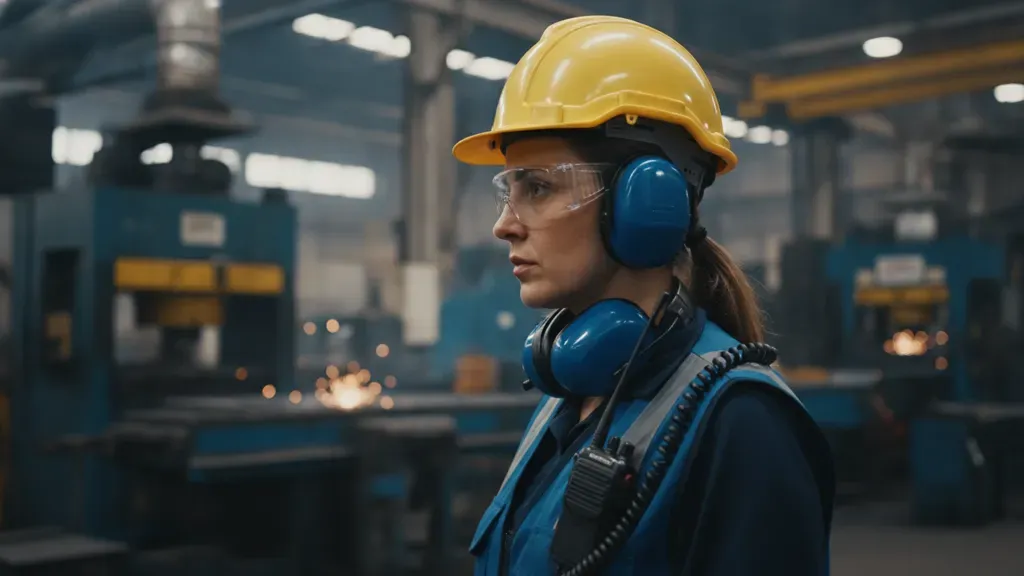
Communication needs should be part of the selection specification. For radio users, evaluate communication earmuffs or other manufacturer-approved systems that are designed for the work environment. Confirm whether the unit is passive, level-dependent, radio-connected, or dependent on another device. Review the operating instructions, power requirements, environmental limitations, and cleaning process before issuing it.
For teams that rely on face-to-face speech, consider protectors with communication-friendly designs, clear procedures for getting attention, visual signals, or designated low-noise communication points. In some settings, a level-dependent system can help preserve awareness of quieter speech while limiting louder sound, but the exact performance depends on the model and its configuration. Do not assume that any electronic feature replaces the site's noise assessment or fit verification.
Test the complete PPE combination in the actual work area. A headset may fit well in a break room but lose its seal when a hard hat, face shield, or respirator is added. Workers should be able to hear required alarms and instructions through the approved system, and supervisors should have a plan for abnormal conditions when the communication device fails.
How should workplaces clean, inspect, and replace hearing protectors?
Care requirements differ by material and design, so the manufacturer's instructions control. A simple site routine can still reduce common failures:
- Disposable plugs: discard when soiled, damaged, compressed, or no longer able to expand and seal. Do not wash foam plugs unless the product instructions specifically allow it.
- Reusable plugs: clean with the approved method, allow them to dry, and store them where they will not pick up dust, oil, or chemical residue.
- Earmuffs: inspect cushions, headbands, attachment points, wiring, controls, and seals. Replace cushions or other parts that are cracked, hard, flattened, torn, loose, or otherwise unable to maintain a seal.
- Communication systems: inspect microphones, cables, connectors, batteries, and controls. Remove damaged equipment from service rather than improvising a repair.
- All protectors: replace as necessary when condition, fit, hygiene, or performance is no longer acceptable. Keep replacement stock available so employees do not have to work without protection.
Make cleaning and inspection part of shift routines, toolbox talks, and supervisor observations. Ask workers what causes them to remove protection, then address the root problem through fit, comfort, communication, scheduling, or equipment changes instead of treating non-use as a discipline issue alone.
Which ear protection works for different workplace settings?
Manufacturing and industrial facilities
Production floors often combine continuous machinery noise with intermittent impact or alarms. Map zones, mark hearing-protection requirements, and evaluate whether employees move between areas with different exposures. Communication-capable muffs may help radio users, while plugs can be more practical for workers who wear other head and face protection.
Construction and maintenance
Noise can change quickly as crews move between tools, vehicles, demolition, and enclosed spaces. Select protectors that remain compatible with hard hats, eye protection, respirators, and face shields. Include short-duration tasks and subcontractor or visitor procedures in the site plan. A banded or earmuff option may be useful for intermittent work, but it still needs a suitable seal and documented selection.
Laboratories and clean work areas
Laboratories may have lower overall noise but still include centrifuges, compressors, animal facilities, mechanical rooms, or construction activity. Consider cleanability, contamination control, fit with goggles and respirators, and whether communication must remain clear for experiments or emergency response.
Food processing and facility operations
Moisture, washdown, temperature, sanitation, and frequent movement can change which materials and styles are practical. Select products that can be cleaned or replaced under the facility's hygiene procedures. Coordinate hearing protection with hair restraints, eye protection, bump caps, and other required PPE.
Contact Safety Company for help narrowing workplace hearing-protection options.
Frequently asked questions about workplace ear protection
Are ear plugs or earmuffs better for OSHA compliance?
Neither is automatically better. OSHA compliance depends on the employer's exposure assessment, hearing-conservation program, attenuation evaluation, fit, training, and consistent use. Offer suitable choices and verify that the selected protector works for the individual and the task.
Can workers wear ear plugs and earmuffs together?
They can when the exposure assessment and attenuation evaluation show that dual protection is appropriate and workers are trained to fit both devices. Do not add the two NRR values together. Use the applicable OSHA evaluation method and confirm that the combined PPE does not create another safety or communication problem.
How often should hearing protectors be replaced?
Replace protectors when they are damaged, dirty, worn, deformed, no longer seal or fit correctly, or cannot be cleaned according to the manufacturer's instructions. OSHA requires hearing protectors to be replaced as necessary. The exact replacement schedule depends on the protector, work environment, use, and manufacturer guidance.
Do higher-rated ear muffs always provide better protection?
No. The label rating is a laboratory value, and real-world protection depends on fit, wear time, noise characteristics, and compatibility with other PPE. A higher rating can also make communication and alarms harder to hear. Choose adequate, verified attenuation rather than the highest number by default.
What should a workplace do when employees cannot hear radios while protected?
Do not solve the problem by asking employees to remove protection in the noise area. Test an approved communication-capable protector, adjust the communication procedure, improve visual signals, establish lower-noise communication points, or reassess the control strategy. Recheck the fit and performance of the complete PPE system in the real work environment.
Build a workplace ear-protection plan with plugs, muffs, and compatible accessories.
Effective hearing protection combines measurement, engineering and administrative controls, suitable PPE, worker choice, training, fit verification, and routine replacement. Use the requirements that apply to your industry and document the decisions that protect employees in each noise environment.
Recent Posts
-
Ear Protection: Plugs, Muffs, and Communication
Choosing ear protection for a workplace is not just a matter of picking the product with the highest …Oct 21st 2026 -

LOTO Explained: Lockout/Tagout Steps for Safer Maintenance
LOTO, short for lockout/tagout, is an energy-control process that prevents a machine from starting o …Oct 12th 2026 -

N95 Respirator Guide for Workplace Safety
Dust, mist, fumes, and other airborne particles can create serious exposure risks before a worker no …Oct 12th 2026