
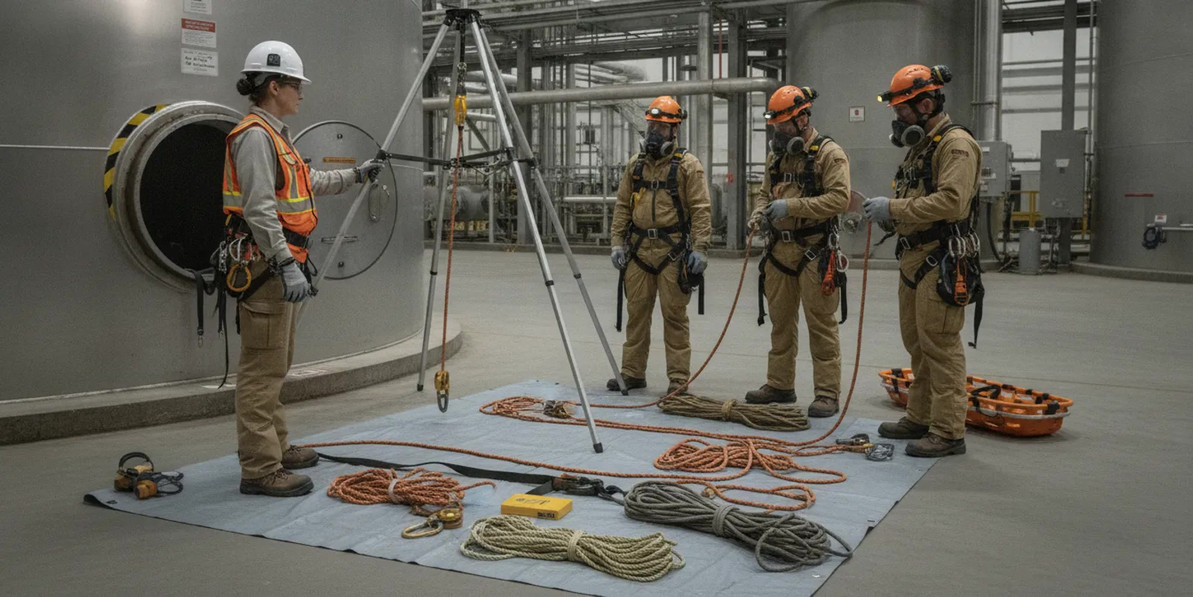
Confined Space Rescue: Equipment and Planning for Employers
Confined space rescue is not a plan to improvise after a worker is in danger. Employers should assess permit spaces, decide how rescue will be provided, assign trained roles, and confirm that people and equipment can respond to the actual hazards. A written plan is useful only when it fits the space, the work, and the response capability available that day.
Talk with a safety equipment specialist
What should a confined-space rescue plan accomplish?
A rescue plan should describe how a worker will be recovered promptly and safely if an incident occurs inside a permit-required confined space. It should not assume that a coworker can enter and pull the person out. An unplanned entry can expose another worker to the same atmospheric, engulfment, mechanical, or other hazards.
OSHA’s general industry permit-required confined-space standard addresses the employer’s rescue and emergency services arrangements. The construction standard also includes requirements for confined spaces in construction. Identify which standard applies to the work, then review its complete requirements with qualified safety personnel. See OSHA’s permit-required confined spaces standard and the construction confined-space standard.
The plan needs to answer practical questions: Who calls for help? Who can enter? What equipment is available and compatible with the space? How will rescuers communicate? Which hazards might change during the task? What happens if the planned resource is unavailable? A plan should name people by role, define the sequence of actions, and make the limits of each role clear.
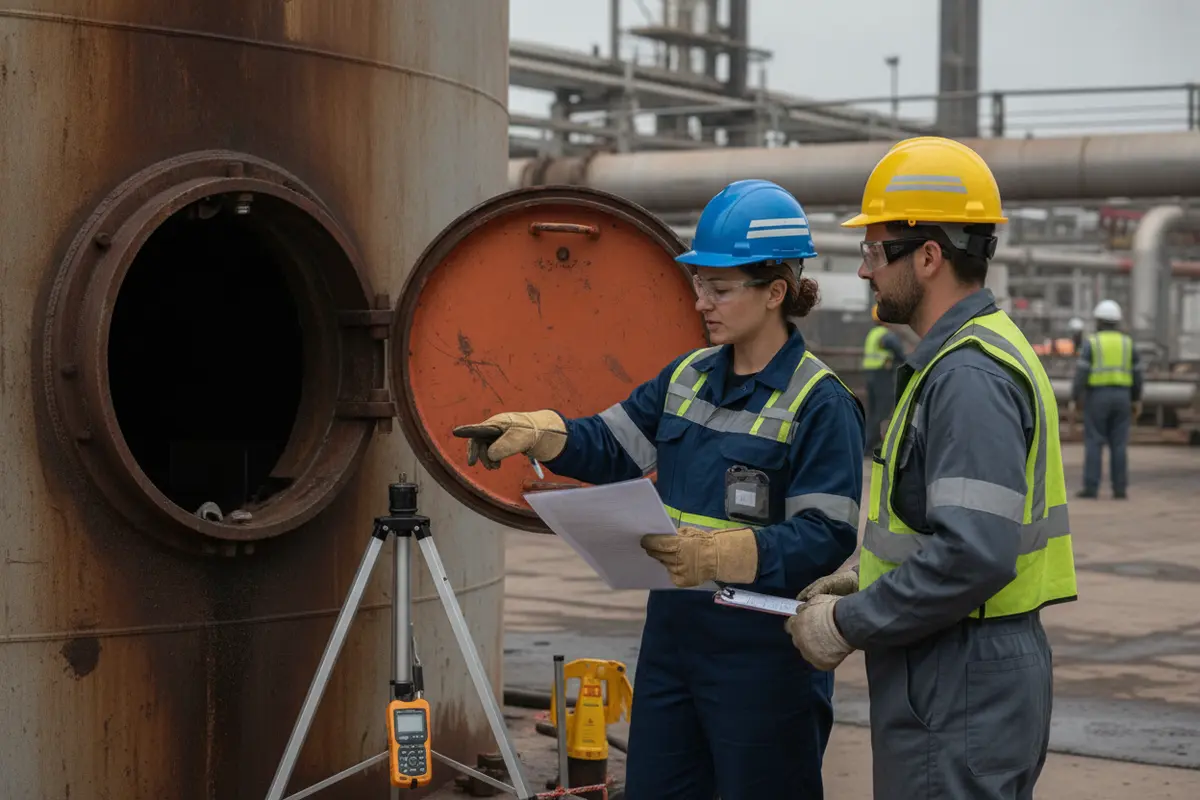
How should employers assess a permit space before work?
Start with the space and the job, not with a generic equipment list. Review the space’s configuration, access openings, internal obstructions, depth, potential hazards, and the work activities that could introduce new hazards. Consider the conditions before entry and how they could change while work is underway.
- Identify the space: Record its location, access points, entry route, and any features that could complicate retrieval.
- Identify hazards: Review atmospheric hazards, engulfment risks, mechanical or electrical hazards, and other conditions relevant to the specific space.
- Consider the task: Account for tools, materials, energy sources, ventilation, and work processes that could alter conditions.
- Review entry controls: Confirm the permit process, isolation measures, atmospheric testing and monitoring arrangements, attendant duties, and communication method as required by the applicable program.
- Consider rescue access: Decide whether non-entry retrieval is feasible and whether rescuers can reach and remove an entrant without creating additional exposure.
Do not treat a space’s previous safe entry as proof that the next entry presents the same conditions. Different tasks, equipment, materials, or environmental conditions can change the risk. Revisit the assessment when the job or conditions change, and stop work when the team cannot confirm that entry conditions and response arrangements remain acceptable.
Which rescue approach fits the space and hazards?
Rescue arrangements generally depend on whether a worker can be recovered without sending another person into the space, or whether entry rescue may be necessary. The employer should evaluate the space and the planned work to determine the appropriate method and ensure that the required responders are available. OSHA’s standard includes provisions concerning rescue and emergency services; do not substitute a generic checklist for review of the applicable rule and the site’s conditions.
| Planning consideration | Non-entry retrieval | Entry rescue |
|---|---|---|
| What happens | Equipment is used to remove an entrant without another rescuer entering, where feasible. | One or more trained rescuers enter under the rescue plan to reach and recover the entrant. |
| Key planning question | Can the entrant be safely moved through the opening and route with the selected arrangement? | Can the rescue service reach the space, enter with suitable controls, and perform the planned rescue? |
| Equipment and access | Check that retrieval equipment, attachment points, opening dimensions, and path are compatible with the space and task. | Assess access, hazard controls, rescue equipment, responder capability, and the support needed outside the space. |
| Important limitation | Retrieval may not be feasible or safe in every configuration or incident. | Entry rescue exposes rescuers to hazards and requires trained, equipped responders and coordinated procedures. |
Non-entry retrieval is not a universal solution. A line, harness, or lifting device can snag, be incompatible with the entrant’s position, or fail to provide a clear path through an opening. Evaluate the actual geometry and work position. If retrieval could worsen an injury or cannot be performed safely, the plan must address the appropriate alternative response rather than rely on a failed attempt.
Where a plan uses a personal fall protection or retrieval component, verify that the selected item is intended for the application and compatible with the complete system. For example, review the specifications and intended use of a Miller Titan anchorage connector as one component, not as a complete rescue system. A component listing does not establish that a system is suitable for a particular space or meets the employer’s rescue obligations.
What roles should the rescue plan assign?
People need to know their responsibilities before entry begins. Assign roles clearly, and make sure the team understands who has authority to stop work or initiate an emergency response. The precise roles depend on the employer’s program and applicable standard, but planning commonly addresses the following functions:
- Entry supervisor: Oversees entry authorization and verifies required preparations and conditions under the entry program.
- Attendant: Remains outside the space, tracks entrants, maintains communication, recognizes signs of trouble, summons help, and does not undertake unauthorized entry rescue.
- Entrant: Follows entry procedures, uses assigned equipment, communicates as directed, and alerts the attendant to signs of exposure or changing conditions.
- Rescue team or service: Performs the response specified by the plan, using trained personnel and the equipment and procedures appropriate to the hazards.
- Incident coordinator: Depending on the site structure, coordinates emergency calls, access for responders, site information, and communication with management or external services.
One person may hold more than one function only when the applicable requirements and the real-time workload allow it. A plan should avoid assigning tasks that compete for attention. For example, an attendant who must continuously monitor entrants should not also be expected to leave the entry point, retrieve equipment from a distant location, and coordinate multiple responders without a clearly workable arrangement.
How should employers select and check rescue equipment?
Choose equipment based on the assessment, rescue method, space geometry, and hazards. Do not select equipment solely because it is commonly used at another site. The system needs to work together, fit the space, and be available in a serviceable condition when entry starts.
- Confirm the intended application and manufacturer instructions for each component.
- Check compatibility across the complete arrangement, including attachment points and any retrieval device.
- Assess whether the setup can reach the entrant and permit a safe route out of the space.
- Consider whether the entrant’s work position, protective equipment, or task could interfere with retrieval.
- Make sure equipment is accessible, inspected as required, and protected from damage or obstruction.
- Train assigned personnel in the actual configuration and how to recognize when it cannot be used safely.
Employers may review applicable fall-protection equipment such as a D-ring extender when it is relevant to the assessed application. Product names and individual components do not establish compliance. Follow the manufacturer’s instructions and consult a qualified person when evaluating suitability, compatibility, and use.
Keep equipment checks connected to the work authorization. Before entry, confirm that the equipment specified by the plan is present, in usable condition, correctly configured, and accessible to the assigned personnel. If it is missing or damaged, do not proceed on the assumption that it can be borrowed or improvised after an emergency occurs.
For planning purposes, build a simple equipment readiness record tied to the space and task. Note the components required by the assessed method, where each item is staged, who checks it, and what condition triggers removal from service. The record is not a substitute for required inspections or manufacturer instructions. Its value is that a supervisor can see whether the planned configuration is actually available before authorizing entry.
How should communication and emergency escalation work?
The attendant and entrants need a dependable way to exchange information. Select a method that works in the space and accounts for noise, distance, protective equipment, and the task. Define check-in intervals or other signals in the site procedure, and state what action follows when communication is lost.
Emergency escalation should be specific. Document how to summon the designated rescue service, how to contact emergency responders when necessary, who meets them, and how they are directed to the exact space. Make space identification and hazard information readily available. An emergency call should communicate the location, number of affected people if known, known hazards, access route, and the response already underway—without delaying the call to gather nonessential details.
Establish a clear rule against unplanned entry. A worker who sees an entrant in distress may feel pressure to act immediately, but entering without the planned controls can create additional casualties. Train attendants to summon the designated response and follow the emergency procedure. Any change to the plan should be made by authorized personnel, not improvised under pressure.
Use a short message format in drills and briefings: identify the site and exact space, state what has happened, report known hazards and the number of people involved, describe access, and confirm who is meeting responders. Keep this information in a location the attendant can reach without leaving their assigned post. Rehearse the process so an emergency call does not depend on someone remembering a long document under stress.
How can teams prepare rescuers through training and drills?
Training should match assigned duties and the hazards of the spaces where people work. A responder needs more than general awareness: the team should practice the relevant communication method, equipment arrangement, access route, and sequence of actions. The exercise should also test whether the rescue service can respond as planned.
Use drills to identify practical gaps. A tabletop review can test decision-making and notification steps, while a hands-on exercise can reveal access, equipment, or coordination problems. Keep exercises controlled and do not create a hazardous entry merely to make a drill realistic. Plan the exercise so participants understand the scenario, their roles, and how to stop it safely.
- Practice the alarm, notification, and escalation sequence.
- Verify that responders can locate the space and obtain essential hazard information.
- Rehearse the planned retrieval or rescue method using the equipment configuration intended for work.
- Check communication with entrants and the attendant, including the response to lost communication.
- Record lessons, assign corrective actions, and confirm changes before the next entry.
Refresh training when assignments, equipment, procedures, or hazards change, and whenever an exercise or event shows that a person does not understand their role. A drill is useful only if the employer acts on what it reveals.
After an exercise, debrief by asking each role what information it needed, what delayed its next action, and which assumptions proved wrong. Separate observations from corrective actions. Assign an owner and due date for each fix, then verify the change through a follow-up review or exercise. If a drill exposes an unavailable rescue resource or inaccessible equipment, pause affected entries until the plan has been corrected.
Review fall-protection equipment options
How should employers coordinate with contractors?
When host employers and contractors share a site, exchange information before work begins. Identify the spaces and hazards, explain the entry procedures and emergency arrangements, and clarify which employer is responsible for each role. A contractor’s rescue plan should not be assumed to cover the host site unless the parties have verified that it addresses the actual space and work.
Coordinate changes during the job. If the task, equipment, space conditions, or rescue provider changes, communicate the update to affected workers and supervisors. Confirm that attendants know whom to call and that external responders can reach the space. Keep responsibilities explicit so an emergency does not expose gaps between organizations.
Before mobilization, conduct a joint walk-through of the entry point and responder route. Ask the contractor to explain its rescue capability and identify any assumptions it makes about site equipment or personnel. The host should share relevant hazards and access limitations. Record who owns notification, who stops work if the plan fails, and how updates reach every crew. Repeat the coordination when a new subcontractor or work phase changes the arrangement.
What should a confined-space rescue planning checklist include?
- Identify the space, entry point, hazards, work activity, and applicable confined-space requirements.
- Document entry controls, roles, communication method, and conditions that require work to stop.
- Determine whether non-entry retrieval is feasible for the entrant’s likely position and the space configuration.
- Specify the rescue service or team, response method, availability, and escalation route.
- Verify equipment selection, compatibility, inspection, access, and readiness against the plan.
- Train attendants, entrants, supervisors, and rescuers for their assigned responsibilities.
- Practice the response and correct gaps before relying on the plan for work.
- Coordinate with contractors and review the plan whenever conditions or work change.
A checklist supports the process but does not replace a permit-space program or a review of OSHA requirements. For site-specific decisions, consult qualified safety professionals and the complete standard that applies to the work. For suitable fall-protection components, review harness options and verify specifications against the assessed task rather than assuming any single item is appropriate.
Frequently Asked Questions
Can an attendant enter the space to rescue a worker?
An attendant should not make an unplanned entry. The attendant’s role is to monitor, communicate, summon help, and follow the established procedure. Entry rescue should be performed only by responders assigned and prepared to do so under the applicable plan and requirements.
Is non-entry retrieval always required?
Employers should evaluate non-entry retrieval where applicable, but it may not be feasible or safe in every space or incident. Assess the actual configuration, work position, and route, and plan an appropriate response if retrieval cannot be used.
Does owning retrieval equipment mean the employer has a rescue plan?
No. Equipment is only one part of a response. Employers also need suitable procedures, assigned and trained people, communication, availability of the rescue service, and coordination that reflects the hazards and space.
How often should a rescue plan be reviewed?
Review it when the space, work, hazards, equipment, personnel, or rescue arrangements change, and after drills or incidents identify a gap. Follow applicable OSHA requirements and the employer’s written program.
Effective confined space rescue planning connects the entry permit, trained people, compatible equipment, communication, and a realistic response into one coordinated system. Confirm those elements before each job so workers and responders know what to do if conditions change.
Recent Posts
-
Confined Space Rescue: Equipment and Planning for Employers
Confined space rescue is not a plan to improvise after a worker is in danger. Employers should asses …Nov 3rd 2026 -

Choosing the Best Cut Resistant Work Gloves for an Industrial Team
Choosing the best cut resistant work gloves for an industrial team starts with the task, not the pro …Nov 2nd 2026 -

Emergency Blankets: Workplace Emergency Planning and Selection
Emergency blankets can support a workplace response when a person is cold, wet, or waiting for help, …Nov 2nd 2026