
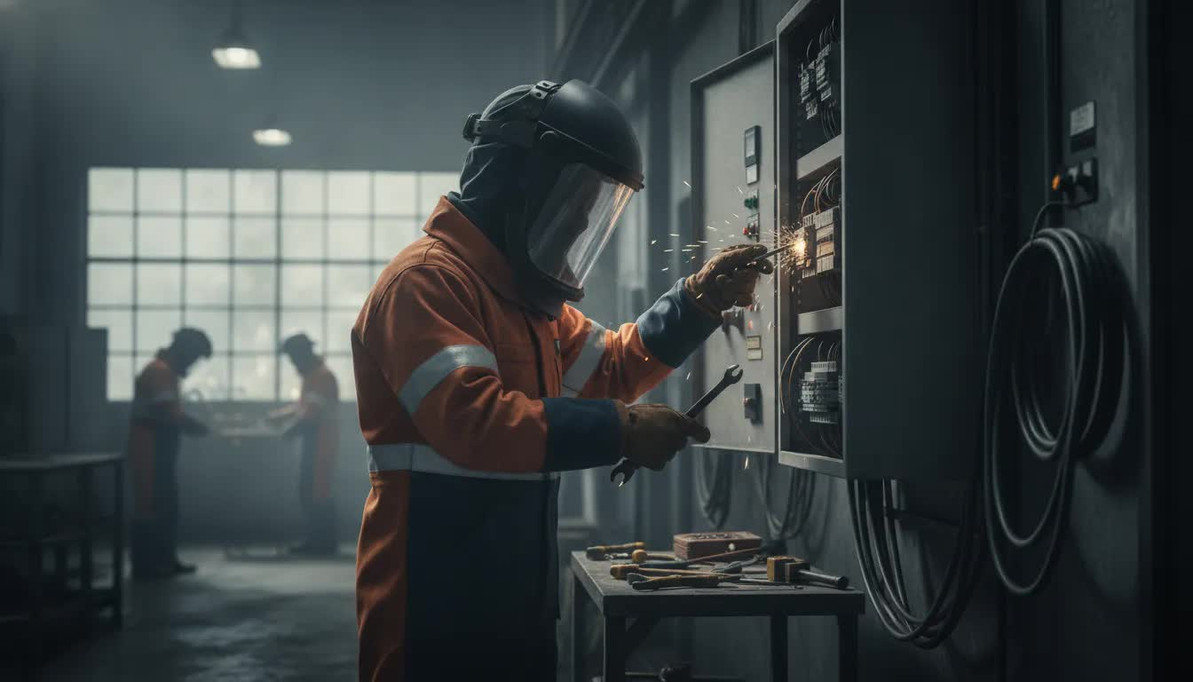
Arc Flash PPE Requirements for Industrial Facilities
An arc flash can turn an ordinary electrical task into a life-threatening event in a fraction of a second. The hazard is not limited to high-voltage equipment: OSHA notes that 120/208V systems can generate enough energy to burn exposed skin. Ignite clothing, and cause catastrophic or fatal injuries. Arc temperatures can exceed 35,000 F.
Arc flash ppe requirements begin with a documented hazard assessment, the correct NFPA 70E selection method, and a complete arc-rated ensemble matched to the task's exposure. PPE must supplement energized-work controls, not replace deenergization, lockout, and qualified-person procedures.
Shop compliant arc flash PPE kits from Safety Company
Effective compliance therefore depends on more than buying a jacket or face shield. Facilities must identify the work conditions, determine the potential incident energy or applicable PPE category, and ensure every protective component works as a system. The foundation is a disciplined assessment of the equipment, task, and worker exposure.
The Core Arc Flash PPE Requirements Every Facility Must Meet
Arc flash PPE requirements begin with a documented hazard assessment, not a product category selected from a catalog. OSHA requires employers to assess the workplace for hazards that are present or likely to be present and that necessitate personal protective equipment under 29 CFR 1910.132(d)(1). For electrical work, that assessment should align with the employer's safe work practices, equipment condition, task, and exposure. NFPA 70E supports this process by establishing practices intended to reduce injuries and fatalities caused by shock, electrocution, arc flash, and arc blast. OSHA explains that NFPA 70E was originally developed at its request for that purpose.
A sound program therefore connects three decisions: identify when energized exposure exists, determine the potential incident energy, and provide an arc-rated PPE ensemble appropriate to the task. Facilities should also document who is authorized to perform the work, what training is required, and how the selected PPE will be inspected and maintained. For additional background, review this guide to understanding arc flash hazards.
Start with the actual electrical exposure
Do not use nominal system voltage as a shortcut for judging arc flash severity. According to OSHA, incident energy depends primarily on amperage, cycle time, and the worker's distance from the arc, not voltage alone. A lower-voltage system can still create a dangerous event when available current and clearing time are significant. The assessment should account for the equipment, the intended work, approach distance, and the protective device's expected clearing time. These inputs help the qualified person determine whether an arc flash boundary exists and what protection is necessary for the specific job.
This distinction matters during procurement. A facility may have several electrical systems with different available fault currents and clearing times. The same glove, garment, or face protection decision should not automatically be applied across every panel, disconnect, or maintenance task without reviewing the exposure at each location.
Treat unverified deenergization as energized work
Deenergizing equipment is the preferred control when feasible, but a shutdown is not complete simply because a switch has been opened. OSHA 1910.333 states that conductors and electrical equipment that have been deenergized but have not been properly locked out or tagged must be treated as energized parts. Until the energy-control procedure is completed and the absence of voltage is verified by a qualified person. Workers must plan for energized exposure and use the controls and PPE required by the assessment.
That requirement should be reflected in written procedures, job briefings, and supervisor checks. It also helps prevent a common failure: assuming that a familiar panel or routine task is safe because it was deenergized previously. PPE is one layer of protection, not a substitute for lockout/tagout, electrical safe work practices, training, or properly maintained equipment. Review the task-specific assessment whenever equipment, procedures, personnel, or system conditions change.
What Do Arc Flash PPE Categories and Arc Ratings Mean?
NFPA 70E provides two recognized ways to select arc flash protection: the arc flash PPE category method and an incident energy analysis. A facility must choose the method that applies to the equipment and work being evaluated. These methods are not interchangeable, and they must not both be used for the same piece of equipment. The category method also should not be assigned from the results of an incident energy analysis. NFPA explains the distinction between these selection methods.
When the category method is appropriate, the category indicates a minimum level of arc-rated protection. The arc rating is expressed in calories per square centimeter, or cal/cm2. It represents the thermal energy exposure that the PPE is designed to withstand during an arc flash. It is not a substitute for an equipment-specific hazard assessment, work-practice controls, or the employer's OSHA compliance responsibilities.
| Arc flash PPE category | Minimum arc rating |
|---|---|
| Category 1 | 4 cal/cm2 |
| Category 2 | 8 cal/cm2 |
| Category 3 | 25 cal/cm2 |
| Category 4 | 40 cal/cm2 |
What the category numbers mean for compliance
A higher category requires PPE with a higher minimum arc rating, but the number alone does not describe every item a worker needs. The complete ensemble may include an arc-rated shirt or coverall, jacket or pants, gloves. Eye and face protection, head protection, and other components selected for the task and hazard. Each item must be suitable for its intended use and work together as part of the employer's documented electrical safety program.
Do not use the table to make a blanket decision for an entire facility. Arc flash risk varies by equipment, available fault current, clearing time, approach boundaries, task, and worker position. OSHA notes that incident energy depends primarily on amperage, cycle time, and worker distance rather than voltage alone: OSHA's electrical flash hazards guidance provides additional context. Even lower-voltage systems can create severe or fatal injuries, so voltage should not be treated as a reason to reduce protection.
For practical arc flash PPE requirements, document which selection method was used, confirm the applicable category or calculated incident energy. And verify the arc rating and components of every garment and accessory before work begins. When the equipment falls outside the category method's permitted applications, use a qualified incident energy analysis instead of forcing the work into a category. That disciplined approach keeps PPE selection tied to the actual electrical hazard and supports safer, more defensible compliance decisions.
Incident Energy Analysis vs. the Arc Flash PPE Category Method: Which Should You Use?
NFPA 70E provides two accepted ways to determine the arc flash PPE requirements for a piece of electrical equipment: the arc-flash PPE category method and the incident energy analysis method. A facility may choose the method that fits its equipment, documentation, and electrical safety program, but it must apply the choice consistently. The two methods are not combined for the same equipment. NFPA explains that either method may be used, but not both methods on the same piece of equipment. Read NFPA 70E guidance on the two methods.
How the arc-flash PPE category method works
The category method uses the applicable NFPA 70E tables. A qualified person identifies the equipment type, task, system conditions, and other table limits, then selects the corresponding PPE category. Each category carries a minimum arc rating for the required clothing and equipment. This approach can be practical for facilities with equipment and tasks that fit the table descriptions and with a program designed around the table-based process.
Its simplicity does not remove the need for careful evaluation. The table method has defined boundaries, including equipment configurations, working conditions, and task descriptions. If the installation or task falls outside those boundaries, the person responsible for the electrical safety program should not force a category selection. The facility should determine whether an incident energy analysis is more appropriate.
How incident energy analysis works
An incident energy analysis uses engineering calculations to estimate the thermal energy a worker could receive at a specified working distance during an arc flash. The result is typically expressed in calories per square centimeter and supports selection of arc-rated PPE based on the calculated exposure. OSHA notes that incident energy depends largely on factors such as amperage, clearing time, and worker distance, rather than voltage alone. That makes accurate system data, protective-device settings, and maintenance important parts of the analysis.
This method is often selected for facilities with complex distribution systems, unusual equipment, changing system configurations, or a need for equipment-specific incident-energy values. It can provide more granular information for labels, approach boundaries, and PPE selection, but it requires qualified electrical engineering work and current system information. A calculation is only as useful as the assumptions and data behind it.
Do not convert an analysis into a PPE category
NFPA 70E Section 130.7(C)(15) addresses a critical compliance distinction: when the arc flash PPE category method is used. It is not permitted to specify an arc flash PPE category based on the results of an incident energy analysis. In practice, a facility should select one method for the equipment, document that method, and use the resulting requirements without blending labels or terminology from the other approach. This prevents personnel from receiving ambiguous instructions at the point of work.
The responsible employer should also ensure that the selected method is reflected in the electrical safety program, equipment labels, job planning, and training. When conditions change, the facility should reassess whether the existing method and underlying information still represent the work employees perform.
Arc Flash PPE Components: Building a Head-to-Toe Protection Ensemble
OSHA and ANSI compliance depends on more than selecting a flame-resistant shirt or a pair of gloves. A qualified person must evaluate the electrical task, determine the applicable arc flash PPE requirements, and ensure that the complete ensemble is appropriate for the hazard. Each item must work with the others without leaving exposed skin, incompatible layers, or gaps in coverage.
Protect the head, face, and neck
An arc-rated hood or faceshield helps protect the face and head from the thermal energy, pressure, and flying debris associated with an arc flash. The choice depends on the task, the equipment, the required arc rating, and the facility's electrical safety program. A faceshield should be used with the other head and face protection specified for the hazard. Rather than treated as a substitute for a complete hood when greater coverage is required. An arc-rated balaclava can provide additional coverage around the neck, ears, and sides of the face where a standard faceshield may not protect fully.
Use arc-rated clothing as a complete system
The clothing layer typically includes an arc-rated shirt or jacket and pants, or an arc-rated coverall or suit designed for the work. Select the garment system for the required category or incident energy level, and follow the manufacturer instructions for compatible components. Sleeves should cover the arms during the task, closures should be secured, and the fit should allow movement without exposing the wrists, waist, or ankles. Clothing that is merely labeled flame-resistant is not automatically suitable for every arc flash exposure. The garment's arc rating must match the documented hazard assessment.
Pair voltage-rated gloves with leather protectors
Rubber insulating gloves are selected by voltage class for the electrical exposure. They address shock protection, but they are not the only hand protection needed for energized work. Leather protectors are worn over the rubber gloves when required to help guard the insulating gloves against cuts, abrasion, and mechanical damage. Keep the glove and protector combination compatible, inspect both before use, and use the class and sizing specified by the employer's electrical safety procedures.
Do not overlook feet and lower-leg coverage
Arc-rated footwear or an arc-rated covering can complete protection below the waist, particularly where the task or equipment configuration creates exposure near the ankles or lower legs. Footwear selection should account for the work environment, electrical hazards, traction, and the required arc rating. Regular work boots alone should not be assumed to satisfy the arc flash protection plan unless their specifications and the applicable program identify them as suitable.
Finally, verify the rating and condition of every component before work begins. OSHA identifies electrical hazards as a compliance issue, while NFPA 70E provides safe work practices intended to reduce exposure to shock, electrocution, arc flash, and arc blast. Safety Company distributes PPE from vetted major brands, helping industrial and construction teams assemble a documented. Task-specific ensemble rather than relying on a single oversized garment or a generic kit.
What Should Workers Wear Under Arc-Rated Clothing?
Arc-rated outerwear is only effective when the entire clothing system is appropriate for the electrical hazard. Under OSHA requirements, workers must not wear flammable or meltable undergarments beneath arc-rated PPE. An outer layer can carry an arc rating and still leave the worker exposed if a shirt. Base layer, underwear, or other garment underneath can ignite or melt during an arc event.
This requirement is central to a complete approach to arc flash ppe requirements. OSHA states that meltable or flammable undergarments are dangerous and prohibited under 29 CFR 1910.269 because they may ignite or melt when exposed to an electric arc. The agency also reports that most arc flash burn injuries result from the arc igniting flammable clothing, rather than from the direct energy of the arc itself. These hazards make base-layer selection a compliance decision, not simply a matter of comfort.
Choose non-melting layers
Workers should select undergarments and base layers made from non-melting natural fibers, such as cotton or wool. When those materials are permitted by the facility's hazard assessment and the PPE manufacturer's instructions. These layers should be comfortable enough to remain fully covered and should not contain exposed synthetic components that could melt against the skin. Follow the garment labeling and the employer's written electrical safety program when selecting specific products.
Non-melting does not automatically mean arc-rated. A natural-fiber shirt may resist melting but still ignite, so it should not be treated as a substitute for the required arc-rated shirt, coverall, or other outer garment. The complete ensemble must match the incident energy exposure or the applicable PPE category method selected for the equipment. Do not combine methods or assume that a heavier-looking layer provides the required protection.
Avoid meltable synthetic materials
Common synthetic fibers, including nylon, polyester, polypropylene, and acetate, can melt, drip, or ignite when exposed to arc energy. Avoid these materials in garments worn under arc-rated clothing unless the product is specifically designed, tested, and labeled for the intended electrical hazard. Pay attention to athletic base layers, thermal underwear, elastic components, and blended fabrics, since a garment's casual appearance does not establish its protective performance.
Before work begins, supervisors should verify that the clothing system is compatible, properly sized, and worn as designed. Workers should also report damaged or contaminated garments and replace them according to the employer's PPE program. Correct layering prevents a compliant outer garment from being undermined by an unsafe base layer.
Inspecting, Caring for, and Replacing Arc Flash PPE
Meeting arc flash ppe requirements is not a one-time purchasing decision. A garment, hood, glove, or face shield protects workers only when it remains serviceable, fits correctly, and is used as part of the facility's documented electrical safety program. NFPA 70E practices and OSHA hazard controls should guide the inspection and care process. Especially because even a 120/208V system can produce enough energy to burn exposed skin, ignite flammable clothing, and cause catastrophic or fatal injuries. OSHA explains the hazard associated with arc flash events.
Inspect before every use
Before entering an applicable electrical work area, inspect every item in the ensemble under good lighting. Look for holes, tears, open seams, frayed edges, broken closures, missing fasteners, and stretched elastic. Check that face shields and hood windows are clear, free of cracks, and securely attached. Examine gloves for cuts, punctures, brittleness, and other damage, and confirm that the glove class and protector combination remain appropriate for the task. Inspect footwear for worn soles, exposed material, or damage that could compromise protection.
Gear should also be free of contamination and excessive wear. Oil, grease, chemicals, metal particles, paint, and other substances may affect fabric performance or remain combustible during an arc event. Inspect arc-rated clothing before every use, and replace any item that shows damage, contamination, or wear. Do not rely on an appearance that seems acceptable from a distance.
Store and clean gear correctly
Store PPE in a clean, dry, ventilated location away from direct sunlight, moisture, sharp tools, welding sparks, chemicals, and unauthorized modifications. Do not leave garments compressed under heavy equipment or folded while damp. Keep hoods, shields, and gloves protected from scratches and deformation. Separate clean serviceable equipment from items awaiting inspection, laundering, repair, or disposal.
Follow the care label and the manufacturer's instructions for laundering and cleaning. Use only approved detergents and methods. Avoid bleach, fabric softeners, solvents, starch, or other products unless the manufacturer specifically permits them. Improper washing can change the fabric's performance, damage reflective trim, or leave contamination behind. Allow items to dry completely before storage, and never alter the garment or add unapproved patches, decals, or closures.
Know when to retire PPE
Remove gear from service immediately when it is torn, burned, chemically contaminated, permanently stained, heavily worn, or otherwise unable to meet the manufacturer's care and performance requirements. Retire damaged shields, gloves, and accessories rather than attempting an improvised repair. Maintain an inspection and replacement process that identifies who evaluated the item, what defect was found, and whether a qualified manufacturer-approved repair is possible. When fit changes because of damage, layering, or worker needs, reassess the complete ensemble before the next energized task.
How to Select the Right Arc Flash PPE for Your Facility
Arc flash PPE selection should be based on a documented hazard assessment and the applicable OSHA, ANSI, and NFPA 70E work practices. The objective is not to purchase the heaviest gear for every task. It is to identify the hazard at each job location, assign the correct protection level, and ensure the complete ensemble works together without leaving an exposed gap.
- Conduct an arc flash risk assessment. Begin by identifying equipment, tasks, approach boundaries, operating conditions, and the locations where employees may be exposed to energized parts. Review normal and abnormal work activities, including installation, testing, troubleshooting, switching, and maintenance. Under OSHA 1910.333, conductors that have been deenergized but not properly locked out and tagged must still be treated as energized parts. Your assessment should therefore confirm when equipment can be placed in an electrically safe work condition and when energized work controls and PPE remain necessary. Document the assessment by equipment and task, rather than relying on a single facility-wide assumption.
- Determine the incident energy or PPE category for each task. For each applicable piece of equipment, use one NFPA 70E selection method: an incident energy analysis or the arc flash PPE category method. Do not combine both methods on the same equipment, and do not assign a PPE category based on incident energy analysis results. If the category method applies, use the category specified for the equipment and task. The category arc ratings are 4, 8, 25, and 40 cal/cm2. If an incident energy analysis applies, use its documented incident energy value and working distance to establish the minimum arc rating. Keep the calculation or category basis with the equipment record so supervisors and workers can verify the selection.
- Match arc-rated garments and gear to that level. Select clothing and equipment with an arc rating at or above the required level for the task. The ensemble may include an arc-rated shirt and pants or coverall, arc-rated jacket, hood or faceshield, balaclava, gloves, and footwear, depending on the exposure. Make sure the protection covers the worker's head, face, neck, hands, torso, arms, legs, and feet as the task requires. A low-voltage label is not enough to dismiss the hazard. OSHA notes that even 120/208V systems can generate enough energy to ignite clothing and cause severe or fatal injuries. For a relevant product option, review Safety Company's arc flash PPE kits.
- Verify that every component is arc-rated and compatible. Check the label, arc rating, voltage class, size range, and intended use of each item before approving it. Do not assume that a non-rated accessory becomes protective because it is worn under or over an arc-rated garment. Confirm that gloves, face protection, hoods, layers, closures, and footwear are suitable for the identified electrical and thermal hazards. Flammable or meltable undergarments are prohibited under the cited OSHA requirements because they can ignite or melt during an arc flash. Inspect each item before use and remove damaged, contaminated, or worn gear from service.
- Standardize the procurement and review pipeline. Convert the assessment into a controlled purchasing specification for each equipment type and task. List the required method, minimum arc rating, garment configuration, glove voltage class, sizes, replacement criteria, and required accessories. Have qualified electrical and safety personnel review substitutions before purchase. Store the approved specifications with training and job planning materials, then audit inventory and field use periodically. A standardized pipeline prevents informal substitutions, keeps replacement items aligned with the documented hazard. And gives supervisors a repeatable way to confirm that workers have compliant protection before the task begins.
Build your compliant arc flash PPE kit from Safety Company
Frequently Asked Questions
What are the NFPA 70E requirements for arc flash PPE?
NFPA 70E requires the employer to establish electrical safety practices, assess hazards, and select protection appropriate to the work and exposure. Facilities generally use either the arc flash PPE category method or an incident energy analysis method for a given piece of equipment, not both. See NFPA 70E guidance.
Does OSHA require arc flash PPE?
OSHA requires employers to protect employees from recognized electrical hazards and to assess the workplace for appropriate personal protective equipment. Before work begins, conductors that are deenergized but not properly locked out or tagged must be treated as energized under OSHA 1910.333.
What is the difference between arc flash PPE categories 1 through 4?
The categories represent increasing minimum arc-rating levels: Category 1 is 4 cal/cm2, Category 2 is 8 cal/cm2, Category 3 is 25 cal/cm2, and Category 4 is 40 cal/cm2. Use the category method only when the equipment and task meet the applicable NFPA 70E conditions.
What clothing materials are required under arc-rated PPE?
Wear non-melting, non-flammable underlayers beneath arc-rated outer clothing. Meltable or flammable undergarments can ignite or melt during an arc flash and are prohibited in the circumstances addressed by 29 CFR 1910.269. Clothing selection should also account for the complete head-to-toe ensemble.
How do you inspect arc flash PPE for compliance?
Inspect every item before each use. Remove and replace gear that has damage, contamination, excessive wear, compromised closures, or other conditions that could reduce its protective performance. Follow the manufacturer care instructions and retain required arc-rating and inspection documentation.
Get Compliant Arc Flash PPE for Your Facility
Meeting your arc flash ppe requirements starts with the right equipment, matched to the hazard assessment for each task. As a specialty B2B industrial safety distributor, Safety Company stocks a broad selection of arc-rated clothing, hoods, gloves. And complete arc flash PPE kits from vetted major brands, so your team can be fitted with a complete, compliant ensemble without juggling multiple suppliers.
Every order is backed by the 5-Star Total Satisfaction Guarantee, with no minimum orders, no memberships, and SSL-secured checkout for safe purchasing. Specially trained representatives can help you confirm ratings, sizes, and compatibility before you buy.
Contact Safety Company to discuss your arc flash PPE requirements and request guidance for your facility. Our team is available by toll-free phone or live chat during business hours to answer questions, confirm product details, and support volume and specification purchases.
Recent Posts
-
Face Shield for Grinding: Selection and Safety Guide
Grinding can send fragments, sparks, dust, and other debris toward a worker's face in an instant. Th …Sep 30th 2026 -
Prescription Safety Glasses: Workplace Guide
Prescription safety glasses help employees maintain clear vision without giving up protection from w …Sep 10th 2026 -

Safety Vest Guide: ANSI Classes and Fit Tips.
On a busy jobsite, a high-visibility garment is part of a worker-protection plan, not simply a brigh …Sep 8th 2026