

Safety Training Matrix: What Workplace Buyers Should Know About OSHA Training
An osha training matrix helps workplace buyers connect job tasks with hazards, instruction, skill checks, and protective equipment. It is a planning aid, not a universal checklist: requirements depend on the work, applicable standards, and the employer’s hazard assessment. The useful question is not simply which courses to buy, but what each worker must understand or demonstrate before doing a particular task.
Talk with a safety supply specialist
What should an OSHA training matrix help a buyer decide?
A practical matrix makes decisions visible. It identifies the people who perform work, the tasks and conditions that matter, hazards and controls, instruction to provide, how learning or proficiency is checked, and the records that show what occurred. It can also point buyers toward equipment information needed for a task. It should not replace an assessment, procedure, or review of the standards that apply.
Build entries around work rather than titles alone. Two employees called “operator” may use different machines, work in different areas, or handle different materials. Meanwhile, employees in production, maintenance, and warehousing may share a hazard but need different instruction because their tasks and exposure differ. Job titles can organize the matrix, but the task description is what makes it useful.
Separate three kinds of entries. First are training or qualification requirements you have verified in an applicable rule. Second are employer procedures or local instruction needed to do the work safely. Third are optional refreshers or awareness topics. Labeling the difference helps a buyer avoid confusing a useful course with a legal requirement, and it helps supervisors know what must be completed before assignment.
How should you build the matrix from real work?
- List work groups and tasks. Start with departments and roles, then break broad duties into activities. Include routine operation and, where relevant, setup, cleaning, troubleshooting, maintenance, material handling, and emergency response. Ask employees what they actually do when a line jams, a changeover runs late, or a task falls outside the normal sequence.
- Describe where and when the work happens. Note work area, equipment, shift, materials, environmental conditions, and whether the task is occasional or routine. A task performed outdoors, in a lab, or near a moving production line may need different controls and preparation even if its name is similar.
- Identify hazards and existing controls. Review the employer’s hazard assessments, procedures, equipment documentation, incident and near-miss learning, and worker observations. Describe the exposure source rather than entering only a broad label such as “PPE.” Consider what could change the exposure, including a different material, tool, location, or work method.
- Verify applicable requirements. Check the actual standard and scope for the task rather than relying on a course title, vendor description, or another employer’s spreadsheet. Record the reference, who checked it, and when. If applicability is unclear, assign the question to the designated safety or compliance owner instead of turning an assumption into a permanent matrix entry.
- Define the learning outcome. State what the worker needs to know or demonstrate. For example, an entry might require recognizing a specified hazard, following the current procedure, selecting the designated equipment, or demonstrating a safe operating step. Avoid an entry that says only “general safety” when the job calls for a task-specific capability.
- Choose delivery and verification. Identify the instructor or responsible party, when instruction is due, and how the team will confirm understanding. A knowledge check may fit some topics; a hands-on demonstration or observation may be more suitable for a practical skill. Make the verification method match the outcome.
- Connect controls, PPE, and records. Point to relevant procedures and equipment specifications, and state what instruction about use, limitations, care, or inspection is needed. Identify the record that documents completion or demonstrated ability, its owner, and where it is kept.
Keep the first version manageable. A useful starting point is a small set of high-risk or frequently assigned tasks, followed by a review with the people who perform and supervise them. Test the entries before expanding them across the organization. If users cannot tell which task or person a row covers, refine the wording before adding more rows.
| Matrix field | What to record | Question for review |
|---|---|---|
| Role and task | Work group, activity, and relevant conditions | Does this match actual work? |
| Hazard and controls | Exposure source and current procedure or control | Is the assessment current and task-specific? |
| Training | Verified requirement, outcome, delivery, and timing | Was the source checked and the outcome stated? |
| Verification | Knowledge check, demonstration, or observation as appropriate | Can the worker show the needed capability? |
| Equipment | Relevant PPE, limits, compatibility, and care instruction | Does the selection fit the assessed hazard? |
| Evidence and ownership | Record location, owner, review trigger, and completion status | Can a responsible person find and interpret the evidence? |
How should training and PPE decisions work together?
Training and equipment selection should inform each other, but neither substitutes for hazard assessment. First establish the task, exposure, applicable requirements, and required performance. Then identify the controls and PPE that fit those conditions. Instruction should address the equipment workers will actually use, including relevant limitations, fit or adjustment, inspection, cleaning, storage, and replacement processes.
Consider a packaging team that handles material with sharp edges. A matrix entry that says only “hand protection” does not tell a buyer what to compare or a supervisor what to teach. The team should examine the material, how it is grasped, whether the work needs dexterity or grip, and other hazards present at the same time. It should connect the assessment to product performance information and define how workers learn the selection, use, and care requirements. A product listing such as HexArmor PointGuard 3043 gloves can be reviewed as an equipment reference; the listing alone does not establish suitability for a particular task.
Work at height requires a different set of questions. The employer needs to evaluate the work method, fall exposure, equipment compatibility, anchorage, inspection, and emergency arrangements under the requirements that apply. The instruction entry should match the actual equipment and procedure. A FallTech roofer’s kit listing is a product reference to assess against the application, not a substitute for system planning or task-specific instruction.
Use the same reasoning for eye, hearing, respiratory, or other protection: define the hazard before selecting a product, and do not infer compliance from a product name. For example, a Radians Voltage safety eyewear listing is information to compare with the employer’s requirements and assessment. Record the approved selection and the worker instruction that goes with it. A matrix can clarify that connection without claiming that one item fits every application.
How can buyers compare training needs across roles?
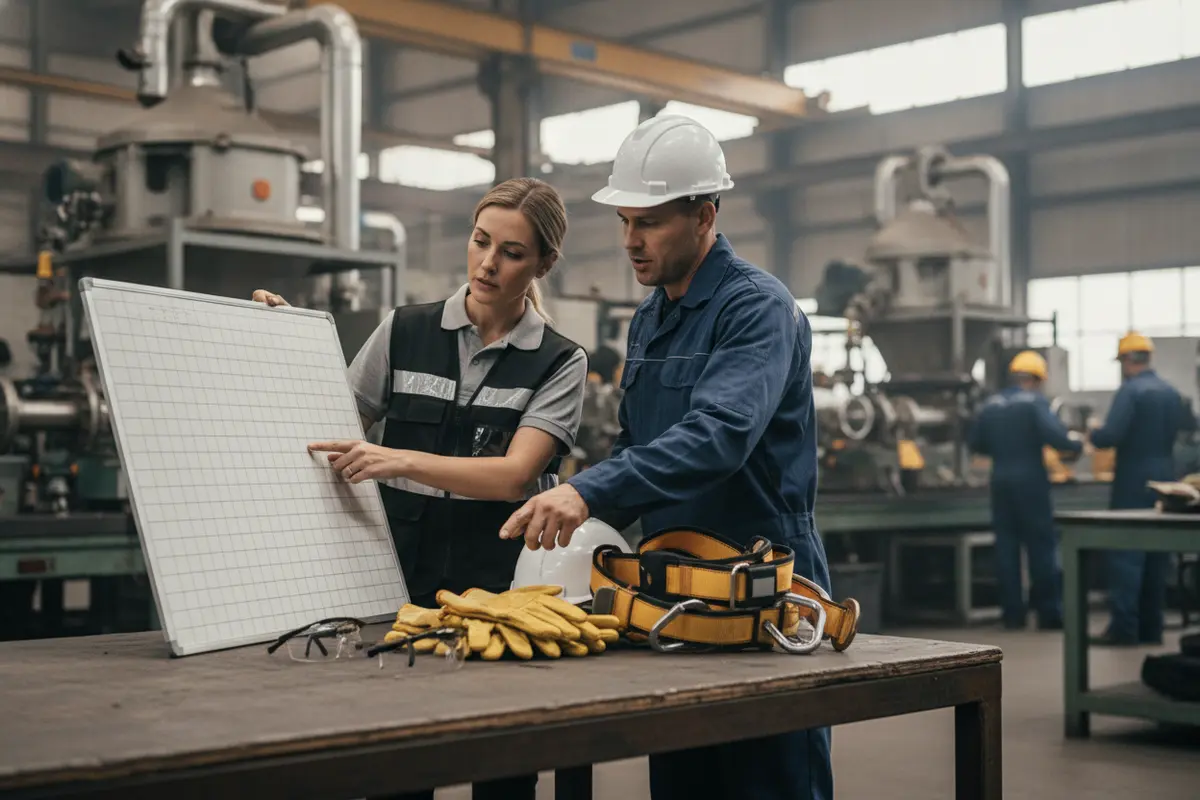
Use a role-and-task map to identify shared topics while preserving meaningful differences. The sample below illustrates questions for a buyer to resolve; it is not a determination of legal requirements. Verify the actual work, equipment, hazards, and standards at your own site before assigning training or selecting products.
| Work group and activity | Questions to resolve | Matrix entry to define | Evidence to connect |
|---|---|---|---|
| Production employee operating equipment | Which machine and conditions? What activities are within the assignment? | Applicable instruction, operating limits, required checks, and skill verification | Training record and the appropriate skill check or authorization record |
| Maintenance employee servicing equipment | What energy sources and servicing steps are involved? Which current procedure applies? | Task-specific procedure, required instruction, authorization, and change triggers | Training evidence and procedure version or other records required by the employer |
| Warehouse employee moving loads | What equipment, routes, loads, and changing conditions affect the task? | Relevant operating practices, hazard recognition, and practical checks | Completion record and observed performance where appropriate |
| Contractor entering an active work area | Which site hazards, work interfaces, and emergency arrangements must be communicated? | Site information, coordination roles, and task-specific expectations | Orientation and communication evidence under the site process |
| Supervisor assigning work | How are needed instruction and qualifications checked before assignment? | Assignment checks, escalation steps, and follow-up responsibility | Evidence specified by the employer’s process |
For each row, decide who determines applicability, who schedules the instruction, who verifies capability, and who follows up on gaps. This ownership matters. A course may be available, but that does not ensure the right employee completes it before a task begins. Likewise, the person who orders equipment may not be the person who approves it for a hazard. Make those roles explicit.
A useful test is to compare two similar-looking assignments. Suppose a warehouse employee sometimes moves packaged goods with a particular device and sometimes works in a pedestrian area with different traffic conditions. The job title has not changed, but the route and exposure have. The matrix should capture the relevant task distinction, communicate which instruction applies, and point to the site procedure. Do not create duplicate courses merely because the location changes; first determine whether the learning outcome and required instruction actually differ.
What records should a matrix connect?
A matrix should point to evidence that answers who received what instruction, when it occurred, who provided or verified it, and what task or requirement it addressed. Depending on the subject and applicable rules, the supporting evidence may be a roster, learning record, practical evaluation, procedure acknowledgment, or qualification record. Follow the requirements that apply and the employer’s retention process; do not assume one generic attendance sheet captures every necessary detail.
Use consistent topic and task names. If the matrix calls a topic “equipment operation” while the training record uses a course code that means nothing to the reviewer, the connection is weak. Add a reference or identifier and keep the corresponding procedure or training material version accessible. If content changes materially, note which version workers received and assess whether the change calls for additional instruction.
Distinguish status from evidence. A cell marked “complete” is a useful status indicator, but it is not the underlying record and may not show demonstrated ability. For a practical skill, decide how the evaluator documents an unsuccessful demonstration, coaching, reassessment, and authorization to perform the work, as appropriate to the task. Define how a temporary exception is recorded and who can approve it.
Make overdue items actionable. Assign an owner, a due-date process, and a method for preventing an unprepared worker from being assigned to work that requires completed instruction. A report of overdue items should show the person, task, topic, and next action rather than just a total count. Limit access to personal training records to the staff who need them, while making relevant status information available to supervisors responsible for work assignments.
How should teams manage role changes and contractors?
Build the matrix into the assignment process, not only the annual review. When a worker moves into a new role, compare the new task list with existing training evidence. Identify gaps before the person performs work that requires instruction or qualification. Similar job titles do not prove that equipment, hazards, or procedures are the same.
For temporary assignments, agree on a trigger for checking readiness: a move to a different area, an unfamiliar machine, a process change, or a task that is performed infrequently. A supervisor can ask whether the worker has the needed instruction, whether the procedure matches current conditions, and whether required equipment is available and appropriate. If any answer is uncertain, route the issue to the designated owner before proceeding.
Contractor coordination requires clear communication about site-specific information and overlapping work. Decide who provides site orientation, who explains hazards and emergency arrangements, who coordinates simultaneous activities, and how relevant updates are exchanged. A host employer’s matrix can record its own responsibilities and the evidence it receives; it should not imply that one employer’s training record automatically satisfies another employer’s obligations.
Make onboarding practical. Before a new employee performs a task, the supervisor should be able to find the applicable matrix entry, the current procedure, the status of required instruction, and any PPE or equipment requirements. If one of those items is missing, the process needs an escalation route. A simple readiness check is more reliable than asking a worker to remember which course might apply.
When should the matrix be reviewed and updated?
Review the matrix when equipment, materials, procedures, work locations, or assignments change. Also consider incident and near-miss learning, audit findings, changes to applicable requirements, and worker feedback. A scheduled review can catch stale information even when nobody has reported a specific change. Set a named owner and a defined interval suited to the operation rather than assuming that someone will notice every update.
Use a change log instead of silently overwriting rows. Capture what changed, why, who reviewed the effect, which tasks and roles are affected, and whether instruction or equipment follow-up is needed. A new tool may affect a single work cell; a revised emergency process may apply across several departments. The log helps teams assign the right follow-up and later confirm that it was completed.
Compare the matrix with work as it is actually performed. Walk the area with supervisors and employees; review procedures, equipment inventories, onboarding materials, and relevant incident learning. Ask whether workers have informal workarounds or whether a task has been added without updating the instruction. If actual practice differs from the written process, resolve the safety issue rather than merely changing the matrix to reflect an unapproved shortcut.
Not every change requires a new course. The responsible reviewer should decide whether the existing instruction still addresses the hazard and outcome, whether workers need an update, and what evidence should document that decision. This avoids both extremes: leaving workers unaware of a meaningful change or repeatedly assigning broad training that does not address the specific gap.
How can buyers evaluate training materials?
Compare materials with the applicable requirement and the task-specific outcome in the matrix. Ask whether the content describes the relevant hazard and controls, fits the equipment and work setting, and gives learners a way to demonstrate understanding. Consider whether a classroom, online, coached, or hands-on format matches the topic. A course title or completion certificate by itself does not demonstrate that every workplace obligation has been met.
Ask the internal trainer or provider to map each lesson to the matrix outcome. What must the worker do differently after instruction? Which part of the course covers it? How will the team verify learning? Who updates the material when equipment or procedures change? Preserve the answers with the course review so the next reviewer can see why the material was selected and what still needs local instruction.
Northern Illinois University’s Environmental Health and Safety training matrix notes that department-specific training may also be needed to safely operate tools, machinery, or equipment and to participate in specific operations. Review the university’s training matrix as an example of connecting general topics to department work, then verify the requirements for your operation. The Training Needs Assessment Guide describes a yes/no approach for identifying training needs under PEOSH and OSHA standards. These are planning references, not replacements for checking the rules that apply at your workplace.
Ask about workplace safety equipment
How should product documentation fit the purchasing process?
Procurement is a useful point to link equipment information to the training plan. Before comparing products, record the task, hazard, required performance, applicable specifications or standards, and compatibility needs. Review manufacturer information and product markings against those needs. If key specifications are unclear, ask for clarification and refer the question to the employer’s safety decision-maker before treating the item as approved.
For example, eye protection may need to address impact, splash, dust, or another exposure, depending on the task. The buyer should identify the hazard and applicable requirements, compare documentation, and confirm compatibility with other equipment. The Radians Voltage eyewear listing is one product reference to review, not a universal recommendation. The matrix can record who is assigned the approved equipment and what instruction on use, limitations, cleaning, or inspection applies.
For fall protection, think about the planned system and task rather than one component in isolation. Check equipment compatibility, use conditions, inspection needs, and rescue planning with the people responsible for the program. Then connect the system and procedure to the workers who need relevant instruction and the method used to verify their understanding. A product reference, such as the FallTech roofer’s kit listing, can inform a product review but cannot establish that a complete setup suits a particular worksite.
Use the matrix to expose unresolved purchasing questions. If the entry says a task requires protective gloves but does not identify performance needs, material compatibility, or use conditions, the buyer has not yet received enough information to select an item. If documentation indicates a limitation that conflicts with the work, pause the selection and ask the appropriate safety owner to reassess. Keep the decision and rationale accessible to purchasing and operational staff.
What should an implementation checklist include?
- Name an owner for the matrix and owners for individual training topics.
- Map roles to actual tasks, hazards, current controls, and applicable requirements.
- Write measurable instruction outcomes and choose suitable verification methods.
- Connect each relevant equipment entry to hazard assessment and product documentation.
- Define how onboarding, role changes, contractors, and unfamiliar equipment are checked.
- Set review triggers, record owners, overdue follow-up, and exception handling.
- Review the draft with supervisors and employees who perform the work.
- Test one employee and one task from assignment through instruction, evidence, and equipment review.
For the last test, trace the chain in both directions. Starting with a task, can the team identify the hazard, required instruction, evidence, and equipment decision? Starting with an employee, can a supervisor tell which tasks the person may perform and what remains due? A break in either direction points to a stale entry, missing record, unclear ownership, or unresolved selection question.
Choose a format people can maintain accurately. A small operation may work with a controlled spreadsheet; a larger organization may need role-based access and managed records. In either case, use version control, clear responsibilities, and a repeatable update process. A matrix is useful when workers and supervisors can rely on it as work changes—not because it is long or complicated.
Discuss equipment information with our team
Frequently Asked Questions
Does every employer have to use an OSHA training matrix?
A single universal matrix format is not the point. Specific standards may require training or records for particular work or hazards, and employers should identify the rules that apply. A matrix is one way to organize training needs, responsibilities, and evidence.
Does a completed matrix prove compliance?
No. It can help organize requirements and records, but it does not by itself establish that the right standard was applied, instruction was adequate, a worker can perform a task, or equipment is suitable. Keep the underlying assessments, procedures, training evidence, and product review available.
Should PPE appear in a training matrix?
It can show how tasks connect to selected equipment and instruction about its use, limitations, care, or inspection. Select PPE through the employer’s hazard assessment and verify applicable requirements and compatibility; do not use a generic matrix entry as a substitute for those decisions.
When should a training matrix be updated?
Review it when job duties, hazards, equipment, materials, procedures, or relevant requirements change, and when employees take on new tasks. A scheduled review and a documented change process also help identify outdated entries between major changes.
Get help with safety equipment questions
How can a team make the decision?
Start with actual duties, check the hazards and applicable requirements, define instruction and proof of ability, and connect equipment decisions to assessed needs. Give each step an owner and revisit the matrix when work changes so it remains a practical aid for safe assignments and informed purchasing.
Recent Posts
-

Safety Training Matrix: What Workplace Buyers Should Know About OSHA Training
An osha training matrix helps workplace buyers connect job tasks with hazards, instruction, skill ch …Nov 6th 2026 -

Construction Hard Hats: Selection and Standards for Worksites
Choosing construction hard hats calls for more than comparing colors, shells, or prices. US workplac …Nov 5th 2026 -

The workplace question: Carbon Fiber Hard Hat
A carbon fiber hard hat may stand out for its shell material, but material alone cannot tell a safet …Nov 4th 2026