
Emergency Blankets: Workplace Emergency Planning and Selection
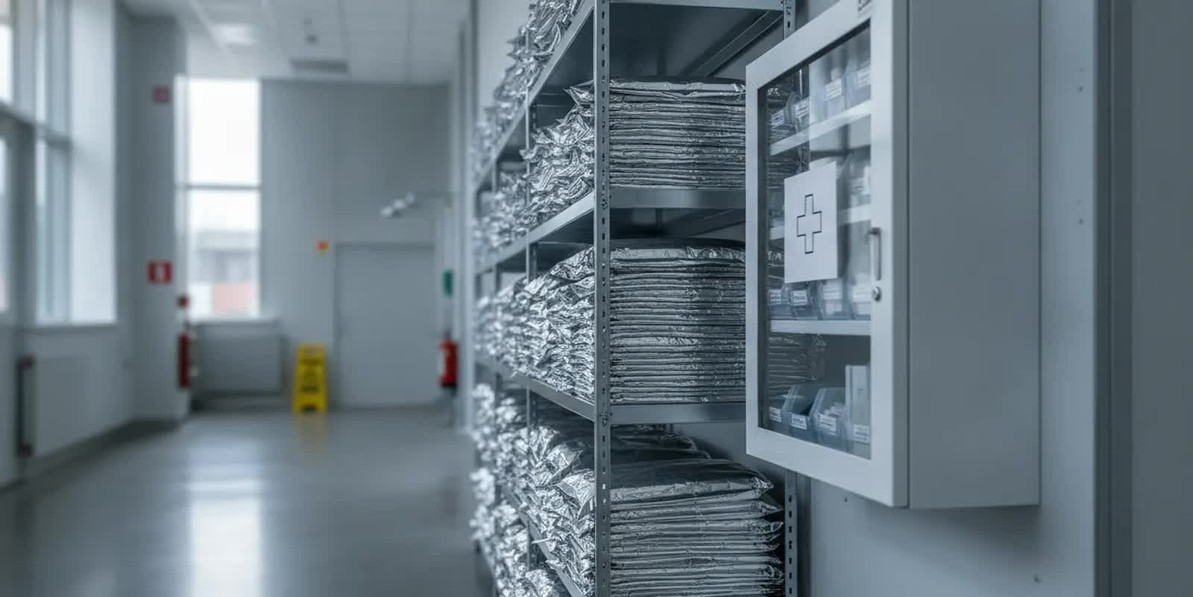
Emergency blankets can support a workplace response when a person is cold, wet, or waiting for help, but they are only one part of a plan. Buyers should choose them for the hazards and response locations they actually have, then define how blankets will be stored, checked, and issued. This guide covers practical selection, quantity planning, exposure considerations, and limitations without treating a blanket as medical care or a substitute for evacuation.
Talk with a safety supply specialist
What role should emergency blankets play in a workplace plan?
An emergency blanket is a response supply intended to help cover a person during an incident or while assistance is being arranged. Depending on the type, it may be a compact reflective sheet, a thicker insulated covering, or a reusable blanket. These products are not interchangeable in every setting. Material, size, construction, packaging, and care instructions determine how a blanket can be used and kept ready.
Set the intended role before comparing products. A compact blanket might be included in a vehicle kit or a mobile response bag. A larger supply of single-use blankets may suit a staffed first-aid point or evacuation assembly area. A reusable blanket may make sense where trained responders can manage cleaning and storage. The correct choice depends on the workplace, the expected response, and the manufacturer's stated use.
Keep the blanket within a broader response system. A written plan should identify who retrieves supplies, who contacts emergency services, how the area is made safe, and how responders hand off care. For workplace emergency planning and applicable requirements, consult OSHA's official resources. For first-aid education and guidance, use American Red Cross resources. Follow the procedures and training applicable to your workplace rather than relying on a product alone.
Which workplace scenarios belong in the selection process?
Map the situations where a blanket may be needed. Avoid buying only for the most visible scenario, such as outdoor work. Conditions inside a warehouse, at a remote maintenance site, or during a power interruption can also affect where responders need supplies.
- First-aid response: A responder may need a covering while monitoring a person and waiting for qualified care. The blanket does not diagnose or treat an injury.
- Evacuation: Workers may gather outside in poor weather or wait for transport. Consider how many people could be at an assembly location and how quickly stored supplies can reach them.
- Outdoor or mobile work: Crews may be spread across a site, roadway, or remote work area. A central cabinet may be too far away, so mobile kits and vehicle storage may be appropriate.
- Weather exposure: Wind, rain, cold, and wet clothing can make a situation more difficult. Plan for shelter, dry layers, and prompt assistance as well as blankets.
- Facility disruption: A utility interruption, equipment incident, or building evacuation can change normal access to supplies. Consider alternate routes and locations.
Use the site's hazard assessment and emergency procedures to decide which scenarios are credible. Do not make a blanket the planned control for a hazard that calls for eliminating exposure, sheltering, evacuation, or professional response. If the situation involves a possible medical emergency, activate the established response process and seek qualified help.
How do emergency blanket materials and formats differ?
Product names can be similar while performance, handling, and care differ. Review the manufacturer's description and instructions for each model. Do not assume a reflective appearance proves that a blanket is waterproof, reusable, flame resistant, or suitable for a particular hazard.
| Format | What buyers may value | What to verify | Planning fit |
|---|---|---|---|
| Compact reflective sheet | Small package and easy placement in a kit | Dimensions, material, intended use, package integrity, and handling cautions | Mobile kits, vehicle supplies, or limited-space storage |
| Insulated or heavier blanket | More substantial covering and potentially easier handling for some tasks | Weight, bulk, care instructions, construction, and stated limitations | Fixed response stations or locations with greater storage capacity |
| Reusable blanket | May be suitable where a controlled cleaning and return-to-stock process exists | Cleaning method, inspection criteria, durability, and when to remove from service | Staffed locations able to manage care and replacement |
| Single-use blanket | Sealed packaging and a straightforward replace-after-use process | Package condition, storage environment, expiration or shelf-life information if provided | Distributed kits or response points without a laundering process |
This comparison is a starting point, not a performance rating. Read the product label and instructions. If a claimed feature matters to the hazard assessment, confirm it in documentation for the exact product rather than inferring it from color, sheen, or a generic category name.
Compare packaging and distribution needs as well as the blanket itself. A team may prefer individually packaged units for kits that are assigned to different crews, while a fixed station may be managed from a common supply area. Check how the units are counted and stored so procurement quantities match the way the workplace will issue them. If several sites or departments share purchasing, keep the item identification consistent in the replenishment record to reduce the risk of ordering a different format by mistake.
Ask the person who will maintain the stock to review the proposed product before an order is finalized. Their feedback can reveal practical issues such as a package that does not fit the vehicle kit, instructions that are difficult to locate, or a reusable option that the site has no process to clean. Resolve those questions before deployment rather than discovering them during an incident.
What should buyers verify before ordering?
Build a short specification around use and stewardship, then compare products against it. A low package size or low unit cost does not settle whether the blanket will fit the responder's task or remain accessible at the point of need.
- Intended use: State the situations the product is expected to support. Ask whether it is for a vehicle kit, a fixed station, an evacuation point, or another location.
- Dimensions: Check the opened size against the planned use and storage space. Do not assume all emergency blankets cover the same area.
- Material and construction: Confirm the product description and manufacturer instructions. Verify any required characteristics with documentation instead of extrapolating from a product photo.
- Single-use or reusable: Decide who will inspect, clean, and return reusable items to service, or how used single-use products will be replaced.
- Packaging: Confirm that each package can be stored and accessed as intended, and identify how damaged, opened, or contaminated packages will be handled.
- Storage limits: Review care information for temperature, moisture, sunlight, chemicals, and other conditions that may affect storage. Apply the manufacturer's instructions.
- Documentation: Keep model details and instructions with procurement or inventory records so replacements can be matched and limitations reviewed.
Where PPE or emergency equipment is part of a regulated task, check the relevant requirements and site procedures. A supplier listing can help identify a product, but it does not replace the employer's hazard assessment or a review of applicable standards. SafetyCompany.com distributes equipment from multiple brands; it does not manufacture emergency blankets.
How many blankets should a workplace keep?
There is no single blanket quantity that suits every worksite. Plan from the number of people who may need a covering at once, the locations they occupy, and how quickly supplies can be brought to them. Record the assumptions so a manager can update the count when staffing, shifts, building use, or operations change.
A workable planning sequence is:
- List response locations. Mark first-aid stations, assembly points, vehicles, remote work areas, and other places where a responder could need supplies.
- Estimate concurrent need. Consider credible incidents and evacuation conditions, not only the average day. Avoid assuming that one blanket will serve several people at once.
- Account for distance and access. A central cache may be adequate in a compact facility, while a spread-out site may need distributed supplies. Confirm that responders can reach them without entering an unsafe area.
- Set a replacement reserve. Include a process for replacing used, damaged, or missing stock. The reserve should reflect the site's procurement and replenishment process, not an unsupported universal ratio.
- Assign ownership. Name the role responsible for routine checks, ordering replacements, and keeping the inventory record current.
As an example, a facility with one staffed first-aid point and several outdoor work zones should compare the response time from the central station with the needs of mobile crews. It may be more useful to place a small number of properly selected supplies in designated kits than to store the entire stock in one inaccessible room. The right arrangement follows the site's plan and storage conditions.
Keep blanket quantity decisions connected to the wider response inventory. A workplace may also assess other first-aid supplies, such as a splint kit, and visibility equipment for a roadside or outdoor response, such as a high-visibility vest. These are separate supplies with separate selection and training needs; they do not replace one another.
Make the quantity estimate explicit. A simple inventory worksheet can list each location, the number of people normally present, the largest credible group that could need assistance at one time, current stock, and the person responsible for restocking. Note which assumptions are estimates and who approved them. This record makes it easier to explain why a remote crew has a mobile supply while another area relies on a central station.
Consider shift changes and contractor access, too. A cabinet that is stocked for the day shift may not serve a night crew if it is locked or in an area they cannot enter. A contractor may not know where the facility keeps supplies. Include their likely presence in planning and communicate locations through site orientation or other established procedures. These checks help ensure that a supply count reflects who may actually be on site, not just the permanent employee roster.
Where and how should emergency blankets be stored?
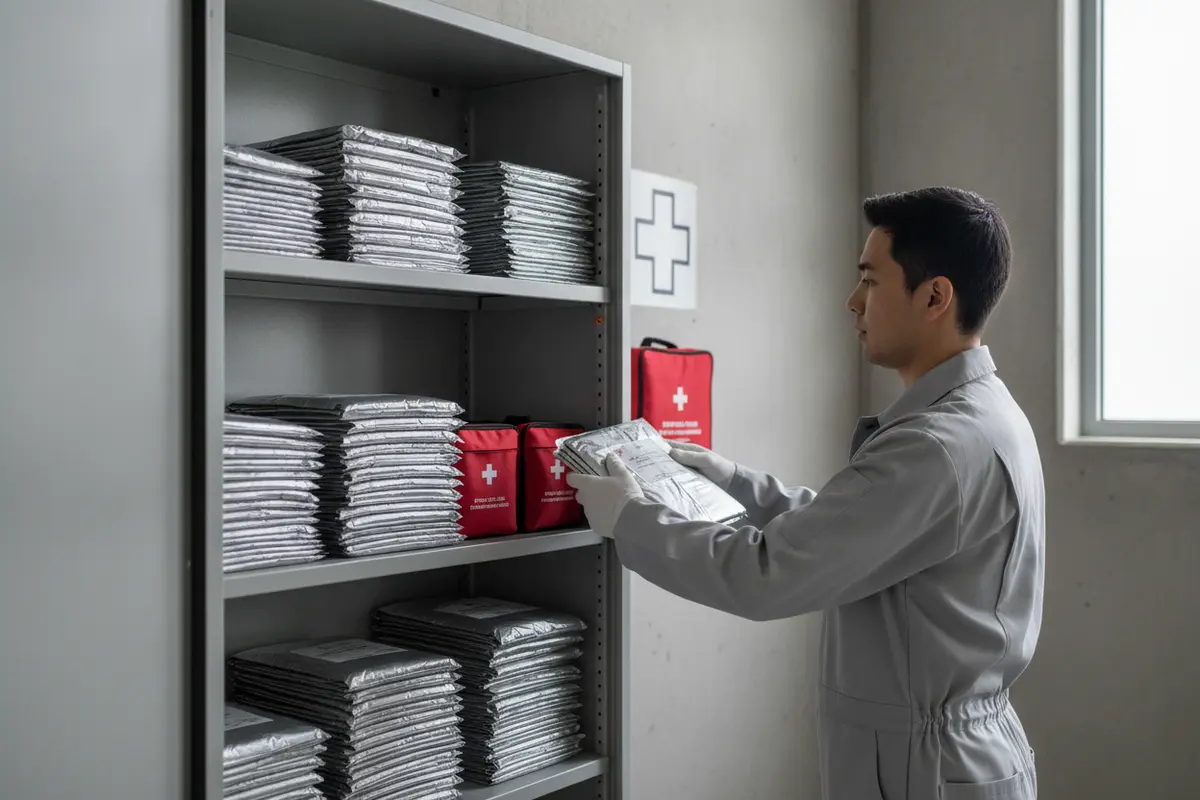
Storage must preserve access as well as condition. Keep blankets in designated locations that responders can find quickly, and make the locations clear in workplace procedures. A sealed package can be hard to use if no one knows where it is, while an easily reached supply can still be unready if its package has deteriorated.
- Choose a dry, protected location within the storage conditions specified by the manufacturer.
- Keep supplies away from unnecessary crushing, sharp edges, contamination, and substances that could damage packaging or material.
- Do not block access with unrelated stock or place supplies behind locked storage unless authorized responders can access it promptly.
- Use clear inventory identification and keep instructions accessible to the people responsible for the response.
- For vehicles or outdoor kits, review whether heat, cold, moisture, or repeated movement could affect the product or package.
- Keep blankets in their intended packaging until needed, unless the manufacturer says otherwise.
Include location and retrieval in drills or briefings where appropriate. Workers should know which role retrieves the supplies and where they are stored, but training should stay within the workplace's response policy. Do not ask an untrained worker to take on medical tasks beyond their training.
Ask about emergency response supplies
How should a team inspect and replace its stock?
Make inspection simple enough to complete consistently. The frequency should follow the product instructions, site policy, and conditions at the storage location. A high-traffic kit or vehicle may need a different check schedule from a protected cabinet. Keep a record of the check and follow up on gaps rather than treating a tick mark as proof that supplies are ready.
An inspection can cover:
- Presence: Is the expected number of blankets in the assigned location?
- Package condition: Are seals intact where applicable, and are there signs of tearing, puncture, water exposure, dirt, or crushing?
- Product condition: If a blanket is reusable or its package has been opened, does it meet the manufacturer's inspection and care criteria?
- Dates and instructions: Where a manufacturer provides shelf-life or other date information, is it still current? Are instructions available and legible?
- Access: Can the assigned responder reach and identify the supply promptly?
- Record and action: Have missing or questionable items been isolated or replaced, with an owner and completion date recorded?
Remove a product from ready stock if it is damaged, contaminated, incomplete, or outside instructions for use. Do not try to repair a product or package unless its manufacturer allows it. After an incident, count what remains and replenish promptly. Also review whether the actual response revealed a location, access, or quantity problem that needs a plan change.
Use a consistent disposition rule for uncertain stock. If a package is wet, torn, unsealed, or otherwise questionable, do not leave it mixed with ready supplies while someone decides what to do. Follow the manufacturer's instructions and the site's process to assess or replace it. When a blanket is reusable, document who is allowed to clean it and how the team confirms that it is ready for reuse. If those steps are unclear, treat the item as unavailable until the process is resolved.
Keep inspection records useful rather than elaborate. Record the date, location, checker, condition, missing items, and action taken. A repeat issue such as packages being crushed in a vehicle kit or supplies disappearing from a shared station is a signal to adjust the storage method or assigned ownership. Reviews are most valuable when they lead to a correction.
What limitations should responders understand?
Emergency blankets are support items, not a guarantee against cold injury, shock, or other harm. They do not warm every person in every condition, stop exposure, correct wet clothing, treat illness or injury, or replace qualified medical assessment. Their effect depends on the product, environment, condition of the person, and actions taken by trained responders.
Temperature and exposure planning should start with the whole scene. Ask whether the person is indoors or outdoors, whether clothing is wet, whether wind or precipitation is present, how long it may take to reach a safe area, and whether transport is available. A packaged blanket does not remove an environmental hazard. Where cold, heat, water, or wind affects operations, the employer's hazard controls and emergency procedures should address the exposure itself, not merely stock a covering for after it occurs.
For evacuation planning, think about the route and destination as well as the assembly point. Workers may have to move through an area with changing weather, wait outside, or be transported elsewhere. Decide who can carry supplies, how they will be distributed without delaying accountability, and where the unused stock goes after an evacuation. For outdoor crews, test whether a responder can reach a designated kit without crossing active traffic or another hazard. Revise the plan if a drill shows the location is hard to reach.
A blanket's package can also affect usability. Some compact products take up little room but require careful unfolding or handling. A thicker product may be easier to manage in one setting but too bulky for a small mobile kit. Have the designated person review the product instructions before relying on a particular format, and do not assume that an opened sample can be returned to ready stock.
A blanket should not delay calling emergency services, moving a person from immediate danger when safe to do so, or following the site's emergency procedures. Responders should not make a diagnosis or promise a particular outcome. For a person who may be injured or unwell, follow applicable training, monitor as directed by the response plan, and transfer care to qualified professionals.
Think beyond the blanket when planning for exposure. The response may also require a safe location, shelter, dry replacement clothing, communication, transportation, or other equipment selected for the hazard. For outdoor work-zone readiness, consider how responders will be visible and protected from traffic; related products such as hazard-warning tape have their own application limits and should be selected for the site's traffic-control plan. Do not assume a single product makes a scene safe.
Similarly, a blanket is not a substitute for protective clothing or required PPE during a hazardous task. Workers must not enter a contaminated, energized, confined, or otherwise unsafe area to retrieve supplies unless the response plan and their training authorize that action. Scene safety and escalation come first.
How can a buyer put the decision into practice?
Use a brief documented process to connect selection to actual response needs:
- Review the hazard assessment and emergency plan. Identify first-aid, evacuation, outdoor, and mobile-work scenarios where a blanket could be useful.
- Map people and locations. Note likely response points, access routes, staffing patterns, and any areas that are difficult to reach.
- Write a product specification. State intended use, format, dimensions, single-use or reusable preference, storage environment, and documentation to review.
- Compare products against the specification. Check manufacturer instructions and claims for the exact item. Do not select based only on a generic name or a reflective finish.
- Set quantities and placement. Use plausible concurrent demand and access time to decide how much stock belongs at each response point.
- Assign inspection and replenishment. Name the role responsible for checks, incident-related replacement, and inventory updates.
- Brief responders. Explain where supplies are, how the response plan applies, and the limits of their training and the product.
- Review after changes or use. Reassess after a drill, incident, site layout change, or change in the manufacturer's instructions.
This process helps purchasing decisions remain tied to workplace conditions instead of an assumed universal kit. Keep the specification, inventory locations, and inspection method in the site's safety documentation so staff and future buyers can maintain the plan.
When a broader response supply inventory is under review, a team can also refer to the SafetyBlog for workplace safety topics and compare needs for relevant PPE. For example, safety eyewear may be part of a separate task-specific PPE assessment; it is not a substitute for emergency response equipment.
Review your workplace supply needs
Frequently Asked Questions
Are emergency blankets required in every workplace first-aid kit?
There is no universal answer for every workplace and kit. Review applicable requirements, hazards, worksite conditions, and the employer's response plan. Ask a qualified safety professional or authority about requirements that apply to your specific operation.
Can an emergency blanket replace a coat or other protective clothing?
No. A blanket is a response supply, not protective clothing for performing a hazardous task. Select and use work clothing and PPE for the task and applicable requirements, and follow the product instructions for the blanket.
Should a workplace choose a reusable or single-use blanket?
Choose based on the response setting and ability to manage the product after use. Reusable products call for an effective inspection, cleaning, and return-to-stock process that follows manufacturer instructions. Single-use products call for replacement after use and checks of package condition.
How often should emergency blankets be inspected?
Follow manufacturer instructions and site policy, and consider storage and use conditions when setting a schedule. Inspect after use or a suspected damaging event, and remove questionable items from ready stock until they can be assessed or replaced.
Do reflective emergency blankets guarantee protection from cold?
No. A blanket cannot guarantee a particular outcome or replace shelter, appropriate care, or emergency response. Its use is limited by the product's instructions and the circumstances, so activate the workplace response process and seek qualified help when needed.
Speak with a safety supply specialist
Choose emergency blankets as one carefully managed part of a workplace response plan, and review the selection whenever site conditions or response needs change.
Recent Posts
-

Emergency Blankets: Workplace Emergency Planning and Selection
Emergency blankets can support a workplace response when a person is cold, wet, or waiting for help, …Nov 2nd 2026 -

Secondary Containment: Choosing Spill Control for Industrial Facilities
Secondary containment helps keep a leak or spill from spreading beyond a designated area while a tea …Nov 2nd 2026 -

What buyers should know about Safety Data Sheet Training
Safety data sheet training should help employees do more than recognize a form. Workers need to find …Oct 30th 2026